Trimigno Alessia, Khakimov Bekzod, Mejia Josue Leonardo Castro, Mikkelsen Mette Skau, Kristensen Mette, Jespersen Birthe Møller, Engelsen Søren Balling
Department of Food Science, Faculty of Science, University of Copenhagen, Rolighedsvej 26, 1958 Frederiksberg C, Denmark.
Department of Agricultural and Food Sciences, Alma Mater Studiorum - University of Bologna, Piazza Goidanich 60, 47521 Cesena (FC), Italy.
Metabolomics. 2017;13(10):108. doi: 10.1007/s11306-017-1247-2. Epub 2017 Aug 18.
Mixed-linkage (1→3),(1→4)-β-d-glucans (BG) reduce cholesterol level and insulin response in humans. Despite this, their role in human metabolism and a mode of action remains largely unknown.
To investigate the effects of three structurally different BG on human fecal metabolome in a full cross-over intervention using GC-MS metabolomics.
Over three weeks of intervention, young healthy adults received food supplemented with BG from oat, two different BG from barley or a non-fiber control in a full cross-over design. Untargeted metabolomics and short chain fatty acid analysis was performed on day three fecal samples. ANOVA-simultaneous component analysis was applied to partition the data variation according to the study design, and PLS-DA was used to select most discriminative metabolite markers.
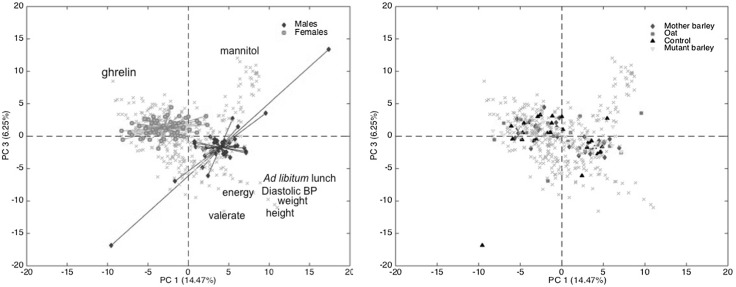
Univariate and multivariate data analysis revealed a dominating effect of inter-individual variances followed by a gender effect. Weak effects of BG intake were identified including an increased level of gamma-amino-butyrate and palmitoleic acid in males and a decreased level of enterolactone in females. Barley and oat derived BG were found to influence the human fecal metabolome differently. Barley BG increased the relative level of formate in males and isobutyrate, isovalerate, 2-methylbutyrate in females. In total 15, 3 and 11 human fecal metabolites were significantly different between control vs. BG, control vs. oat BG, and barley BG vs. oat BG, respectively.
The study show that human fecal metabolome largely reflects individual (∼28% variation) and gender (∼15% variation) differences, whereas the treatment effect of the BG (∼8% variation) only manifests in a few key metabolites (primarily by the metabolites: d-2-aminobutyric acid, palmitoleic acid, linoleic acid and 11-eicosenoic acid).
混合连接的(1→3),(1→4)-β-D-葡聚糖(BG)可降低人体胆固醇水平和胰岛素反应。尽管如此,它们在人体新陈代谢中的作用和作用方式仍 largely 未知。
在一项使用气相色谱-质谱代谢组学的完全交叉干预中,研究三种结构不同的 BG 对人体粪便代谢组的影响。
在为期三周的干预期间,年轻健康成年人在完全交叉设计中接受补充了燕麦 BG、两种不同大麦 BG 或非纤维对照的食物。对第三天的粪便样本进行非靶向代谢组学和短链脂肪酸分析。应用方差分析-同时成分分析根据研究设计对数据变异进行划分,并使用偏最小二乘判别分析(PLS-DA)选择最具判别力的代谢物标记。
单变量和多变量数据分析显示个体间差异占主导,其次是性别效应。确定了 BG 摄入的微弱影响,包括男性中γ-氨基丁酸和棕榈油酸水平升高,女性中肠内酯水平降低。发现大麦和燕麦来源的 BG 对人体粪便代谢组的影响不同。大麦 BG 增加了男性中甲酸的相对水平以及女性中异丁酸、异戊酸、2-甲基丁酸的相对水平。对照组与 BG 组、对照组与燕麦 BG 组、大麦 BG 组与燕麦 BG 组之间分别有 15、3 和 11 种人体粪便代谢物存在显著差异。
该研究表明,人体粪便代谢组在很大程度上反映了个体差异(约 28%的变异)和性别差异(约 15%的变异),而 BG 的治疗效果(约 8%的变异)仅在少数关键代谢物中体现(主要通过代谢物:D-2-氨基丁酸、棕榈油酸酸、亚油酸和 11-二十碳烯酸)。