Department of Internal Medicine, Inha University School of Medicine, Incheon, Korea.
Department of Biomedical Sciences, Inha University School of Medicine, Incheon, Korea.
Diabetes Metab J. 2020 Dec;44(6):875-886. doi: 10.4093/dmj.2019.0221. Epub 2020 Jul 10.
Recent studies have demonstrated that the levels of adipocyte fatty acid-binding protein (A-FABP) are closely associated with diabetic kidney disease (DKD) in patients with type 2 diabetes mellitus (T2DM). This study aimed to examine the association between serum A-FABP level and rapid renal function decline in patients with T2DM and preserved renal function.
This was a prospective observational study of 452 patients with T2DM and preserved renal function who had serial measurements of estimated glomerular filtration rate (eGFR). Rapid renal function decline was defined as an eGFR decline of >4% per year. The association between baseline serum A-FABP level and rapid renal function decline was investigated.
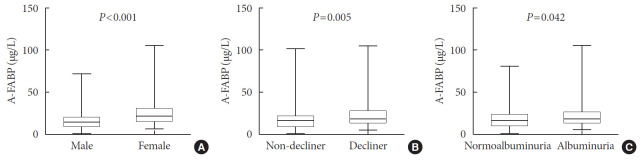
Over a median follow-up of 7 years, 82 participants (18.1%) experienced rapid renal function decline. Median A-FABP levels were significantly higher in patients with rapid renal function decline, compared to non-decliners (20.2 ng/mL vs. 17.2 ng/mL, P=0.005). A higher baseline level of A-FABP was associated with a greater risk of developing rapid renal function decline, independent of age, sex, duration of diabetes, body mass index, systolic blood pressure, history of cardiovascular disease, baseline eGFR, urine albumin creatinine ratio, total cholesterol, glycosylated hemoglobin, high-sensitivity C-reactive protein and use of thiazolidinedione, insulin, angiotensin-converting-enzyme inhibitors and angiotensin II-receptor blockers and statin (odds ratio, 3.10; 95% confidence interval, 1.53 to 6.29; P=0.002).
A high level of serum A-FABP is associated with an increased risk of rapid renal function decline in patients with T2DM and preserved renal function. This suggests that A-FABP could play a role in the progression of DKD in the early stages.
最近的研究表明,脂肪细胞脂肪酸结合蛋白(A-FABP)的水平与 2 型糖尿病(T2DM)患者的糖尿病肾病(DKD)密切相关。本研究旨在探讨血清 A-FABP 水平与 T2DM 合并肾功能正常患者肾功能快速下降之间的关系。
这是一项前瞻性观察研究,纳入了 452 名 T2DM 合并肾功能正常的患者,这些患者的估算肾小球滤过率(eGFR)进行了连续测量。肾功能快速下降定义为 eGFR 每年下降>4%。研究人员分析了基线血清 A-FABP 水平与肾功能快速下降之间的关系。
在中位随访 7 年期间,82 名患者(18.1%)经历了肾功能快速下降。与非快速下降者相比,快速下降者的 A-FABP 中位数水平显著更高(20.2ng/mL 比 17.2ng/mL,P=0.005)。在调整了年龄、性别、糖尿病病程、体重指数、收缩压、心血管疾病史、基线 eGFR、尿白蛋白/肌酐比值、总胆固醇、糖化血红蛋白、高敏 C 反应蛋白以及噻唑烷二酮类、胰岛素、血管紧张素转换酶抑制剂和血管紧张素 II 受体阻滞剂和他汀类药物的使用后,较高的基线 A-FABP 水平与发生快速肾功能下降的风险增加相关(比值比,3.10;95%置信区间,1.53 至 6.29;P=0.002)。
血清 A-FABP 水平升高与 T2DM 合并肾功能正常患者肾功能快速下降的风险增加相关。这表明 A-FABP 可能在 DKD 的早期进展中发挥作用。