Boston University School of Medicine, Boston, Massachusetts.
University of Vermont, Burlington, Vermont.
Ann Am Thorac Soc. 2020 Nov;17(11):1343-1351. doi: 10.1513/AnnalsATS.202005-514ST.
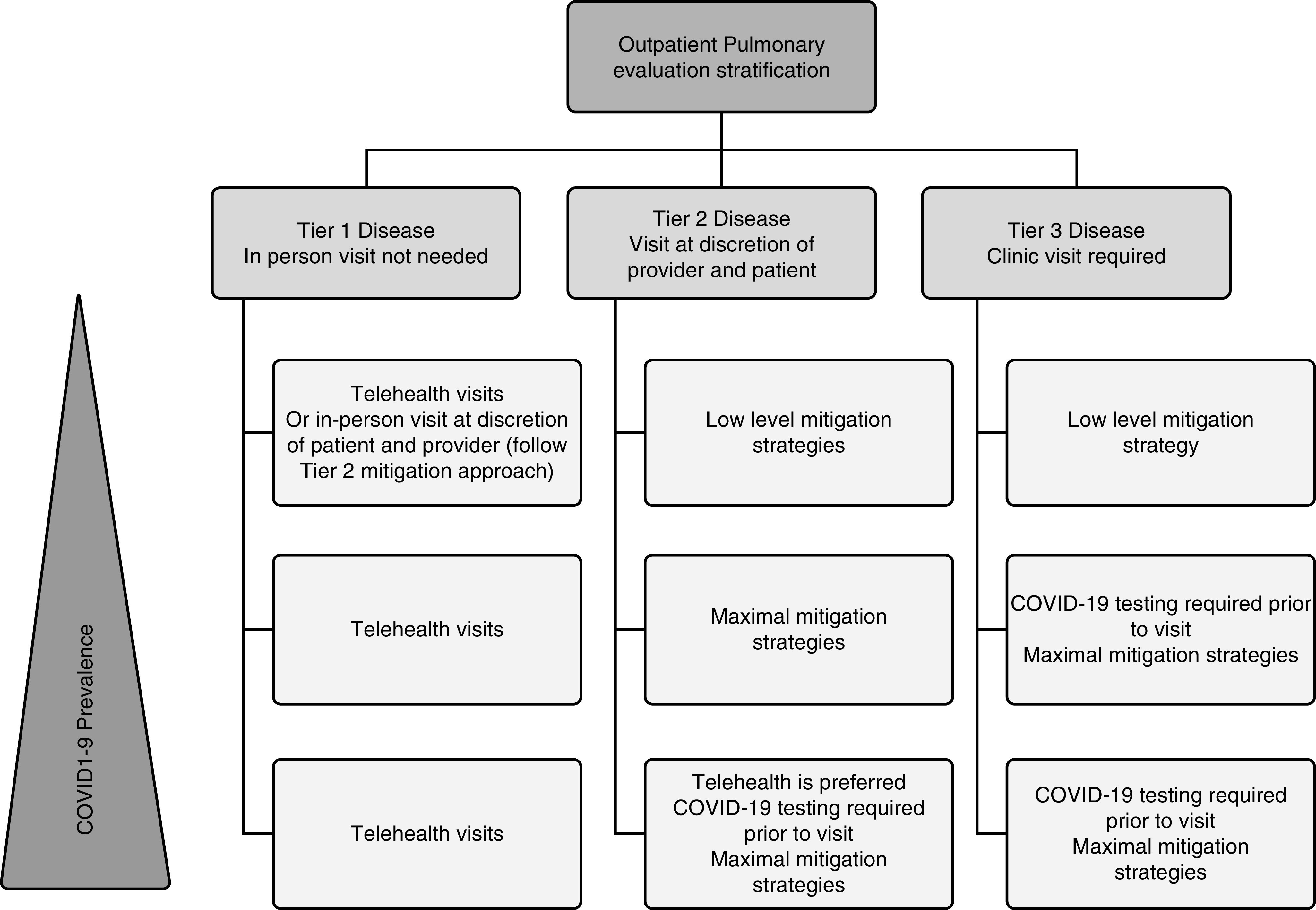
In March 2020, many elective medical services were canceled in response to the coronavirus disease 2019 (COVID-19) pandemic. The daily case rate is now declining in many states and there is a need for guidance about the resumption of elective clinical services for patients with lung disease or sleep conditions. Volunteers were solicited from the Association of Pulmonary, Critical Care, and Sleep Division Directors and American Thoracic Society. Working groups developed plans by discussion and consensus for resuming elective services in pulmonary and sleep-medicine clinics, pulmonary function testing laboratories, bronchoscopy and procedure suites, polysomnography laboratories, and pulmonary rehabilitation facilities. The community new case rate should be consistently low or have a downward trajectory for at least 14 days before resuming elective clinical services. In addition, institutions should have an operational strategy that consists of patient prioritization, screening, diagnostic testing, physical distancing, infection control, and follow-up surveillance. The goals are to protect patients and staff from exposure to the virus, account for limitations in staff, equipment, and space that are essential for the care of patients with COVID-19, and provide access to care for patients with acute and chronic conditions. Transmission of severe acute respiratory syndrome coronavirus 2 (SARS-CoV-2) is a dynamic process and, therefore, it is likely that the prevalence of COVID-19 in the community will wax and wane. This will impact an institution's mitigation needs. Operating procedures should be frequently reassessed and modified as needed. The suggestions provided are those of the authors and do not represent official positions of the Association of Pulmonary, Critical Care, and Sleep Division Directors or the American Thoracic Society.
2020 年 3 月,许多择期医疗服务因 2019 年冠状病毒病(COVID-19)大流行而被取消。目前,许多州的每日病例数正在下降,需要指导如何为患有肺部疾病或睡眠状况的患者恢复择期临床服务。我们向美国胸科学会(ATS)和呼吸、危重病和睡眠科主任协会的成员招募了志愿者。工作组通过讨论和协商制定了恢复肺科和睡眠医学诊所、肺功能检测实验室、支气管镜和操作套房、多导睡眠图实验室以及肺康复设施的择期服务的计划。在恢复择期临床服务之前,社区新增病例数应持续较低或呈下降趋势,至少持续 14 天。此外,医疗机构应制定运营策略,包括患者优先级排序、筛查、诊断检测、保持身体距离、感染控制和随访监测。目标是保护患者和工作人员免受病毒暴露,考虑到为 COVID-19 患者提供护理所必需的工作人员、设备和空间的限制,并为急性和慢性疾病患者提供护理机会。严重急性呼吸综合征冠状病毒 2(SARS-CoV-2)的传播是一个动态过程,因此,社区中 COVID-19 的流行程度很可能会时高时低。这将影响机构的缓解需求。应经常重新评估和修改操作程序,并根据需要进行修改。本建议仅代表作者的意见,并不代表呼吸、危重病和睡眠科主任协会或美国胸科学会的官方立场。