Świderski Grzegorz, Jabłońska-Trypuć Agata, Kalinowska Monika, Świsłocka Renata, Karpowicz Danuta, Magnuszewska Marta, Lewandowski Włodzimierz
Department of Chemistry, Biology and Biotechnology, Bialystok University of Technology, Wiejska 45E Street, 15-351 Bialystok, Poland.
Department of Food Analysis, Institute of Agricultural and Food Biotechnology, Rakowiecka 36 Street, 02-532 Warsaw, Poland.
Materials (Basel). 2020 Jul 11;13(14):3102. doi: 10.3390/ma13143102.
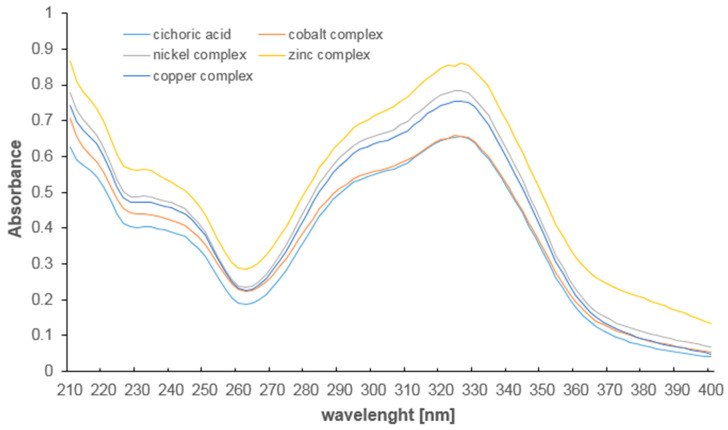
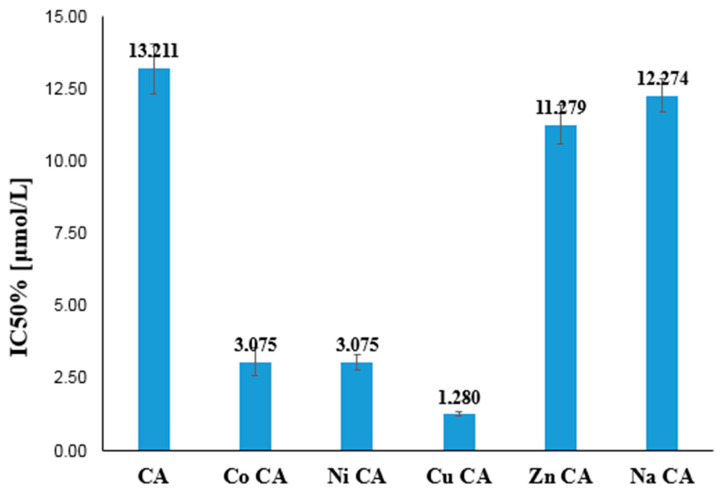
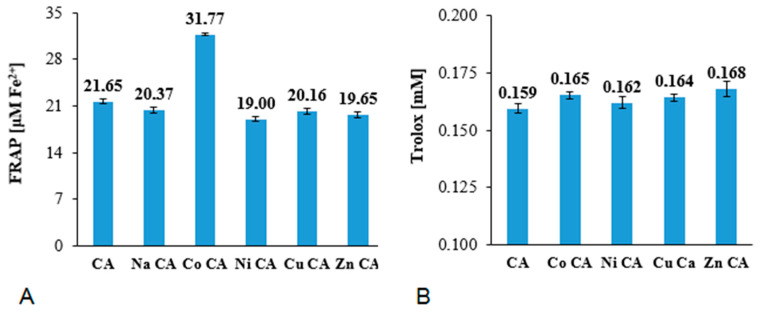
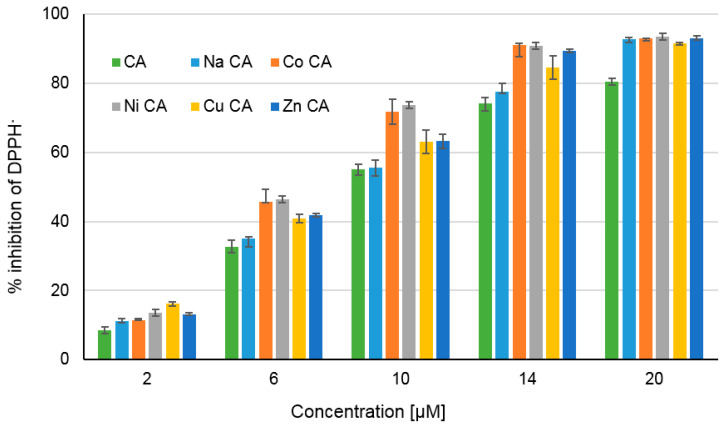
Cichoric acid (CA) is a derivative of both caffeic acid and tartaric acid. It was isolated for the first time from L. (chicory) but it also occurs in significant amounts in , particularly , dandelion leaves, basil, lemon balm and in aquatic plants, including algae and sea grasses. It has a wide spectrum of biological properties, including antioxidant, antiviral, anti-inflammatory and other. The work yielded cichoric acid complexes with selected transition metals, i.e., copper(II), nickel(II), zinc(II) and cobalt(II). In this work the dependency between the molecular structure and biological activity was discussed. The molecular structure was studied by means of infrared spectroscopy (Fourier transform infrared (FT-IR) Raman (FT-Raman)), electronic absorption spectroscopy (ultraviolet-visible (UV/VIS)) and theoretical calculations (density functional theory (DFT), Hartree-Fock (HF)). Understanding the mechanism of the effect of metals on the electronic system of ligands with biological importance will facilitate in the future the search for new, effective and natural antioxidants. The composition of the studied complexes in aqueous solutions was determined at a constant pH by the Job's method. Antioxidative properties of the tested compounds were determined using the ferric-reducing antioxidant power (FRAP), DPPH (2,2-diphenyl-1-picryl-hydrazyl-hydrate free radical method), cupric-reducing antioxidant capacity (CUPRAC) and Superoxide Dismutase Activity Assay (SOD).
菊苣酸(CA)是咖啡酸和酒石酸的衍生物。它首次从菊苣中分离得到,但在其他植物中也大量存在,特别是紫锥菊、蒲公英叶、罗勒、柠檬香脂以及包括藻类和海草在内的水生植物。它具有广泛的生物学特性,包括抗氧化、抗病毒、抗炎等。这项工作得到了菊苣酸与选定过渡金属(即铜(II)、镍(II)、锌(II)和钴(II))的配合物。在这项工作中,讨论了分子结构与生物活性之间的关系。通过红外光谱(傅里叶变换红外(FT-IR)、拉曼(FT-拉曼))、电子吸收光谱(紫外-可见(UV/VIS))和理论计算(密度泛函理论(DFT)、哈特里-福克(HF))研究了分子结构。了解金属对具有生物学重要性的配体电子系统的作用机制,将有助于未来寻找新的、有效且天然的抗氧化剂。通过乔布氏法在恒定pH值下测定了水溶液中所研究配合物的组成。使用铁还原抗氧化能力(FRAP)、DPPH(2,2-二苯基-1-苦基肼基水合物自由基法)、铜还原抗氧化能力(CUPRAC)和超氧化物歧化酶活性测定法(SOD)测定了测试化合物的抗氧化性能。