Department of Nephrology, Children's Hospital of Fudan University, Shanghai, China.
Department of Nephrology, Wuhan Children's Hospital of Tongji Medical College, Huazhong University of Science and Technology, Wuhan, China.
Clin J Am Soc Nephrol. 2020 Sep 7;15(9):1259-1266. doi: 10.2215/CJN.03630320. Epub 2020 Jul 14.
During the coronavirus disease 2019 outbreak, the treatment of families with children on long-term KRT is challenging. This study was conducted to identify the current difficulties, worries regarding the next 2 months, and mental distress experienced by families with children on long-term KRT during the coronavirus disease 2019 outbreak and to deliver possible management approaches to ensure uninterrupted treatment for children on long-term KRT.
DESIGN, SETTING, PARTICIPANTS, & MEASUREMENTS: A multicenter online survey was conducted between February 10 and 15, 2020, among the families with children on long-term KRT from five major pediatric dialysis centers in mainland China. The primary caregivers of children currently on long-term KRT were eligible and included. Demographic information, severe acute respiratory syndrome coronavirus 2 infection status, current difficulties, and worries regarding the next 2 months were surveyed using a self-developed questionnaire. The Patient Health Questionnaire-9 and the General Anxiety Disorder Scale-7 were used to screen for depressive symptoms and anxiety, respectively.
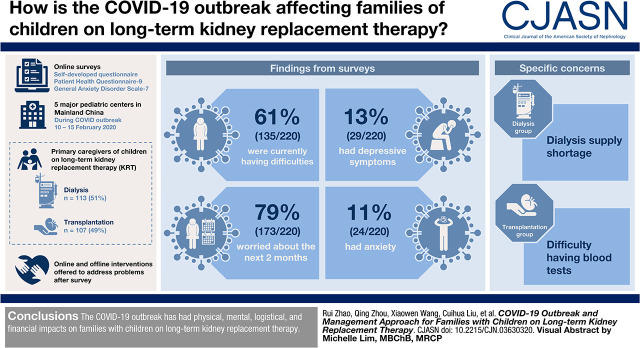
Among the children in the 220 families included in data analysis, 113 (51%) children were on dialysis, and the other 107 (49%) had kidney transplants. No families reported confirmed or suspected cases of coronavirus disease 2019. Overall, 135 (61%) and 173 (79%) caregivers reported having difficulties now and having worries regarding the next 2 months, respectively. Dialysis supply shortage (dialysis group) and hard to have blood tests (kidney transplantation group) were most commonly reported. A total of 29 (13%) caregivers had depressive symptoms, and 24 (11%) had anxiety. After the survey, we offered online and offline interventions to address their problems. At the time of the submission of this paper, no treatment interruption had been reported.
The coronavirus disease 2019 outbreak has had physical, mental, logistical, and financial effects on families with children on long-term KRT.
在 2019 冠状病毒病(coronavirus disease 2019,COVID-19)疫情期间,对接受长期肾脏替代治疗(kidney replacement therapy,KRT)的患儿家庭的治疗带来了挑战。本研究旨在确定 COVID-19 疫情期间接受长期 KRT 治疗的患儿家庭目前所面临的困难、对未来 2 个月的担忧,以及他们所经历的精神困扰,并提出可能的管理方法,以确保患儿的治疗不受影响。
方法、地点、参与者和测量:2020 年 2 月 10 日至 15 日,采用多中心在线调查的方式,对中国大陆 5 家主要儿科透析中心的接受长期 KRT 治疗的患儿家庭的主要照顾者进行调查。目前正在接受长期 KRT 治疗的患儿的主要照顾者符合入组条件并被纳入研究。采用自行设计的问卷,调查照顾者的人口统计学信息、严重急性呼吸综合征冠状病毒 2(severe acute respiratory syndrome coronavirus 2,SARS-CoV-2)感染状况、目前面临的困难以及对未来 2 个月的担忧。采用患者健康问卷-9(Patient Health Questionnaire-9,PHQ-9)和广泛性焦虑障碍量表-7(Generalized Anxiety Disorder Scale-7,GAD-7)分别筛查抑郁症状和焦虑症状。
在纳入数据分析的 220 个家庭的 220 名患儿中,113 名(51%)患儿正在接受透析治疗,107 名(49%)患儿接受了肾脏移植。没有家庭报告 COVID-19 确诊或疑似病例。总体而言,135 名(61%)和 173 名(79%)照顾者现在分别存在困难和对未来 2 个月的担忧。透析供应短缺(透析组)和难以进行血液检查(肾脏移植组)是最常报告的问题。共有 29 名(13%)照顾者存在抑郁症状,24 名(11%)照顾者存在焦虑症状。调查后,我们提供了在线和线下干预措施来解决他们的问题。在本论文提交时,尚未报告治疗中断的情况。
COVID-19 疫情对接受长期 KRT 治疗的患儿家庭的身体、精神、后勤和财务方面都产生了影响。