Department of Clinical Science/Diabetes and Endocrinology, Lund University Diabetes Centre, 205 02, Malmö, Sweden.
Department of Clinical Science, Center for Diabetes Research, University of Bergen, 5032, Bergen, Norway.
Sci Rep. 2020 Jul 14;10(1):11561. doi: 10.1038/s41598-020-68130-y.
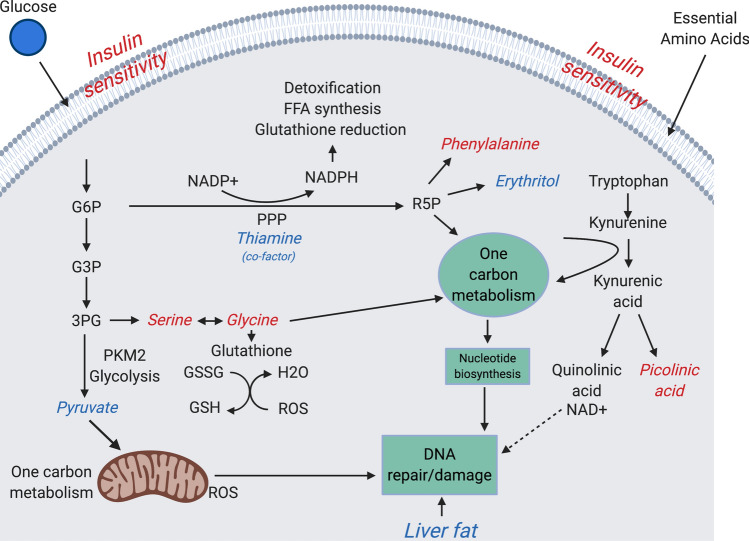
Identification of biomarkers associated with protection from developing diabetic complications is a prerequisite for an effective prevention and treatment. The aim of the present study was to identify clinical and plasma metabolite markers associated with freedom from vascular complications in people with very long duration of type 1 diabetes (T1D). Individuals with T1D, who despite having longer than 30 years of diabetes duration never developed major macro- or microvascular complications (non-progressors; NP) were compared with those who developed vascular complications within 25 years from diabetes onset (rapid progressors; RP) in the Scandinavian PROLONG (n = 385) and DIALONG (n = 71) cohorts. The DIALONG study also included 75 healthy controls. Plasma metabolites were measured using gas and/or liquid chromatography coupled to mass spectrometry. Lower hepatic fatty liver indices were significant common feature characterized NPs in both studies. Higher insulin sensitivity and residual ß-cell function (C-peptide) were also associated with NPs in PROLONG. Protection from diabetic complications was associated with lower levels of the glycolytic metabolite pyruvate and APOCIII in PROLONG, and with lower levels of thiamine monophosphate and erythritol, a cofactor and intermediate product in the pentose phosphate pathway as well as higher phenylalanine, glycine and serine in DIALONG. Furthermore, T1D individuals showed elevated levels of picolinic acid as compared to the healthy individuals. The present findings suggest a potential beneficial shunting of glycolytic substrates towards the pentose phosphate and one carbon metabolism pathways to promote nucleotide biosynthesis in the liver. These processes might be linked to higher insulin sensitivity and lower liver fat content, and might represent a mechanism for protection from vascular complications in individuals with long-term T1D.
鉴定与预防和治疗糖尿病并发症相关的生物标志物是有效预防和治疗的前提。本研究旨在鉴定与 1 型糖尿病(T1D)患者无血管并发症相关的临床和血浆代谢标志物。与在糖尿病发病后 25 年内发生大血管或微血管并发症的快速进展者(RP)相比,30 年以上糖尿病病程但从未发生重大大血管或微血管并发症的 T1D 患者(非进展者;NP),在斯堪的纳维亚 PROLONG(n=385)和 DIALONG(n=71)队列中进行了比较。DIALONG 研究还包括 75 名健康对照者。使用气相和/或液相色谱法与质谱法联合测量血浆代谢物。在两项研究中,较低的肝脂肪指数都是 NP 的显著共同特征。在 PROLONG 中,更高的胰岛素敏感性和残余β细胞功能(C 肽)也与 NP 相关。在 PROLONG 中,糖尿病并发症的保护与糖酵解代谢物丙酮酸和 APOCIII 水平降低有关,而在 DIALONG 中,与硫胺素单磷酸和赤藓糖醇水平降低以及苯丙氨酸、甘氨酸和丝氨酸水平升高有关,后者是戊糖磷酸途径的辅酶和中间产物。此外,与健康个体相比,T1D 个体的吡啶甲酸水平升高。本研究结果表明,糖酵解底物可能向戊糖磷酸和一碳代谢途径有益分流,以促进肝脏核苷酸的生物合成。这些过程可能与更高的胰岛素敏感性和更低的肝脂肪含量有关,可能代表长期 T1D 个体预防血管并发症的一种机制。