Ambe J P, Balogun S T, Waziri M B, Nglass I N, Saddiq A
Department of Paediatrics, Faculty of Clinical Sciences, College of Medical Sciences, University of Maiduguri, Maiduguri, Nigeria.
Department of Clinical Pharmacology and Therapeutics, Faculty of Basic Clinical Sciences, College of Medical Sciences, University of Maiduguri, Maiduguri, Nigeria.
J Trop Med. 2020 Jul 1;2020:9372457. doi: 10.1155/2020/9372457. eCollection 2020.
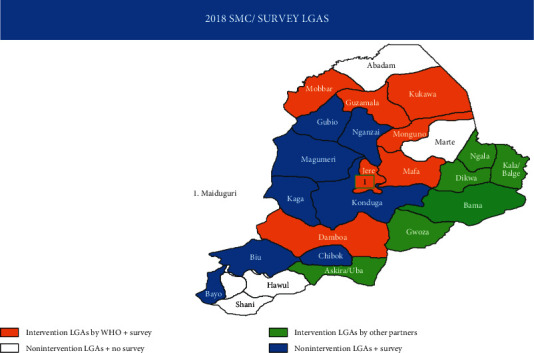
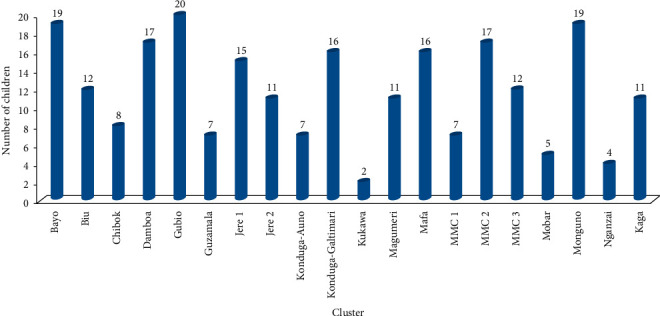
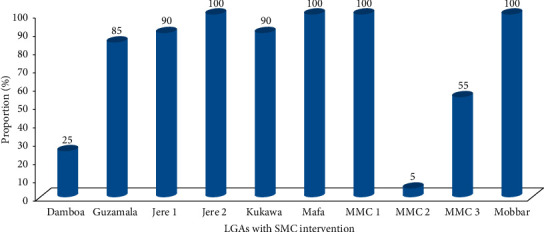
Malaria disproportionately affects all ages with a high burden among children below five years. Thus, control measures are deployed including Seasonal Malaria Chemoprevention (SMC). The present study assessed the impacts of SMC on malaria burden among subjects aged 3-59 months in Borno State, Nigeria. Twenty (20) clusters were randomly selected from accessible 16 Local Government Areas (LGAs) of Borno State, Nigeria, and SMC was deployed in 10 of the clusters by administering a full dose of amodiaquine plus sulfadoxine-pyrimethamine at monthly intervals for 4 months consecutively. Three hundred and ninety-nine children were enrolled in the study. A structured questionnaire was used to obtain demographic and malaria-related data. Thick blood smear, thin blood smear, and capillary sample were collected two weeks after the 4 cycle of SMC. The prevalence of malaria and anaemia was determined among the subjects and for the clusters. The proportions of the female (46.4%; 185/399) and male (53.6%; 214/399) subjects were similar ( > 0.05) with subjects aged 24-47 months (35.8%; 143/399) accounting for the highest proportion ( < 0.05). Malaria prevalence was 10.3% (41/399) and was higher among non-SMC subjects (15.9%; 31/195) than among SMC subjects (4.9%; 10/204) ( < 0.05, df = 1, = 10.8). Malaria prevalence was higher in non-SMC clusters (80.0%; 8/10) than in SMC clusters (30.0%; 3/10) ( < 0.05, df = 1, = 40.5). The mean haematocrit of the 399 subjects was 34.0 ± 5.3% with an anaemia prevalence of 18.1% (72/399). The mean haematocrit was higher among SMC subjects (35.4 ± 5.0% vs. 33.1 ± 4.2%; < 0.05) while anaemia prevalence was higher among non-SMC subjects (21.5% vs. 14.6%; < 0.05, df = 1, = 2.8). Of the SMC subjects, 4.9% reported adverse drug reactions. SMC is safe and significantly reduced malaria burden among children in Borno State, and thus, the measure could be deployed in the state for effective malaria control.
疟疾对所有年龄段人群的影响程度各异,五岁以下儿童负担尤重。因此,已采取多种控制措施,包括季节性疟疾化学预防(SMC)。本研究评估了SMC对尼日利亚博尔诺州3至59个月龄人群疟疾负担的影响。从尼日利亚博尔诺州16个可及的地方政府辖区(LGA)中随机选取了20个群组,其中10个群组实施了SMC,即连续4个月每月间隔服用一剂全量阿莫地喹加磺胺多辛-乙胺嘧啶。共有399名儿童参与了该研究。使用结构化问卷获取人口统计学和疟疾相关数据。在4轮SMC结束两周后采集厚血涂片、薄血涂片和毛细血管样本。确定了研究对象及各群组中疟疾和贫血的患病率。女性(46.4%;185/399)和男性(53.6%;214/399)研究对象的比例相似(>0.05),年龄在24至47个月的研究对象占比最高(<0.05),为35.8%(143/399)。疟疾患病率为10.3%(41/399),非SMC组研究对象中的患病率(15.9%;31/195)高于SMC组(4.9%;10/204)(<0.05,自由度df = 1,χ² = 10.8)。非SMC群组中的疟疾患病率(80.0%;8/10)高于SMC群组(30.0%;3/10)(<0.05,自由度df = 1,χ² = 40.5)。399名研究对象的平均血细胞比容为34.0±5.3%,贫血患病率为18.1%(72/399)。SMC组研究对象的平均血细胞比容更高(35.4±5.0% 对 33.1±4.2%;<0.05),而非SMC组研究对象的贫血患病率更高(21.5% 对 14.6%;<0.05,自由度df = 1,χ² = 2.8)。在SMC组研究对象中,4.9%报告有药物不良反应。SMC安全有效,显著降低了博尔诺州儿童的疟疾负担,因此该措施可在该州用于有效控制疟疾。