Zampella Casey J, Bennetto Loisa, Herrington John D
Center for Autism Research, Children's Hospital of Philadelphia, Philadelphia, Pennsylvania, USA.
Department of Psychology, University of Rochester, Rochester, New York, USA.
Autism Res. 2020 Dec;13(12):2133-2142. doi: 10.1002/aur.2334. Epub 2020 Jul 15.
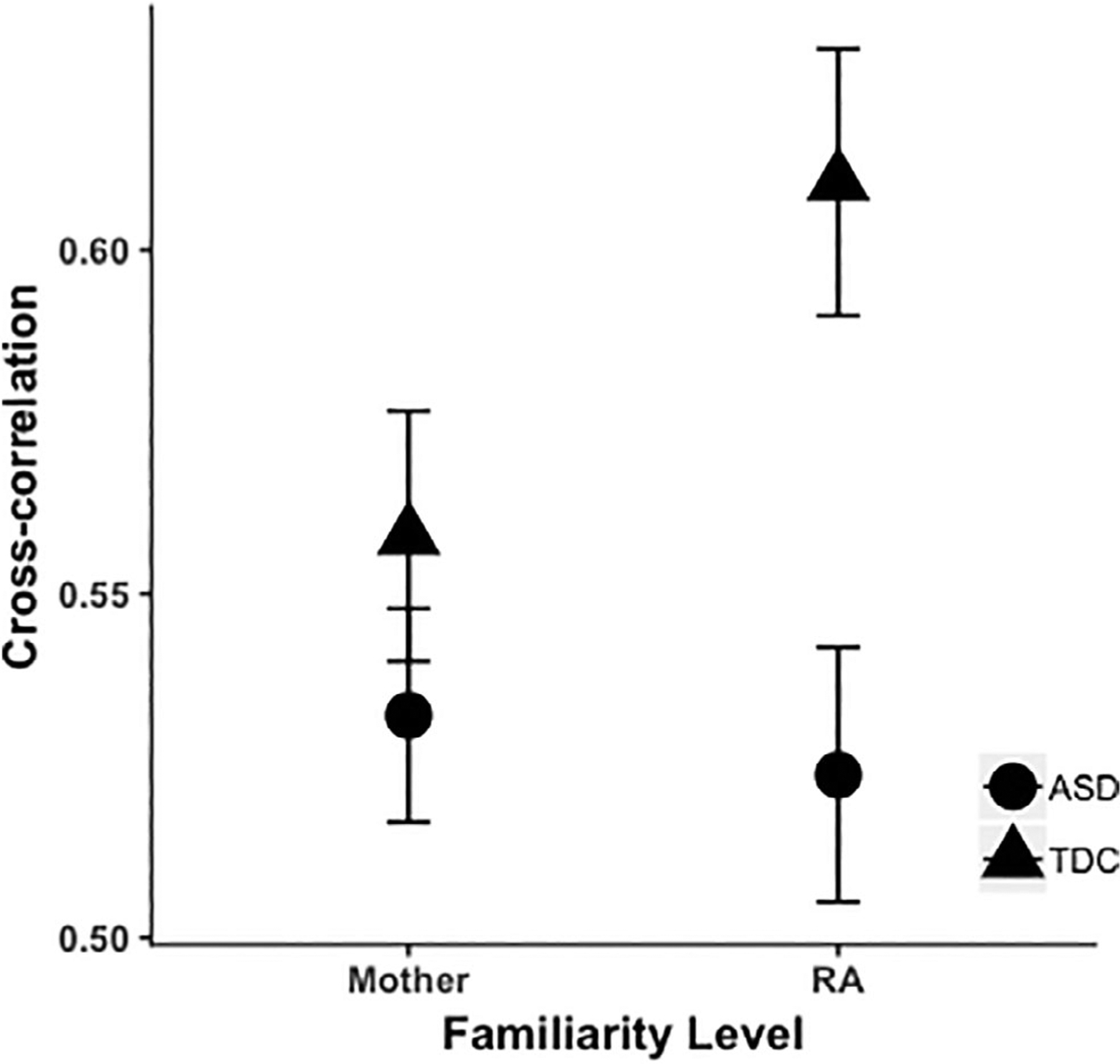
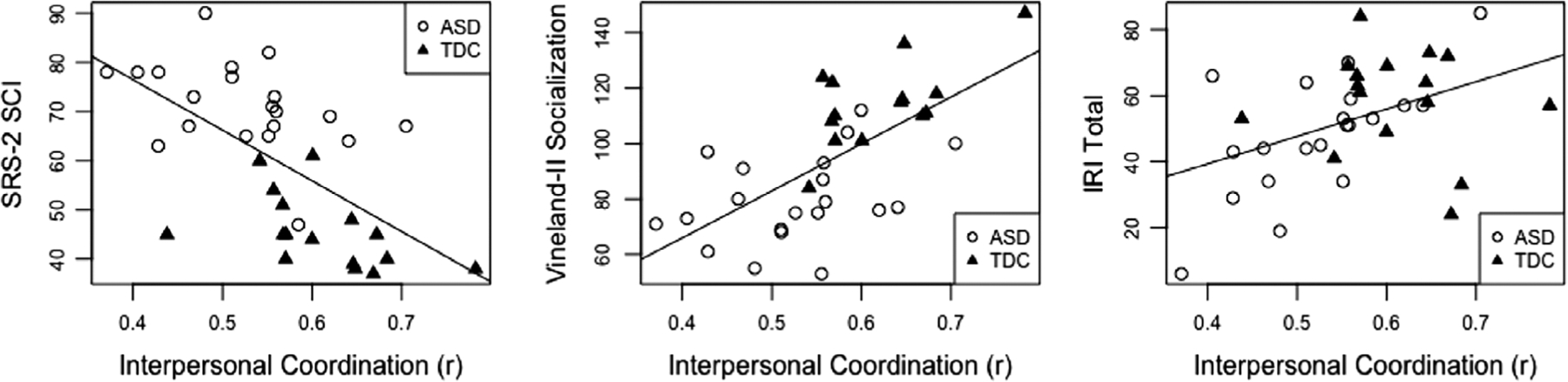
Atypical social-emotional reciprocity is a core feature of autism spectrum disorder (ASD) but can be difficult to operationalize. One measurable manifestation of reciprocity may be interpersonal coordination, the tendency to align the form and timing of one's behaviors (including facial affect) with others. Interpersonal affect coordination facilitates sharing and understanding of emotional cues, and there is evidence that it is reduced in ASD. However, most research has not measured this process in true social contexts, due in part to a lack of tools for measuring dynamic facial expressions over the course of an interaction. Automated facial analysis via computer vision provides an efficient, granular, objective method for measuring naturally occurring facial affect and coordination. Youth with ASD and matched typically developing youth participated in cooperative conversations with their mothers and unfamiliar adults. Time-synchronized videos were analyzed with an open-source computer vision toolkit for automated facial analysis, for the presence and intensity of facial movements associated with positive affect. Both youth and adult conversation partners exhibited less positive affect during conversations when the youth partner had ASD. Youth with ASD also engaged in less affect coordination over the course of conversations. When considered dimensionally across youth with and without ASD, affect coordination significantly predicted scores on rating scales of autism-related social atypicality, adaptive social skills, and empathy. Findings suggest that affect coordination is an important interpersonal process with implications for broader social-emotional functioning. This preliminary study introduces a promising novel method for quantifying moment-to-moment facial expression and emotional reciprocity during natural interactions. LAY SUMMARY: This study introduces a novel, automated method for measuring social-emotional reciprocity during natural conversations, which may improve assessment of this core autism diagnostic behavior. We used computerized methods to measure facial affect and the degree of affect coordination between conversation partners. Youth with autism displayed reduced affect coordination, and reduced affect coordination predicted lower scores on measures of broader social-emotional skills.
非典型社会情感互惠是自闭症谱系障碍(ASD)的一个核心特征,但可能难以实施操作化。互惠的一种可测量表现形式可能是人际协调,即个人行为(包括面部表情)的形式和时间与他人保持一致的倾向。人际情感协调有助于情感线索的共享和理解,并且有证据表明在ASD中这种协调会减少。然而,大多数研究并未在真实的社会情境中测量这一过程,部分原因是缺乏在互动过程中测量动态面部表情的工具。通过计算机视觉进行的自动面部分析提供了一种高效、细致、客观的方法来测量自然发生的面部情感和协调性。患有ASD的青少年以及与之匹配的发育正常的青少年与他们的母亲和陌生成年人进行合作对话。利用一个用于自动面部分析的开源计算机视觉工具包,对时间同步的视频进行分析,以确定与积极情感相关的面部动作的存在和强度。当青少年对话伙伴患有ASD时,青少年和成年对话伙伴在对话过程中表现出的积极情感都较少。患有ASD的青少年在对话过程中进行的情感协调也较少。当从有ASD和无ASD的青少年维度进行考虑时,情感协调显著预测了自闭症相关社会非典型性、适应性社交技能和同理心评分量表上的得分。研究结果表明,情感协调是一个重要的人际过程,对更广泛的社会情感功能有影响。这项初步研究引入了一种有前景的新方法,用于量化自然互动过程中瞬间的面部表情和情感互惠。简要总结:本研究引入了一种新颖的自动方法来测量自然对话中的社会情感互惠,这可能会改善对这种核心自闭症诊断行为的评估。我们使用计算机化方法来测量面部情感以及对话伙伴之间的情感协调程度。患有自闭症的青少年表现出情感协调减少,而情感协调减少预示着更广泛社会情感技能测量中的得分较低。