Fujiwara Tomoko, Ono Masanori, Iizuka Takashi, Sekizuka-Kagami Naomi, Maida Yoshiko, Adachi Yumi, Fujiwara Hiroshi, Yoshikawa Hiroaki
Department of Social Work and Life Design, Kyoto Notre Dame University, 1 Minami-Nonogami-cho, Shimogamo, Sakyo-ku, Kyoto 606-0847, Japan.
Department of Obstetrics and Gynecology, Graduate School of Medical Science, Kanazawa University, Kanazawa 920-8640, Japan.
Diagnostics (Basel). 2020 Jul 13;10(7):476. doi: 10.3390/diagnostics10070476.
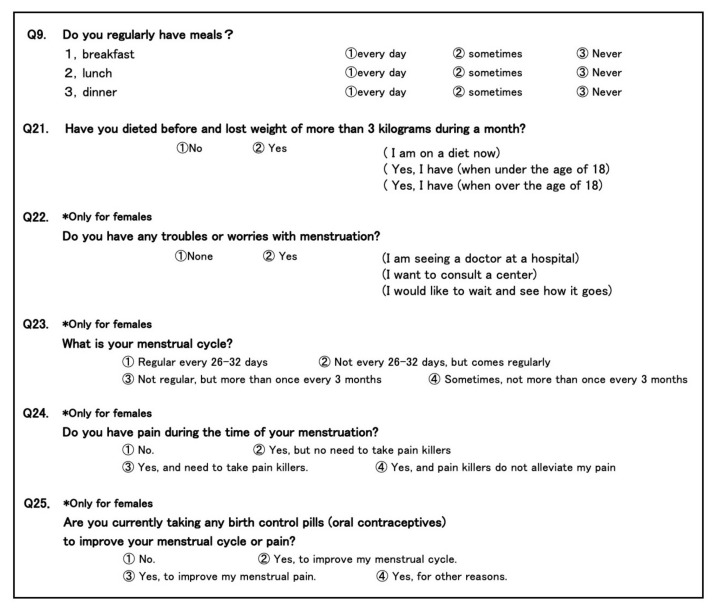
Inadequate dietary habits in youth are known to increase the risk of onset of various diseases in adulthood. Previously, we found that female college students who skipped breakfast had higher incidences of dysmenorrhea, suggesting that breakfast skipping interferes with ovarian and uterine functions. Since dietary habits can be managed by education, it is preferable to establish a convenient screening system for meal skipping that is associated with dysmenorrhea as part of routine services of health service centers. In this study, we recruited 3172 female students aged from 18 to 25 at Kanazawa University and carried out an annual survey of the status of students' health and lifestyle in 2019, by a questionnaire. We obtained complete responses from 3110 students and analyzed the relationship between dietary habits, such as meal skipping and history of dieting, and menstrual disorders, such as troubles or worries with menstruation, menstrual irregularity, menstrual pain, and use of oral contraceptives. The incidence of troubles or worries with menstruation was significantly higher in those with breakfast skipping ( < 0.05) and a history of dieting ( < 0.001). This survey successfully confirmed the positive relationship between breakfast skipping and menstrual pain ( < 0.001), indicating that this simple screening test is suitable for picking up breakfast skippers who are more prone to gynecologic disorders. In conclusions, since dysmenorrhea is one of the important clinical signs, breakfast skipping may become an effective marker to predict the subsequent onset of gynecological diseases at health service centers. Considering educational correction of meal skipping, breakfast skipping is a potential and preventable predictor that will contribute to managing menstrual disorders from a preventive standpoint in the future.
众所周知,青少年不良的饮食习惯会增加成年后患各种疾病的风险。此前,我们发现不吃早餐的女大学生痛经发生率更高,这表明不吃早餐会干扰卵巢和子宫功能。由于饮食习惯可以通过教育来管理,因此最好建立一种方便的筛查系统,用于筛查与痛经相关的不规律饮食情况,作为健康服务中心常规服务的一部分。在本研究中,我们招募了金泽大学3172名年龄在18至25岁之间的女学生,并于2019年通过问卷调查对学生的健康状况和生活方式进行了年度调查。我们获得了3110名学生的完整回复,并分析了饮食习惯(如不吃正餐和节食史)与月经紊乱(如月经问题或担忧、月经不规律、痛经以及口服避孕药的使用)之间的关系。月经有问题或担忧的发生率在不吃早餐的学生中显著更高(<0.05),在有节食史的学生中更高(<0.001)。这项调查成功证实了不吃早餐与痛经之间存在正相关关系(<0.001),表明这种简单的筛查测试适合筛选出更易患妇科疾病的不吃早餐者。总之,由于痛经是重要的临床症状之一,不吃早餐可能成为健康服务中心预测后续妇科疾病发病的有效指标。考虑到对不规律饮食进行教育纠正,不吃早餐是一个潜在的、可预防的预测因素,未来将有助于从预防角度管理月经紊乱。