Department of Synthetic Chemistry and Biological Chemistry, Graduate School of Engineering, Kyoto University, Katsura, Nishikyo-ku, Kyoto, 615-8510, Japan.
Department of Physics, Kyoto University, Sakyo-ku, Kyoto, 606-8502, Japan.
Nat Commun. 2020 Jul 15;11(1):3541. doi: 10.1038/s41467-020-17394-z.
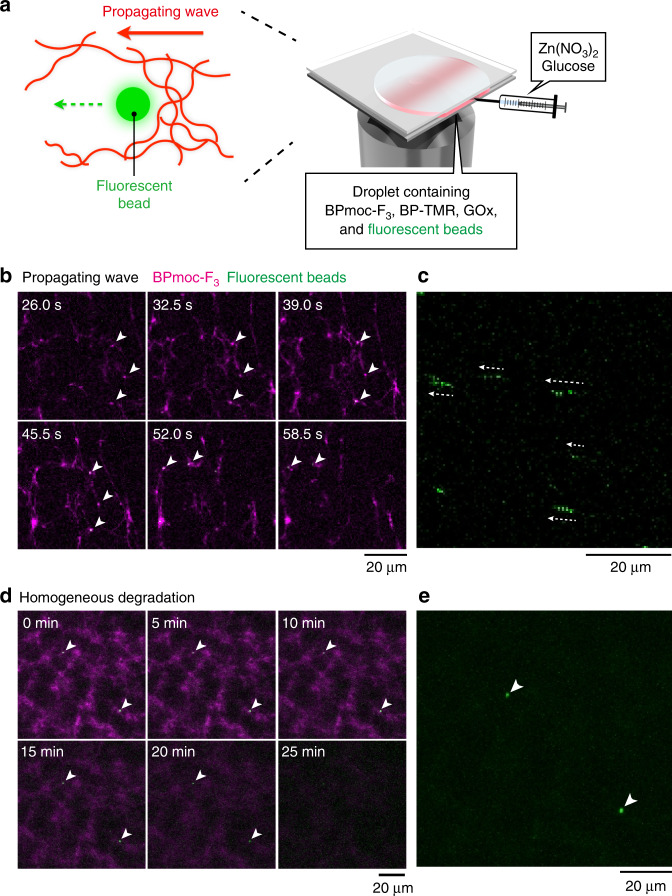
Dynamic spatiotemporal patterns that arise from out-of-equilibrium biochemical reactions generate forces in living cells. Despite considerable recent efforts, rational design of spatiotemporal patterns in artificial molecular systems remains at an early stage of development. Here, we describe force generation by a propagating wave of supramolecular nanofibers. Inspired by actin dynamics, a reaction network is designed to control the formation and degradation of nanofibers by two chemically orthogonal stimuli. Real-time fluorescent imaging successfully visualizes the propagating wave based on spatiotemporally coupled generation and collapse of nanofibers. Numerical simulation indicates that the concentration gradient of degradation stimulus and the smaller diffusion coefficient of the nanofiber are critical for wave emergence. Moreover, the force (0.005 pN) generated by chemophoresis and/or depletion force of this propagating wave can move nanobeads along the wave direction.
非平衡生化反应产生的动态时空模式会在活细胞中产生力。尽管最近做了相当多的努力,但人工分子系统中时空模式的合理设计仍处于早期发展阶段。在这里,我们描述了超分子纳米纤维传播波产生的力。受肌动蛋白动力学的启发,设计了一个反应网络来通过两种化学正交的刺激来控制纳米纤维的形成和降解。实时荧光成像成功地基于纳米纤维时空耦合的产生和坍塌来可视化传播波。数值模拟表明,降解刺激的浓度梯度和纳米纤维较小的扩散系数对于波的出现至关重要。此外,这种传播波的化学趋化和/或耗尽力产生的力(0.005 pN)可以沿波的方向移动纳米珠。