Van 't Hoff Laboratory for Physical and Colloid Chemistry, Debye Institute for NanoMaterials Science, Utrecht University, 3584 CH Utrecht, The Netherlands.
Department of Chemical Engineering, Delft University of Technology, Van der Maasweg 9, 2629 HZ Delft, The Netherlands.
Langmuir. 2020 Sep 15;36(36):10639-10656. doi: 10.1021/acs.langmuir.0c01763. Epub 2020 Aug 25.
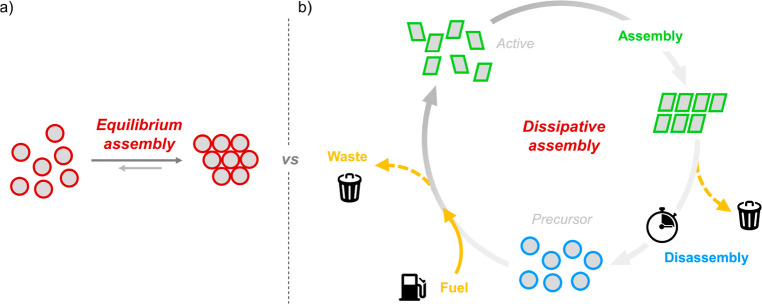
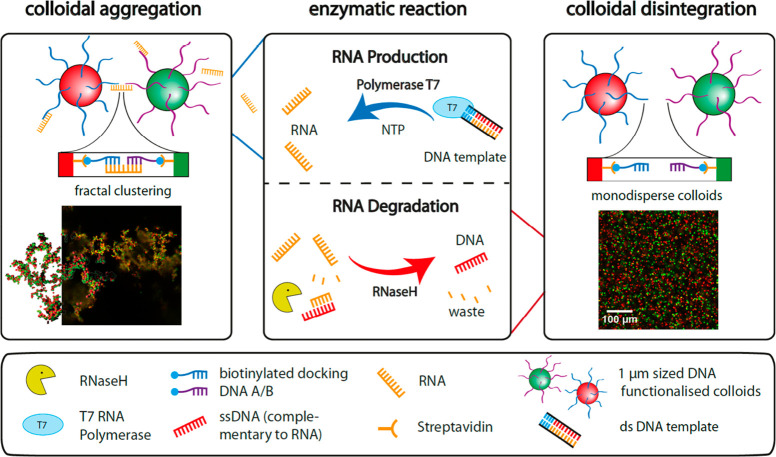
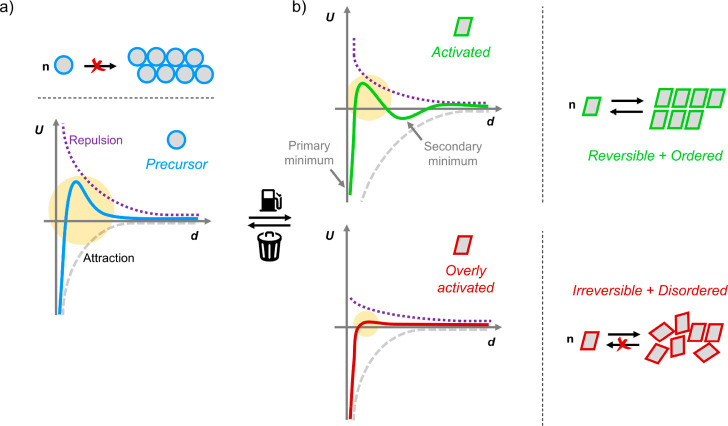
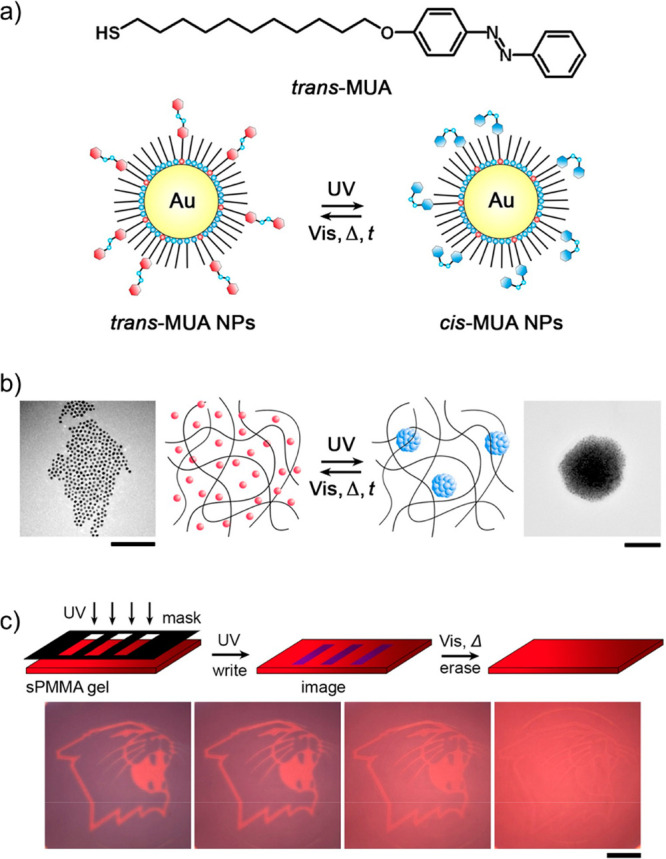
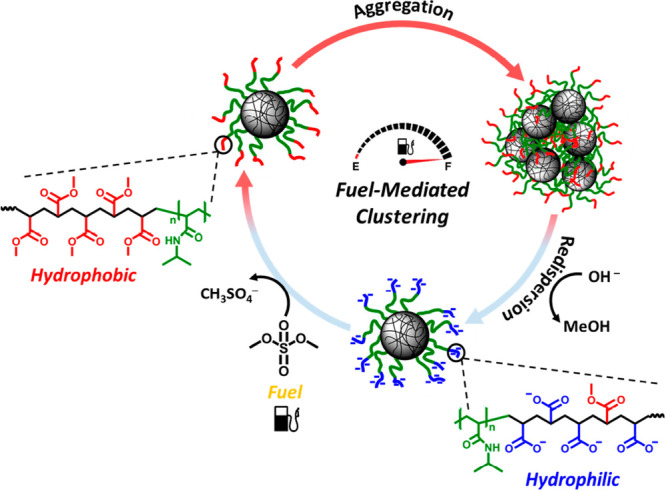
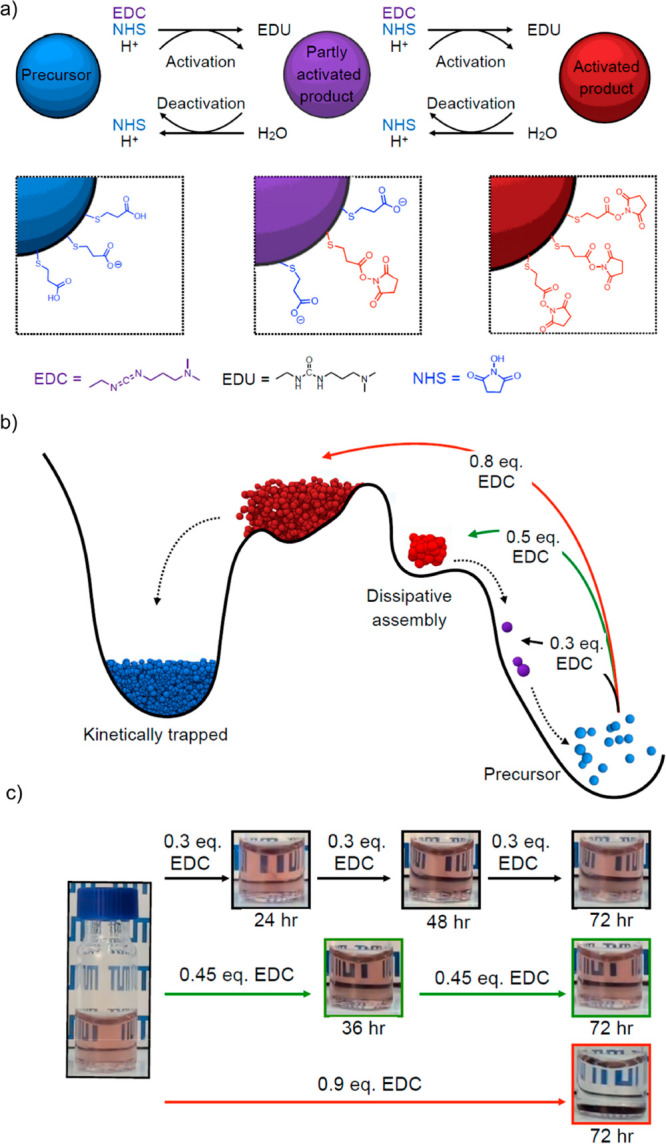
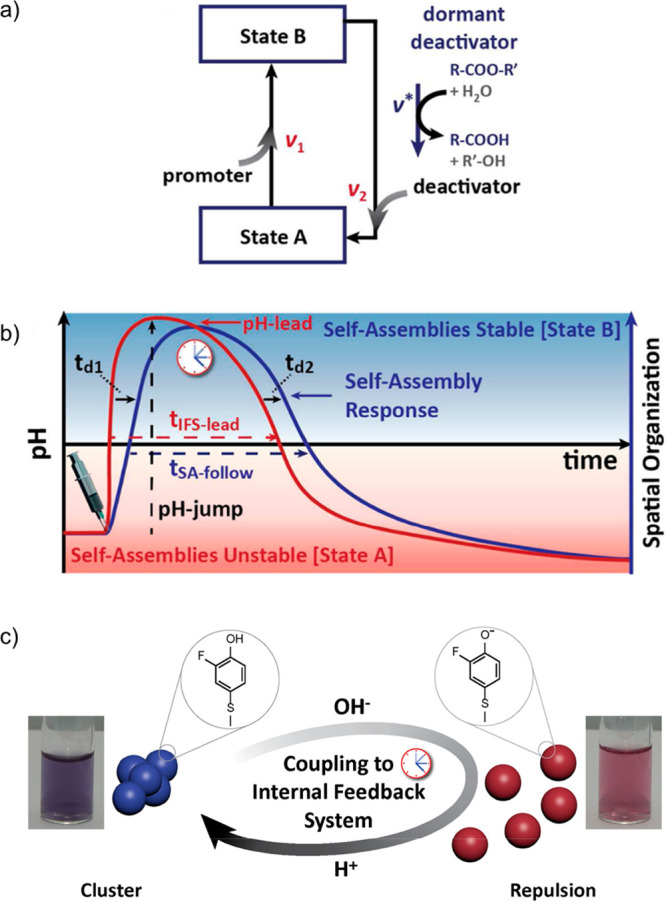
Transient assembled structures play an indispensable role in a wide variety of processes fundamental to living organisms including cellular transport, cell motility, and proliferation. Typically, the formation of these transient structures is driven by the consumption of molecular fuels via dissipative reaction networks. In these networks, building blocks are converted from inactive precursor states to active (assembling) states by (a set of) irreversible chemical reactions. Since the activated state is intrinsically unstable and can be maintained only in the presence of sufficient fuel, fuel depletion results in the spontaneous disintegration of the formed superstructures. Consequently, the properties and behavior of these assembled structures are governed by the kinetics of fuel consumption rather than by their thermodynamic stability. This fuel dependency endows biological systems with unprecedented spatiotemporal adaptability and inherent self-healing capabilities. Fascinated by these unique material characteristics, coupling the assembly behavior to molecular fuel or light-driven reaction networks was recently implemented in synthetic (supra)molecular systems. In this invited feature article, we discuss recent studies demonstrating that dissipative assembly is not limited to the molecular world but can also be translated to building blocks of colloidal dimensions. We highlight crucial guiding principles for the successful design of dissipative colloidal systems and illustrate these with the current state of the art. Finally, we present our vision on the future of the field and how marrying nonequilibrium self-assembly with the functional properties associated with colloidal building blocks presents a promising route for the development of next-generation materials.
瞬态组装结构在包括细胞运输、细胞运动和增殖在内的各种生命活动中起着不可或缺的作用。通常,这些瞬态结构的形成是由消耗分子燃料通过耗散反应网络驱动的。在这些网络中,构建块通过(一组)不可逆化学反应从非活性前体状态转化为活性(组装)状态。由于激活状态本质上是不稳定的,并且只能在有足够燃料的情况下维持,因此燃料耗尽会导致形成的超结构自发解体。因此,这些组装结构的性质和行为受燃料消耗动力学的控制,而不是热力学稳定性的控制。这种燃料依赖性赋予生物系统前所未有的时空适应性和内在自修复能力。受这些独特的材料特性的吸引,最近在合成(超)分子系统中将组装行为与分子燃料或光驱动反应网络耦合。在这篇特邀专题文章中,我们讨论了最近的研究,这些研究表明耗散组装不仅限于分子世界,也可以转化为胶体尺寸的构建块。我们强调了成功设计耗散胶体系统的关键指导原则,并通过最新的研究进展来说明这些原则。最后,我们提出了我们对该领域未来的看法,以及将非平衡自组装与与胶体构建块相关的功能特性相结合,为下一代材料的发展提供了一条很有前途的途径。