Scotland's Rural College, Edinburgh, UK.
Aquaculture Branch, FAO Fisheries and Aquaculture Department, Rome, Italy.
Sci Rep. 2020 Jul 15;10(1):11679. doi: 10.1038/s41598-020-68231-8.
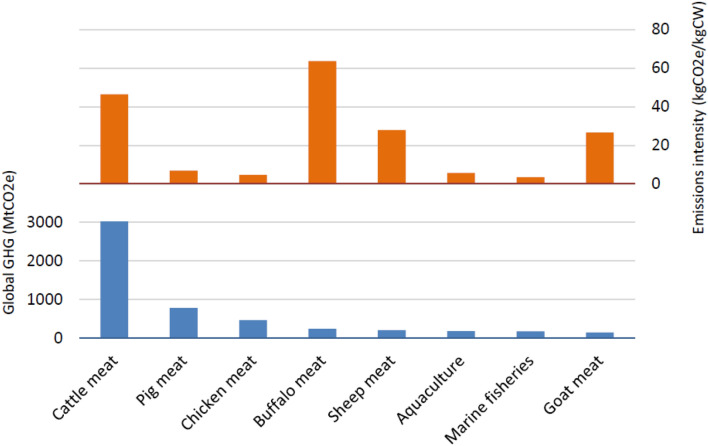
Global aquaculture makes an important contribution to food security directly (by increasing food availability and accessibility) and indirectly (as a driver of economic development). In order to enable sustainable expansion of aquaculture, we need to understand aquaculture's contribution to global greenhouse gas (GHG) emissions and how it can be mitigated. This study quantifies the global GHG emissions from aquaculture (excluding the farming of aquatic plants), with a focus on using modern, commercial feed formulations for the main species groups and geographic regions. Here we show that global aquaculture accounted for approximately 0.49% of anthropogenic GHG emissions in 2017, which is similar in magnitude to the emissions from sheep production. The modest emissions reflect the low emissions intensity of aquaculture, compared to terrestrial livestock (in particular cattle, sheep and goats), which is due largely to the absence of enteric CH in aquaculture, combined with the high fertility and low feed conversion ratios of finfish and shellfish.
全球水产养殖直接(通过增加食物的可获得性和可及性)和间接(作为经济发展的驱动力)为粮食安全做出了重要贡献。为了使水产养殖能够可持续扩张,我们需要了解水产养殖对全球温室气体(GHG)排放的贡献,以及如何减轻这种影响。本研究量化了水产养殖(不包括水生植物的养殖)的全球温室气体排放,重点是使用现代商业饲料配方来养殖主要物种组和地理区域。研究表明,2017 年全球水产养殖约占人为温室气体排放的 0.49%,与绵羊养殖的排放量相当。适度的排放量反映了水产养殖与陆地牲畜(特别是牛、绵羊和山羊)相比,温室气体排放强度较低,这主要是由于水产养殖中不存在肠道 CH,加上鱼类和贝类的高繁殖力和低饲料转化率。