Estrada Esteban, Décima Jose L, Rodríguez Marcelo, Di Tomaso Marianela, Roberti Javier
Hospital de Alta Complejidad 'Pte. Juan Domingo Perón', Formosa, Argentina.
Clin Med Insights Arthritis Musculoskelet Disord. 2020 Jul 3;13:1179544120931086. doi: 10.1177/1179544120931086. eCollection 2020.
The objective of this study was to compare platelet-rich plasma (PRP), bone marrow aspirate concentrate (BMAC), and adipose-derived mesenchymal stem cell (MSC) injections in the treatment of osteoarthritis (OA) of the knee using functional scores.
A total of 89 patients with painful knee OA were included in this study. Patients were assigned to one of the 3 treatments according to severity of OA as indicated by symptoms and radiography to PRP (stage I), BMAC (stage II), or adipose-derived MSC (stage III). Clinical assessment was performed using the Knee Society Score, which combines the Knee Score, based on the clinical parameters, and the Functional Score, and IKDC score. Surveys were completed at preoperative and at 90, 180, and 265 days postoperative. The follow-up responses were compared with baseline and between treatment groups.
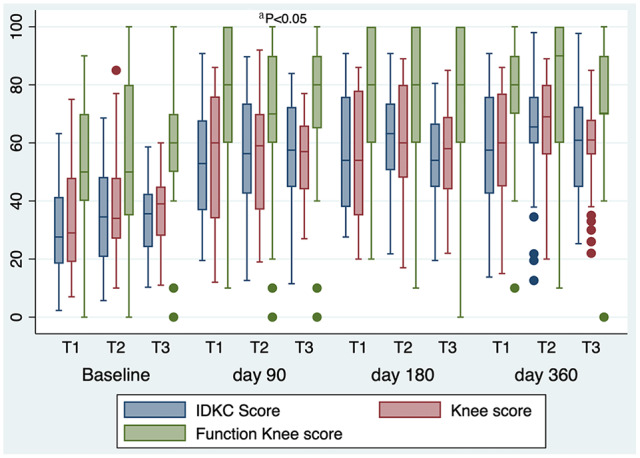
Treatment with PRP, BMAC, and adipose-derived MSC included 29 (32.6%), 27 (30.3%), and 33 (37.1%) patients, respectively. For the total group, median age was 61 years (range: 22-84 years). Score values were comparable among treatment groups at baseline. Statistically significant improvement was observed in the 3 groups according to the 3 scores at all time points during follow-up compared with baseline. No difference was found among treatment type.
Our findings support previous reports and encourage further research on the use of these cost-effective treatments for OA of the knee.
本研究的目的是使用功能评分比较富血小板血浆(PRP)、骨髓抽吸浓缩物(BMAC)和脂肪来源间充质干细胞(MSC)注射治疗膝关节骨关节炎(OA)的效果。
本研究共纳入89例膝关节OA疼痛患者。根据症状和X线片所示的OA严重程度,将患者分为3种治疗方法之一:PRP(I期)、BMAC(II期)或脂肪来源的MSC(III期)。使用膝关节协会评分进行临床评估,该评分结合了基于临床参数的膝关节评分、功能评分和IKDC评分。在术前以及术后90、180和265天完成调查。将随访反应与基线以及各治疗组之间进行比较。
接受PRP、BMAC和脂肪来源MSC治疗的患者分别为29例(32.6%)、27例(30.3%)和33例(37.1%)。对于整个组,中位年龄为61岁(范围:22 - 84岁)。各治疗组在基线时的评分值具有可比性。与基线相比,在随访期间的所有时间点,根据这3项评分,3组均观察到统计学上的显著改善。治疗类型之间未发现差异。
我们的研究结果支持先前的报道,并鼓励对这些用于膝关节OA的经济有效治疗方法的使用进行进一步研究。