Muthu Sathish, Patil Sandesh C, Jeyaraman Naveen, Jeyaraman Madhan, Gangadaran Prakash, Rajendran Ramya Lakshmi, Oh Eun Jung, Khanna Manish, Chung Ho Yun, Ahn Byeong-Cheol
Department of Orthopaedics, Government Medical College and Hospital, Dindigul 624001, Tamil Nadu, India.
Department of Biotechnology, School of Engineering and Technology, Sharda University, Greater Noida 201310, Uttar Pradesh, India.
World J Orthop. 2023 Jan 18;14(1):23-41. doi: 10.5312/wjo.v14.i1.23.
Osteoarthritis (OA) is the most common joint disorder, is associated with an increasing socioeconomic impact owing to the ageing population.
To analyze and compare the efficacy and safety of bone-marrow-derived mesenchymal stromal cells (BM-MSCs) and adipose tissue-derived MSCs (AD-MSCs) in knee OA management from published randomized controlled trials (RCTs).
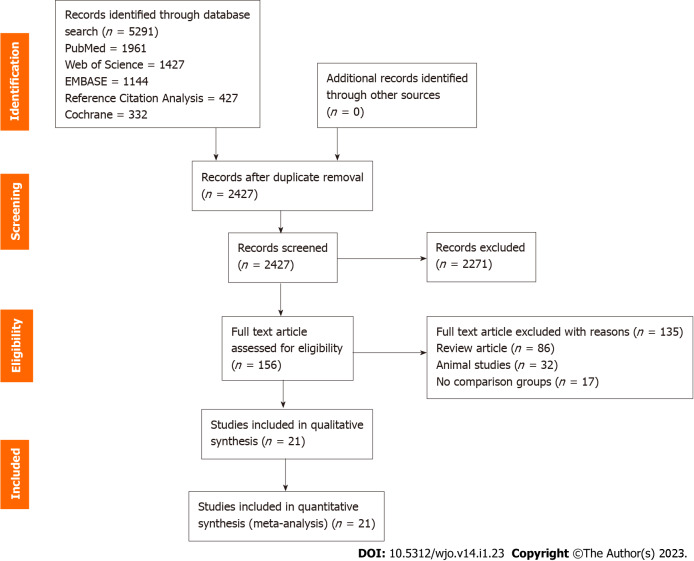
Independent and duplicate electronic database searches were performed, including PubMed, EMBASE, Web of Science, and Cochrane Library, until August 2021 for RCTs that analyzed the efficacy and safety of AD-MSCs and BM-MSCs in the management of knee OA. The visual analog scale (VAS) score for pain, Western Ontario McMaster Universities Osteoarthritis Index (WOMAC), Lysholm score, Tegner score, magnetic resonance observation of cartilage repair tissue score, knee osteoarthritis outcome score (KOOS), and adverse events were analyzed. Analysis was performed on the R-platform using OpenMeta (Analyst) software. Twenty-one studies, involving 936 patients, were included. Only one study compared the two MSC sources without patient randomization; hence, the results of all included studies from both sources were pooled, and a comparative critical analysis was performed.
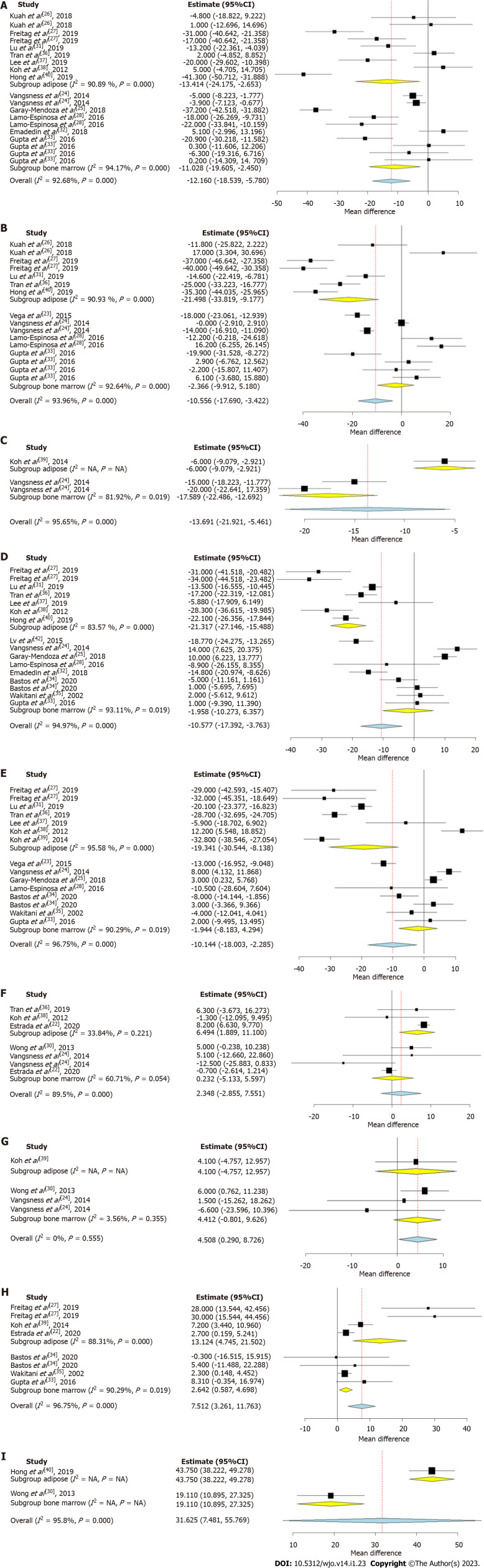
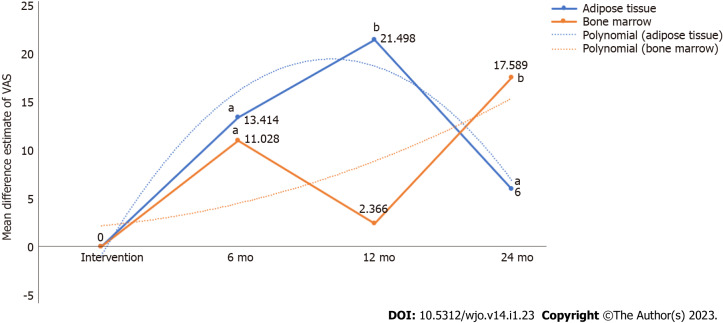
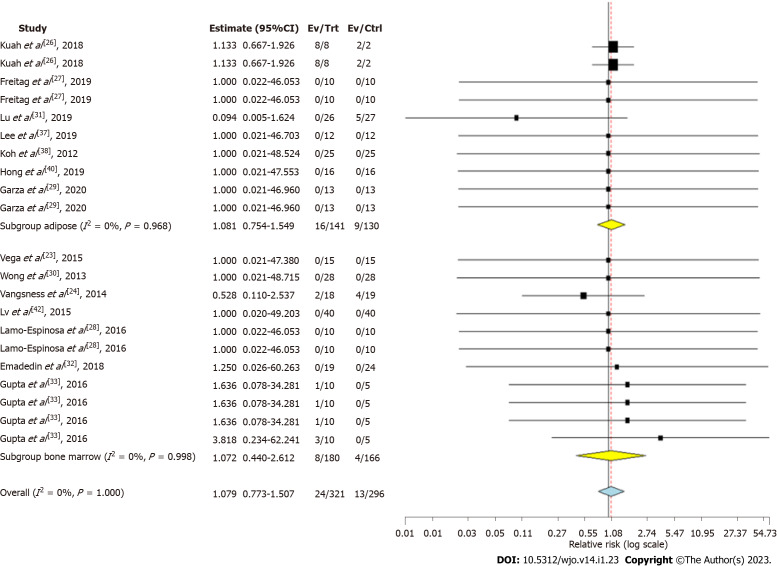
At six months, both AD-MSCs and BM-MSCs showed significant VAS improvement ( = 0.015, = 0.012); this was inconsistent at 1 year for BM-MSCs ( < 0.001, = 0.539), and AD-MSCs outperformed BM-MSCs compared to controls in measures such as WOMAC ( < 0.001, = 0.541), Lysholm scores ( = 0.006; = 0.933), and KOOS ( = 0.002; = 0.012). BM-MSC-related procedures caused significant adverse events ( = 0.003) compared to AD-MSCs ( = 0.673).
Adipose tissue is superior to bone marrow because of its safety and consistent efficacy in improving pain and functional outcomes. Future trials are urgently warranted to validate our findings and reach a consensus on the ideal source of MSCs for managing knee OA.
骨关节炎(OA)是最常见的关节疾病,由于人口老龄化,其社会经济影响日益增加。
通过已发表的随机对照试验(RCT)分析和比较骨髓间充质干细胞(BM-MSCs)和脂肪组织来源的间充质干细胞(AD-MSCs)在膝关节OA治疗中的疗效和安全性。
进行独立和重复的电子数据库检索,包括PubMed、EMBASE、科学网和Cochrane图书馆,检索截至2021年8月分析AD-MSCs和BM-MSCs在膝关节OA治疗中疗效和安全性的RCT。分析疼痛的视觉模拟量表(VAS)评分、西安大略和麦克马斯特大学骨关节炎指数(WOMAC)、Lysholm评分、Tegner评分、软骨修复组织的磁共振观察评分、膝关节骨关节炎结局评分(KOOS)以及不良事件。使用OpenMeta(Analyst)软件在R平台上进行分析。纳入21项研究,涉及936例患者。只有一项研究比较了两种间充质干细胞来源,但未对患者进行随机分组;因此,汇总了来自两种来源的所有纳入研究的结果,并进行了比较批判性分析。
在6个月时,AD-MSCs和BM-MSCs均显示VAS有显著改善(P = 0.015,P = 0.012);BM-MSCs在1年时情况不一致(P < 0.001,P = 0.539),在WOMAC(P < 0.001,P = 0.541)、Lysholm评分(P = 0.006;P = 0.933)和KOOS(P = 0.002;P = 0.012)等指标上,与对照组相比,AD-MSCs的表现优于BM-MSCs。与AD-MSCs(P = 0.673)相比,BM-MSC相关操作导致显著不良事件(P = 0.003)。
脂肪组织在改善疼痛和功能结局方面具有安全性和一致疗效方面优于骨髓。迫切需要未来的试验来验证我们的发现,并就用于治疗膝关节OA的间充质干细胞的理想来源达成共识。