Hanlon Charlene, Ramachandran Ramesh, Zuidhof Martin J, Bédécarrats Grégoy Y
Department of Animal Biosciences, University of Guelph, Guelph, ON, Canada.
Center for Reproductive Biology and Health, Department of Animal Science, Pennsylvania State University, University Park, PA, United States.
Front Physiol. 2020 Jun 26;11:707. doi: 10.3389/fphys.2020.00707. eCollection 2020.
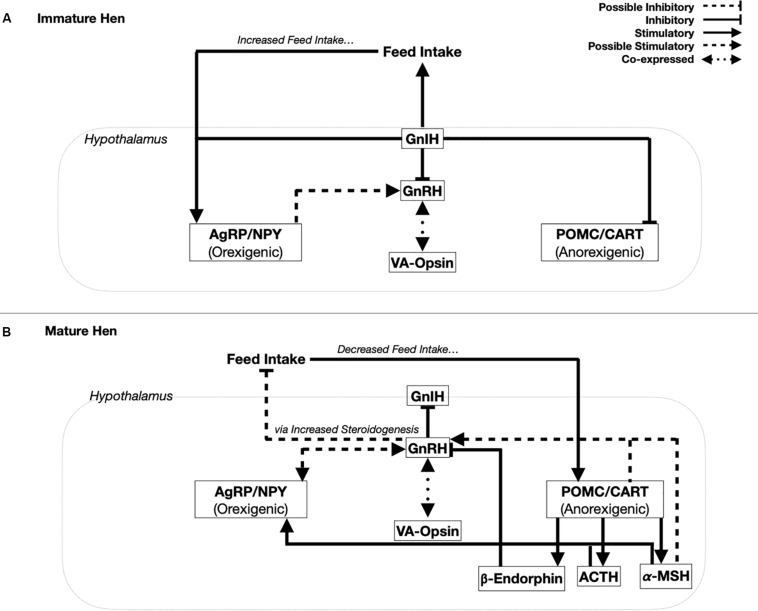
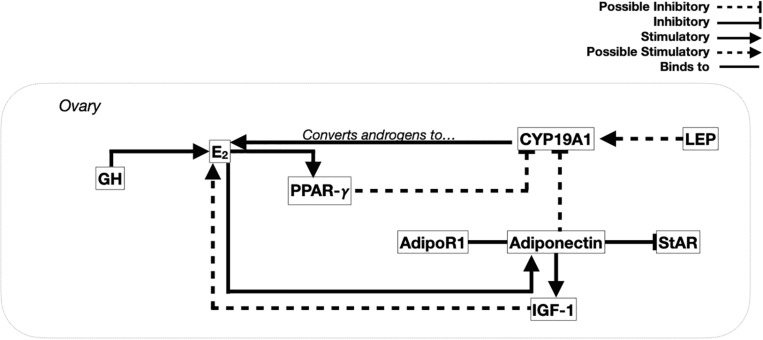
While photoperiod has been generally accepted as the primary if not the exclusive cue to stimulate reproduction in photoperiodic breeders such as the laying hen, current knowledge suggests that metabolism, and/or body composition can also play an influential role to control the hypothalamic-pituitary gonadal (HPG)-axis. This review thus intends to first describe how photoperiodic and metabolic cues can impact the HPG axis, then explore and propose potential common pathways and mechanisms through which both cues could be integrated. Photostimulation refers to a perceived increase in day-length resulting in the stimulation of the HPG. While photoreceptors are present in the retina of the eye and the pineal gland, it is the deep brain photoreceptors (DBPs) located in the hypothalamus that have been identified as the potential mediators of photostimulation, including melanopsin (OPN4), neuropsin (OPN5), and vertebrate-ancient opsin (VA-Opsin). Here, we present the current state of knowledge surrounding these DBPs, along with their individual and relative importance and, their possible downstream mechanisms of action to initiate the activation of the HPG axis. On the metabolic side, specific attention is placed on the hypothalamic integration of appetite control with the stimulatory (Gonadotropin Releasing Hormone; GnRH) and inhibitory (Gonadotropin Inhibitory Hormone; GnIH) neuropeptides involved in the control of the HPG axis. Specifically, the impact of orexigenic peptides agouti-related peptide (AgRP), and neuropeptide Y (NPY), as well as the anorexigenic peptides pro-opiomelanocortin (POMC), and cocaine-and amphetamine regulated transcript (CART) is reviewed. Furthermore, beyond hypothalamic control, several metabolic factors involved in the control of body weight and composition are also presented as possible modulators of reproduction at all three levels of the HPG axis. These include peroxisome proliferator-activated receptor gamma (PPAR-γ) for its impact in liver metabolism during the switch from growth to reproduction, adiponectin as a potential modulator of ovarian development and follicular maturation, as well as growth hormone (GH), and leptin (LEP).
虽然光周期已被普遍认为是刺激光周期繁殖动物(如蛋鸡)繁殖的主要(即便不是唯一)信号,但目前的知识表明,新陈代谢和/或身体组成也可能在控制下丘脑-垂体-性腺(HPG)轴方面发挥重要作用。因此,本综述首先旨在描述光周期和代谢信号如何影响HPG轴,然后探索并提出这两种信号可能整合的潜在共同途径和机制。光刺激是指感知到的日照长度增加,从而刺激HPG轴。虽然眼睛视网膜和松果体中存在光感受器,但位于下丘脑的深部脑光感受器(DBP)已被确定为光刺激的潜在介质,包括黑视蛋白(OPN4)、神经视蛋白(OPN5)和脊椎动物古老视蛋白(VA-视蛋白)。在此,我们介绍围绕这些DBP的当前知识状态,以及它们各自的和相对的重要性,以及它们启动HPG轴激活的可能下游作用机制。在代谢方面,特别关注下丘脑对食欲控制与参与HPG轴控制的刺激性(促性腺激素释放激素;GnRH)和抑制性(促性腺激素抑制激素;GnIH)神经肽的整合。具体而言,对促食欲肽刺鼠相关肽(AgRP)和神经肽Y(NPY),以及厌食肽阿片促黑素皮质素原(POMC)和可卡因及苯丙胺调节转录物(CART)的影响进行了综述。此外,除了下丘脑控制外,参与体重和身体组成控制的几种代谢因子也被认为是HPG轴所有三个水平上生殖的可能调节因子。这些包括过氧化物酶体增殖物激活受体γ(PPAR-γ),因为它在从生长到繁殖的转变过程中对肝脏代谢有影响;脂联素作为卵巢发育和卵泡成熟的潜在调节因子;以及生长激素(GH)和瘦素(LEP)。