Blomster Lyshol Johanna K, Thomsen Lotte, Seibt Beate
Department of Psychology, University of Oslo, Oslo, Norway.
Department of Political Science, Aarhus University, Aarhus, Denmark.
Front Psychol. 2020 Jun 24;11:1240. doi: 10.3389/fpsyg.2020.01240. eCollection 2020.
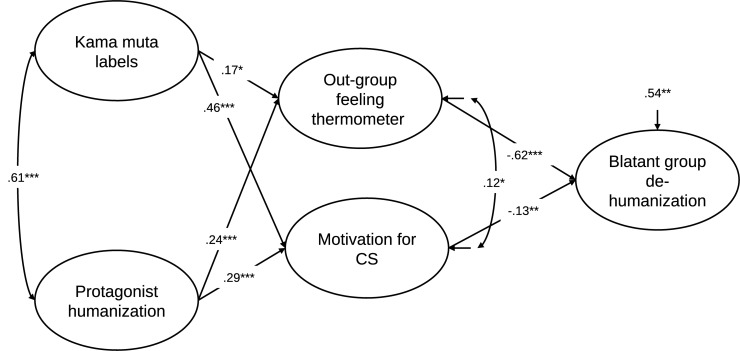
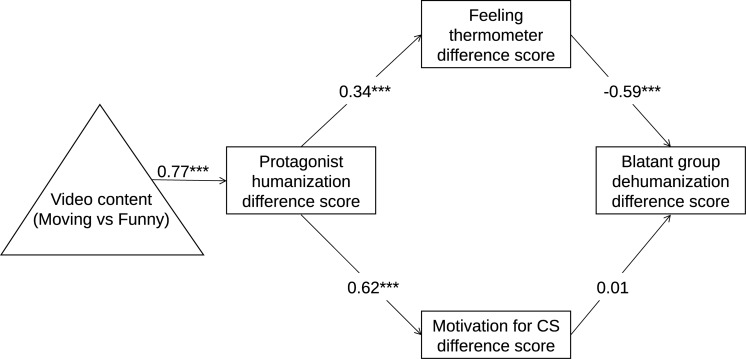
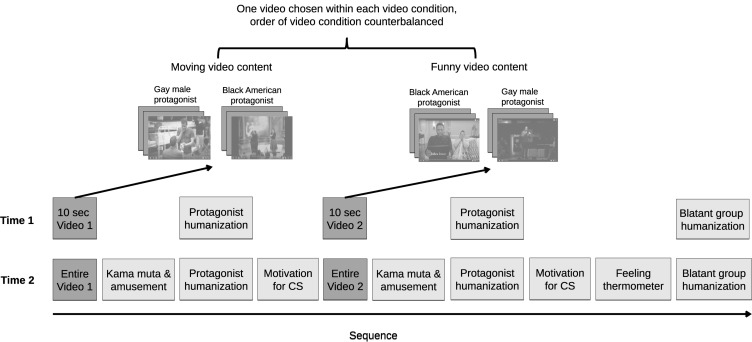
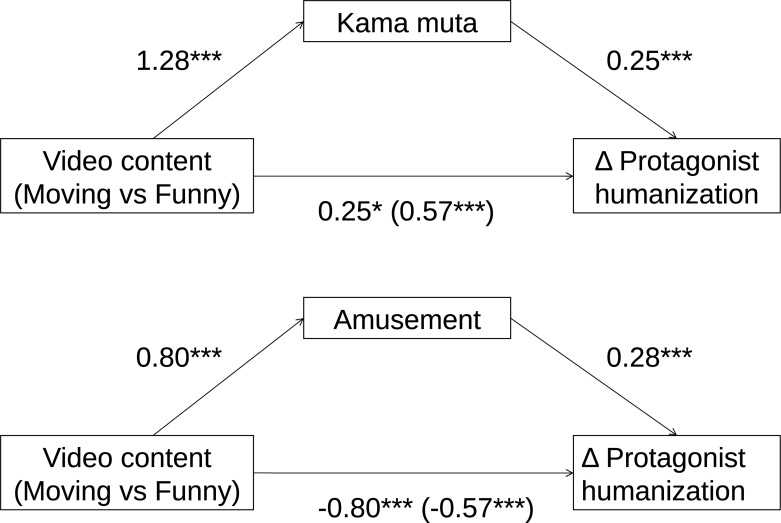
People often view out-groups as less human than their in-group. Some media video content is and leaves one feeling or . Recent research indicates that this reflects a positive social emotion, , which is evoked by a sudden increase in interpersonal closeness, specifically by the relational model of communal sharing. Because forming strong, close, and communal bonds exemplifies valued human qualities, and because other humans are our primary target partners of communal sharing, we predicted that feeling kama muta in response to observing communal sharing among out-group strangers would make people view out-groups as more human. In Study 1, we replicated a model obtained through a large exploratory preliminary study which indicated that videos depicting out-group members enacting communal sharing evoked kama muta and increased protagonist humanization. This, in turn, led to decreased blatant dehumanization of the entire out-group via perceived out-group warmth and motivation to develop a communal sharing relationship with the protagonist. The preregistered Study 2 further tested our model, demonstrating (1) that the relationship between protagonist humanization and kama muta is bidirectional such that baseline humanization of the protagonist also increases feelings of kama muta in response to acts of communal sharing; (2) that watching videos of communal sharing, as compared to funny videos, increased protagonist humanization; and (3) that kama muta videos, compared to funny videos, had an indirect effect on the reduction of out-group blatant dehumanization, which was mediated by protagonist humanization and out-group warmth.
人们通常认为外群体成员比内群体成员更缺乏人性。一些媒体视频内容令人感到 ,并让人产生 或 的感觉。最近的研究表明,这反映了一种积极的社会情感,即卡玛慕塔(kama muta),它是由人际亲密度的突然增加所引发的,具体而言是由共同分享的关系模型所引发。因为形成牢固、亲密和共同的纽带体现了人类所珍视的品质,而且因为其他人是我们共同分享的主要目标对象,所以我们预测,在观察外群体陌生人之间的共同分享时产生卡玛慕塔的感觉会让人们认为外群体成员更具人性。在研究1中,我们复制了一项通过大型探索性初步研究获得的模型,该模型表明,描绘外群体成员进行共同分享的视频会引发卡玛慕塔,并增加对主角的人性化认知。反过来,这又通过感知到的外群体温暖以及与主角建立共同分享关系的动机,导致对外群体整体的明显非人化程度降低。预先注册的研究2进一步检验了我们的模型,证明了(1)主角人性化与卡玛慕塔之间的关系是双向的,即主角的基线人性化也会增加对共同分享行为产生的卡玛慕塔感觉;(2)与搞笑视频相比,观看共同分享视频会增加主角的人性化;(3)与搞笑视频相比,卡玛慕塔视频对外群体明显非人化的减少有间接影响,这是由主角人性化和外群体温暖介导的。