Etter Danai, Corti Sabrina, Spirig Simona, Cernela Nicole, Stephan Roger, Johler Sophia
Institute for Food Safety and Hygiene, Vetsuisse Faculty, University of Zurich, Zurich, Switzerland.
Institute of Food, Nutrition and Health, Department of Health Science and Technology, ETH Zürich, Zurich, Switzerland.
Front Microbiol. 2020 Jun 24;11:1289. doi: 10.3389/fmicb.2020.01289. eCollection 2020.
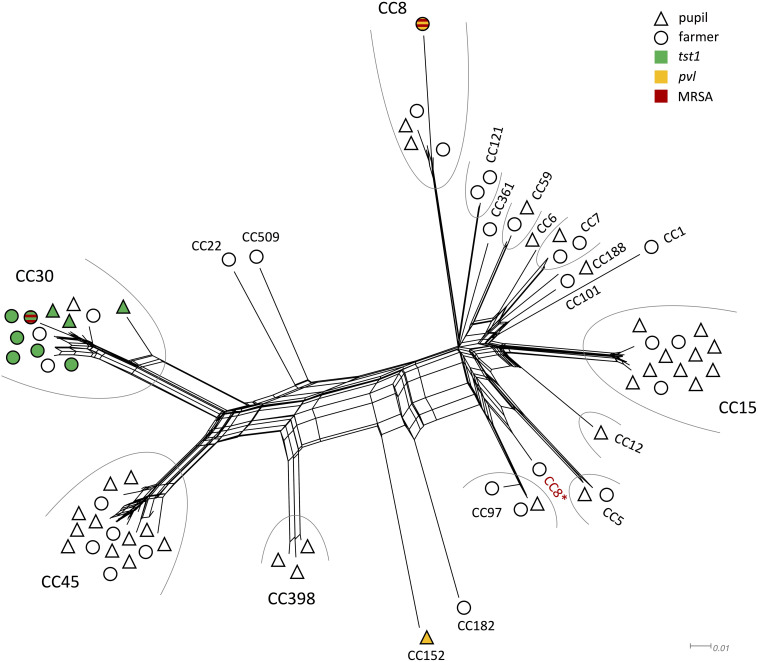
is a leading cause for clinical infections and food intoxications, causing over 100,000 yearly cases of bacteremia in the United States and 434 food-borne outbreaks in the European Union. Approximately 30% of the population permanently carry asymptomatically in their nasal cavity. The risk of infection and transmission to food items or the environment is higher in individuals that are nasally colonized. In addition, can acquire various antimicrobial resistances leading to therapeutic failure, additional medical costs, and fatalities. Methicillin-resistant (MRSA) cause a considerable burden of disease in humans and animals. MRSA carriage has been associated with animal and in particular livestock contact. Extensive current data on the virulence gene profiles, as well as data on antimicrobial resistance determinants is crucial in developing effective strategies to mitigate the burden of disease. To this end, we screened the anterior nares of 160 test subjects (87 pupils and 73 members of farmer families) in Switzerland for carriage. A total of 73 isolates were obtained. Factors such as exposure to farm or companion animals and personal medical history were recorded using a questionnaire. Using a DNA microarray, isolates were assigned to clonal complexes (CCs), and virulence and resistance gene profiles were determined. The collected strains were assigned to 20 CCs, among others CC1, CC7, CC8, CC15, CC30, CC45, CC97, and CC398. Two MRSA strains and one multiresistant isolate carrying genes , , , , and were isolated from farmers with intensive exposure to animals. Strains carrying , causing severe skin lesions and necrotizing pneumonia, as well as tetracycline, erythromycin, and kanamycin resistance genes were found in individuals that had taken antibiotics during the last year. A variety of superantigenic toxin genes was detected, including among others, the toxic shock syndrome toxin (), and various enterotoxins (, , , and the cluster). Contact to chickens was identified as a significant factor contributing to colonization.
是临床感染和食物中毒的主要原因,在美国每年导致超过10万例菌血症病例,在欧盟导致434起食源性疾病暴发。大约30%的人口鼻腔中无症状地长期携带。鼻腔定植的个体感染并传播到食品或环境的风险更高。此外,可获得各种抗菌耐药性,导致治疗失败、额外的医疗费用和死亡。耐甲氧西林金黄色葡萄球菌(MRSA)给人类和动物造成了相当大的疾病负担。MRSA携带与动物尤其是家畜接触有关。目前关于毒力基因谱的大量数据以及抗菌耐药性决定因素的数据对于制定减轻疾病负担的有效策略至关重要。为此,我们在瑞士对160名受试对象(87名学生和73名农民家庭成员)的前鼻孔进行了金黄色葡萄球菌携带情况筛查。共获得73株金黄色葡萄球菌分离株。使用问卷记录了接触农场动物或伴侣动物以及个人病史等因素。使用DNA微阵列将分离株分配到克隆复合体(CCs),并确定毒力和耐药基因谱。收集的菌株被分配到20个CCs中,包括CC1、CC7、CC8、CC15、CC30、CC45、CC97和CC398等。从大量接触动物的农民中分离出两株MRSA菌株和一株携带基因、、、、和的多重耐药分离株。在去年服用过抗生素的个体中发现了携带、导致严重皮肤损伤和坏死性肺炎以及四环素、红霉素和卡那霉素耐药基因的菌株。检测到多种超抗原毒素基因,包括中毒性休克综合征毒素()和各种肠毒素(、、、以及簇)。接触鸡被确定为导致金黄色葡萄球菌定植的一个重要因素。