Maul Karola, Wei Yu-Mei, Nebel Martin, Luebert Federico, Ho Boon-Chuan, Quandt Dietmar, Kessler Michael
Nees Institute for Biodiversity of Plants, University of Bonn, Bonn, Germany.
Guangxi Key Laboratory of Plant Conservation and Restoration Ecology in Karst Terrain, Guangxi Institute of Botany, Guangxi Zhuang Autonomous Region and Chinese Academy of Sciences, Guilin, China.
Front Plant Sci. 2020 Jun 24;11:765. doi: 10.3389/fpls.2020.00765. eCollection 2020.
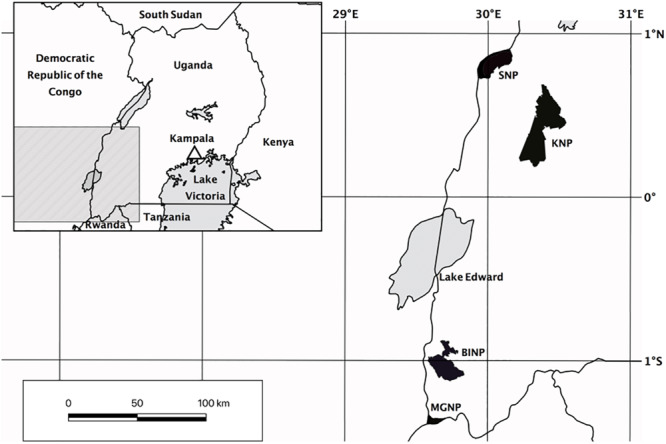
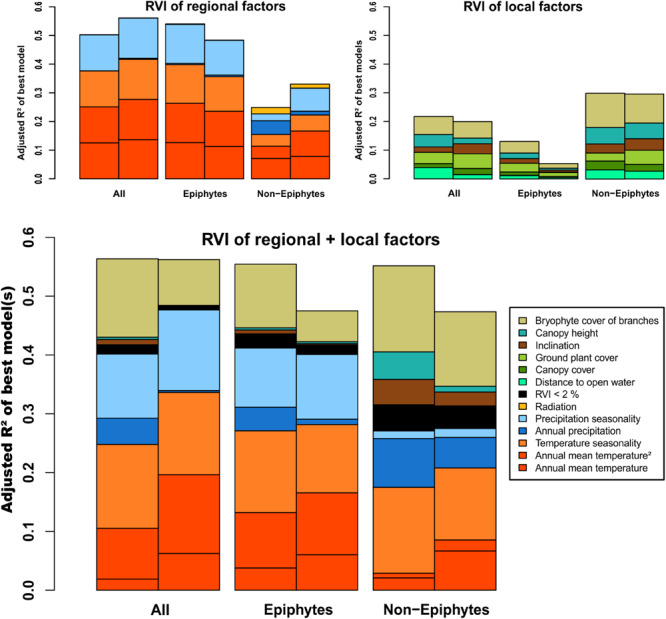
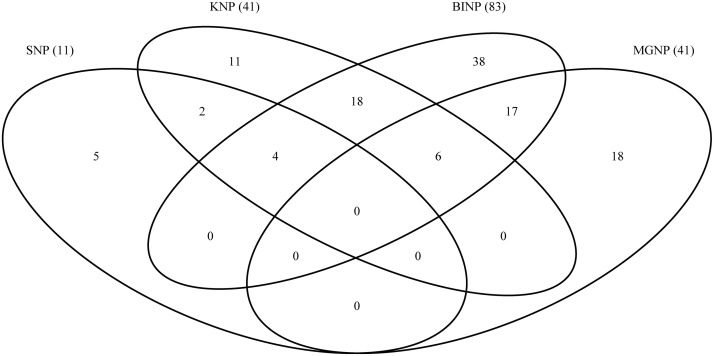
We studied the influence of regional and local variables on the liverwort diversity within natural forest vegetation of Uganda to contribute to our understanding of the mechanisms and processes determining species richness. To this end, we compared the species richness distribution patterns of epiphytic and non-epiphytic liverworts (Marchantiophytina) in 24 plots in the forests of four Ugandan national parks. We recorded a total of 119 species and subspecies from 18 families, including 16 new species records for the country. We used generalized linear models (GLMs) and the relative variable importance of regional and local climatic and environmental variables to assess their respective impact on the species diversity. We found that the richness patterns of total and epiphytic richness were largely driven by regional climatic factors related to temperature and water-availability. In contrast, species diversity of non-epiphytic and rare species was additionally strongly determined by local-scale microhabitat factors such as height of forest canopy and slope inclination, reflecting the availability of suitable microhabitats. We conclude that macroclimatic variables perform well in predicting epiphytic liverwort richness, whereas the adequate prediction of non-epiphytic richness requires site-specific variables. Also, we propose that richness of epiphytic liverworts will be impacted more directly by climate change than richness of non-epiphytic and rare species.
我们研究了区域和局部变量对乌干达天然森林植被中苔类植物多样性的影响,以增进我们对决定物种丰富度的机制和过程的理解。为此,我们比较了乌干达四个国家公园森林中24个样地内附生和非附生苔类植物(地钱纲)的物种丰富度分布模式。我们共记录了来自18个科的119个物种和亚种,其中包括该国16个新的物种记录。我们使用广义线性模型(GLMs)以及区域和局部气候与环境变量的相对变量重要性来评估它们对物种多样性的各自影响。我们发现,总丰富度和附生丰富度模式在很大程度上受与温度和水分可利用性相关的区域气候因素驱动。相比之下,非附生和稀有物种的物种多样性还强烈地由局部尺度的微生境因素决定,如林冠高度和坡度,这反映了合适微生境的可利用性。我们得出结论,宏观气候变量在预测附生苔类植物丰富度方面表现良好,而非附生丰富度的充分预测则需要特定地点的变量。此外,我们提出,气候变化对附生苔类植物丰富度的影响将比非附生和稀有物种的丰富度更直接。