Maul Karola, Wei Yu-Mei, Iskandar Eka Aditya Putri, Chantanaorrapint Sahut, Ho Boon-Chuan, Quandt Dietmar, Kessler Michael
Nees Institute for Biodiversity of Plants University of Bonn Bonn Germany.
Guangxi Key Laboratory of Plant Conservation and Restoration Ecology in Karst Terrain, Guangxi Institute of Botany Guangxi Zhuang Autonomous Region and Chinese Academy of Sciences Guilin China.
Ecol Evol. 2023 Mar 23;13(3):e9862. doi: 10.1002/ece3.9862. eCollection 2023 Mar.
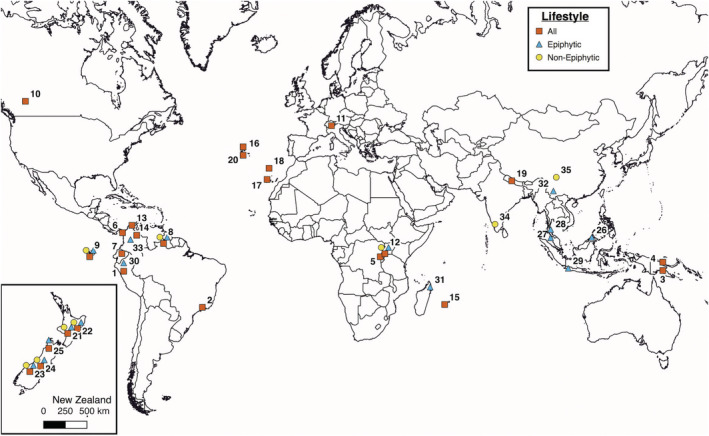
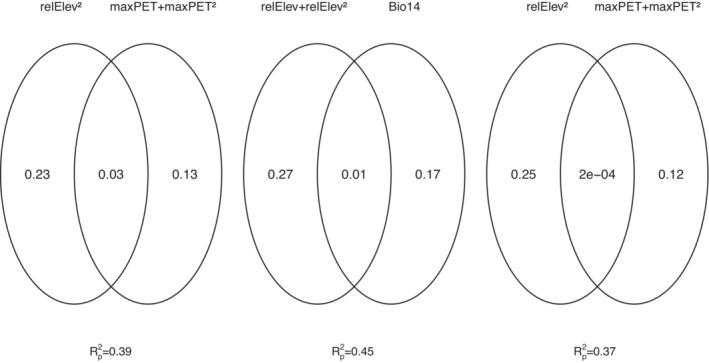
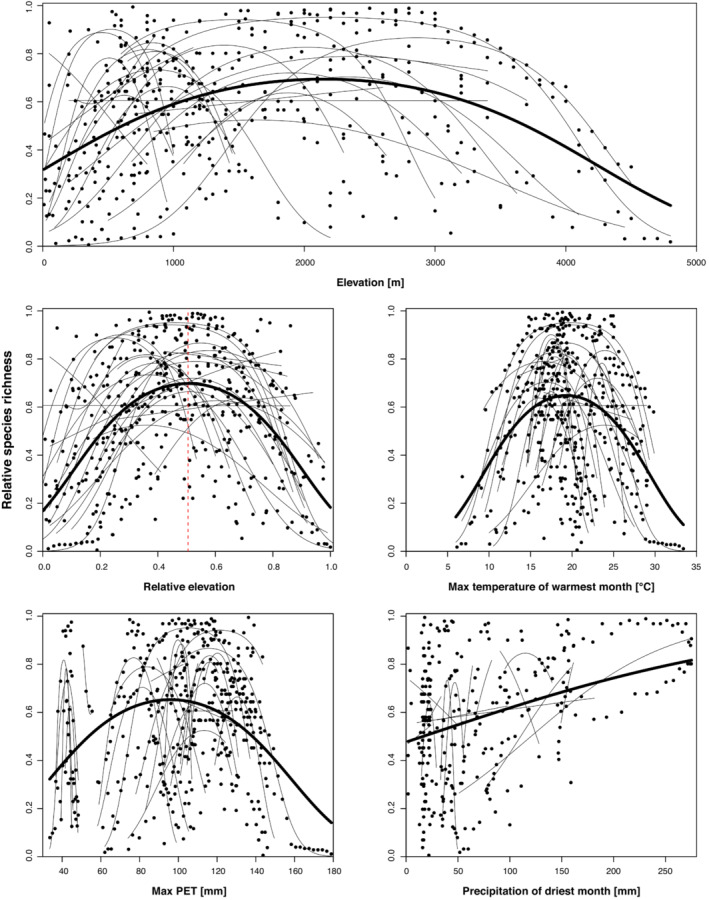
The study of elevational gradients allows to draw conclusions on the factors and mechanisms determining patterns in species richness distribution. Several earlier studies investigated liverwort diversity on single or few elevational transects. However, a comprehensive survey of the elevational distribution patterns of liverwort richness and their underlying factors is lacking so far. This study's purpose was to fill this gap by compiling an extensive data set of liverwort elevational patterns encompassing a broad diversity of mountains and mountain ranges around the world. Using polynomial regression analyses, we found a prevalence of hump-shaped richness patterns (19 of 25 gradients), where liverwort species richness peaked at mid-elevation and decreased towards both ends of the gradient. Against our expectation and unlike in other plant groups, in liverworts, this pattern also applies to elevational gradients at mid-latitudes in temperate climates. Indeed, relative elevation, calculated as the percentage of the elevational range potentially inhabited by liverworts, was the most powerful predictor for the distribution of liverwort species richness. We conclude from these results that the admixture of low- and high-elevation liverwort floras, in combination with steep ecological gradients, leads to a mid-elevation floristic turnover shaping elevational patterns of liverwort diversity. Our analyses further detected significant effects of climatic variables (temperature of the warmest month, potential evapotranspiration, and precipitation of the warmest month) in explaining elevational liverwort richness patterns. This indicates that montane liverwort diversity is restricted by high temperatures and subsequent low water availability especially towards lower elevations, which presumably will lead to serious effects by temperature shifts associated with global warming.
对海拔梯度的研究有助于就决定物种丰富度分布格局的因素和机制得出结论。早期的一些研究调查了单个或少数几个海拔样带上的叶苔多样性。然而,迄今为止,仍缺乏对叶苔丰富度的海拔分布格局及其潜在因素的全面调查。本研究的目的是通过汇编一个广泛的叶苔海拔格局数据集来填补这一空白,该数据集涵盖了世界各地多种多样的山脉。通过多项式回归分析,我们发现驼峰状丰富度格局普遍存在(25个梯度中有19个),即叶苔物种丰富度在海拔中部达到峰值,并向梯度两端递减。与我们的预期相反,与其他植物类群不同的是,在叶苔中,这种格局也适用于温带气候中纬度地区的海拔梯度。事实上,以叶苔可能栖息的海拔范围百分比计算的相对海拔,是叶苔物种丰富度分布最有力的预测因子。我们从这些结果中得出结论,低海拔和高海拔叶苔植物区系的混合,再加上陡峭的生态梯度,导致了海拔中部的植物区系更替,从而形成了叶苔多样性的海拔格局。我们的分析还发现气候变量(最暖月温度、潜在蒸散量和最暖月降水量)在解释叶苔海拔丰富度格局方面有显著影响。这表明山地叶苔多样性受到高温以及随之而来的低水分可用性的限制,特别是在较低海拔地区,这可能会因与全球变暖相关的温度变化而产生严重影响。