From Harvard Medical School, Harvard University, Boston, Mass (N.P.J., N.J.R.); Departments of Radiology (A.S., M.D.L., M.L., F.D., D.P.M., B.P.L., A.K.N., E.J.F.), Internal Medicine (E.P.H., C.M.D., J.R.B.), Infectious Diseases (E.P.H., C.M.D.), and Center for Equity and Inclusion (J.R.B.), Massachusetts General Hospital, 55 Fruit St, Boston, MA 02114.
Radiology. 2020 Dec;297(3):E303-E312. doi: 10.1148/radiol.2020202602. Epub 2020 Jul 16.
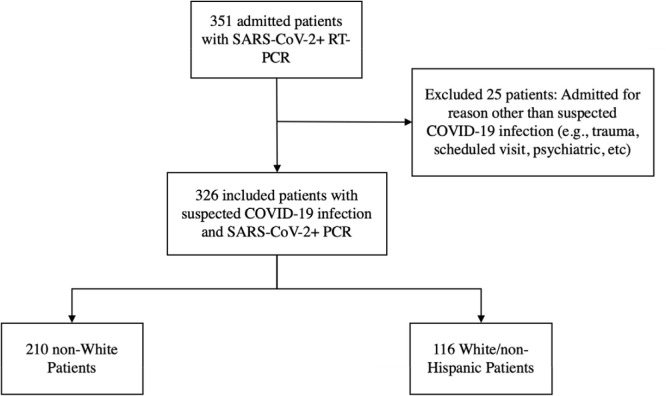
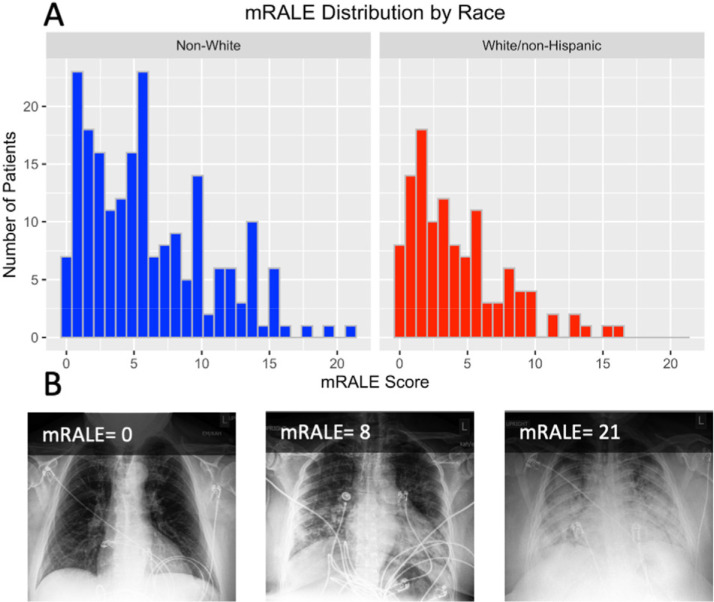
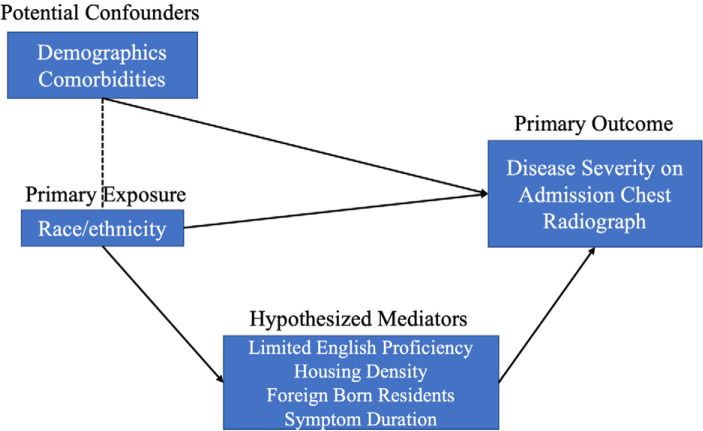
Background Disease severity on chest radiographs has been associated with higher risk of disease progression and adverse outcomes from coronavirus disease 2019 (COVID-19). Few studies have evaluated COVID-19-related racial and/or ethnic disparities in radiology. Purpose To evaluate whether non-White minority patients hospitalized with confirmed COVID-19 infection presented with increased severity on admission chest radiographs compared with White or non-Hispanic patients. Materials and Methods This single-institution retrospective cohort study was approved by the institutional review board. Patients hospitalized with confirmed COVID-19 infection between March 17, 2020, and April 10, 2020, were identified by using the electronic medical record ( = 326; mean age, 59 years ±17 [standard deviation]; male-to-female ratio: 188:138). The primary outcome was the severity of lung disease on admission chest radiographs, measured by using the modified Radiographic Assessment of Lung Edema (mRALE) score. The secondary outcome was a composite adverse clinical outcome of intubation, intensive care unit admission, or death. The primary exposure was the racial and/or ethnic category: White or non-Hispanic versus non-White (ie, Hispanic, Black, Asian, or other). Multivariable linear regression analyses were performed to evaluate the association between mRALE scores and race and/or ethnicity. Results Non-White patients had significantly higher mRALE scores (median score, 6.1; 95% confidence interval [CI]: 5.4, 6.7) compared with White or non-Hispanic patients (median score, 4.2; 95% CI: 3.6, 4.9) (unadjusted average difference, 1.8; 95% CI: 0.9, 2.8; < .01). For both White (adjusted hazard ratio, 1.3; 95% CI: 1.2, 1.4; < .001) and non-White (adjusted hazard ratio, 1.2; 95% CI: 1.1, 1.3; < .001) patients, increasing mRALE scores were associated with a higher likelihood of experiencing composite adverse outcome with no evidence of interaction ( = .16). Multivariable linear regression analyses demonstrated that non-White patients presented with higher mRALE scores at admission chest radiography compared with White or non-Hispanic patients (adjusted average difference, 1.6; 95% CI: 0.5, 2.7; < .01). Adjustment for hypothesized mediators revealed that the association between race and/or ethnicity and mRALE scores was mediated by limited English proficiency ( < .01). Conclusion Non-White patients hospitalized with coronavirus disease 2019 infection were more likely to have a higher severity of disease on admission chest radiographs than White or non-Hispanic patients, and increased severity was associated with worse outcomes for all patients. © RSNA, 2020
背景 胸部 X 线片上的疾病严重程度与 2019 年冠状病毒病(COVID-19)的疾病进展和不良结局风险增加相关。很少有研究评估 COVID-19 相关的种族和/或民族差异在放射学方面的差异。目的 评估与白人或非西班牙裔患者相比,因确诊 COVID-19 感染住院的非白人少数民族患者入院时的胸部 X 线片上的疾病严重程度是否增加。材料与方法 这项单机构回顾性队列研究得到了机构审查委员会的批准。通过电子病历确定 2020 年 3 月 17 日至 4 月 10 日期间因确诊 COVID-19 感染住院的患者(=326;平均年龄 59 岁±17[标准差];男对女比例:188:138)。主要结局是入院时的肺部疾病严重程度,通过改良放射学肺水肿评估(mRALE)评分来衡量。次要结局是插管、入住重症监护病房或死亡的复合不良临床结局。主要暴露因素是种族和/或民族类别:白人或非西班牙裔与非白人(即西班牙裔、黑人、亚洲人或其他)。采用多变量线性回归分析评估 mRALE 评分与种族和/或民族之间的关系。结果 与白人或非西班牙裔患者(中位数评分 4.2;95%置信区间[CI]:3.6,4.9)相比,非白人患者的 mRALE 评分明显更高(中位数评分 6.1;95%CI:5.4,6.7)(未校正平均差异 1.8;95%CI:0.9,2.8;<.01)。对于白人(调整后的危险比,1.3;95%CI:1.2,1.4;<.001)和非白人(调整后的危险比,1.2;95%CI:1.1,1.3;<.001)患者,mRALE 评分的增加与复合不良结局的发生几率更高相关,且无交互作用的证据(=0.16)。多变量线性回归分析表明,与白人或非西班牙裔患者相比,非白人患者入院时的 mRALE 评分更高(校正平均差异 1.6;95%CI:0.5,2.7;<.01)。对假设性中介因素的调整表明,种族和/或民族与 mRALE 评分之间的关系受到英语水平有限的影响(<.01)。结论 与白人或非西班牙裔患者相比,因 COVID-19 感染住院的非白人患者入院时胸部 X 线片上的疾病严重程度更高,且严重程度的增加与所有患者的预后更差相关。