Hermann Julia, Bender Melanie, Schumacher Dagmar, Woo Marcel S, Shaposhnykov Artem, Rosenkranz Sina C, Kuryshev Vladimir, Meier Chris, Guse Andreas H, Friese Manuel A, Freichel Marc, Tsvilovskyy Volodymyr
Institute of Pharmacology, Heidelberg University, Heidelberg, Germany.
DZHK (German Centre for Cardiovascular Research), Partner Site Heidelberg/Mannheim, Heidelberg, Germany.
Front Cell Dev Biol. 2020 Jun 25;8:496. doi: 10.3389/fcell.2020.00496. eCollection 2020.
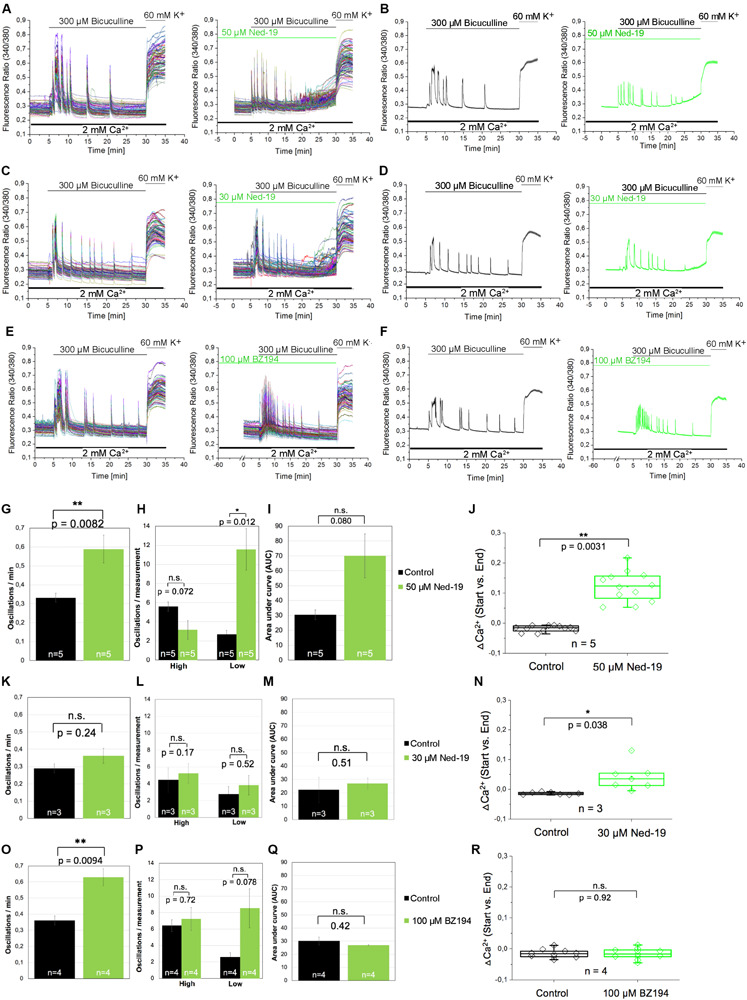
Nicotinic acid adenine dinucleotide phosphate (NAADP) is a second messenger that evokes calcium release from intracellular organelles by the engagement of calcium release channels, including members of the Transient Receptor Potential (TRP) family, such as TRPML1, the (structurally) related Two Pore Channel type 1 (TPC1) and TPC2 channels as well as Ryanodine Receptors type 1 (RYR1; Guse, 2012). NAADP evokes calcium release from acidic calcium stores of many cell types (Guse, 2012), and NAADP-sensitive Ca stores have been described in hippocampal neurons of the rat (Bak et al., 1999; McGuinness et al., 2007). Glutamate triggers Ca-mediated neuronal excitotoxicity in inflammation-induced neurodegenerative pathologies such as Multiple Sclerosis (MS; Friese et al., 2014), and when applied extracellularly to neurons glutamate can elevate NAADP levels in these cells. Accordingly, glutamate-evoked Ca signals from intracellular organelles were inhibited by preventing organelle acidification (Pandey et al., 2009). Analysis of reported RNA sequencing experiments of cultured hippocampal neurons revealed the abundance of Mcoln1 (encoding TRPML1), Tpcn1, and Tpcn2 (encoding TPC1 and TPC2, respectively) as potential NAADP target channels in these cells. Transcripts encoding Ryr1 were not found in contrast to Ryr2 and Ryr3. To study the contribution of NAADP signaling to glutamate-evoked calcium transients in murine hippocampal neurons we used the NAADP antagonists Ned-19 (Naylor et al., 2009) and BZ194 (Dammermann et al., 2009). Our results show that both NAADP antagonists significantly reduce glutamate-evoked calcium transients. In addition to extracellular glutamate application, we studied synchronized calcium oscillations in the cells of the neuronal cultures evoked by addition of the GABA receptor antagonist bicuculline. Pretreatment with Ned-19 (50 μM) or BZ194 (100 μM) led to an increase in the frequency of bicuculline-induced calcium oscillations at the cost of calcium transient amplitudes. Interestingly, Ned-19 triggered a rise in intracellular calcium concentrations 25 min after bicuculline stimulation, leading to the question whether NAADP acts as a neuroprotective messenger in hippocampal neurons. Taken together, our results are in agreement with the concept that NAADP signaling significantly contributes to glutamate evoked Ca rise in hippocampal neurons and to the amplitude and frequency of synchronized Ca oscillations triggered by spontaneous glutamate release events.
烟酰胺腺嘌呤二核苷酸磷酸(NAADP)是一种第二信使,它通过激活钙释放通道,包括瞬时受体电位(TRP)家族的成员,如TRPML1、结构相关的双孔通道1型(TPC1)和TPC2通道以及1型兰尼碱受体(RYR1;Guse,2012年),引发细胞内细胞器释放钙。NAADP可引发多种细胞类型酸性钙库释放钙(Guse,2012年),并且在大鼠海马神经元中已描述了对NAADP敏感的钙库(Bak等人,1999年;McGuinness等人,2007年)。在炎症诱导的神经退行性疾病如多发性硬化症(MS;Friese等人,2014年)中,谷氨酸会引发钙介导的神经元兴奋毒性,当将谷氨酸细胞外施加到神经元时,它可提高这些细胞中的NAADP水平。因此,通过阻止细胞器酸化可抑制谷氨酸从细胞内细胞器引发的钙信号(Pandey等人,2009年)。对培养的海马神经元已报道的RNA测序实验分析显示,Mcoln1(编码TRPML1)、Tpcn1和Tpcn2(分别编码TPC1和TPC2)在这些细胞中作为潜在的NAADP靶通道丰度较高。与Ryr2和Ryr3相反,未发现编码Ryr1的转录本。为了研究NAADP信号传导对小鼠海马神经元中谷氨酸引发的钙瞬变的作用,我们使用了NAADP拮抗剂Ned - 19(Naylor等人,2009年)和BZ194(Dammermann等人,2009年)。我们的结果表明,两种NAADP拮抗剂均显著降低谷氨酸引发的钙瞬变。除了细胞外施加谷氨酸外,我们还研究了添加GABA受体拮抗剂荷包牡丹碱后神经元培养物细胞中同步的钙振荡。用Ned - 19(50μM)或BZ194(100μM)预处理导致荷包牡丹碱诱导的钙振荡频率增加,但以钙瞬变幅度为代价。有趣的是,Ned - 19在荷包牡丹碱刺激后25分钟引发细胞内钙浓度升高,这引发了一个问题,即NAADP是否在海马神经元中作为神经保护信使起作用。综上所述,我们的结果与以下概念一致,即NAADP信号传导对海马神经元中谷氨酸引发的钙升高以及由自发谷氨酸释放事件触发的同步钙振荡的幅度和频率有显著贡献。