Melero Roberto, Sorzano Carlos Oscar S, Foster Brent, Vilas José-Luis, Martínez Marta, Marabini Roberto, Ramírez-Aportela Erney, Sanchez-Garcia Ruben, Herreros David, Del Caño Laura, Losana Patricia, Fonseca-Reyna Yunior C, Conesa Pablo, Wrapp Daniel, Chacon Pablo, McLellan Jason S, Tagare Hemant D, Carazo Jose-Maria
Centro Nacional de Biotecnologia-CSIC, C/ Darwin, 3, 28049, Cantoblanco, Madrid, Spain.
Dept. of Radiology and Biomedical Imaging, Yale University, New Haven, CT 06520, USA.
bioRxiv. 2020 Jul 8:2020.07.08.191072. doi: 10.1101/2020.07.08.191072.
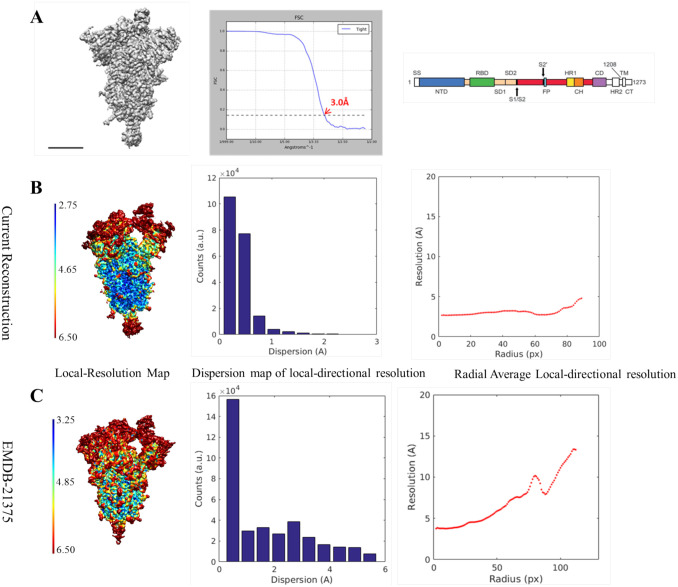
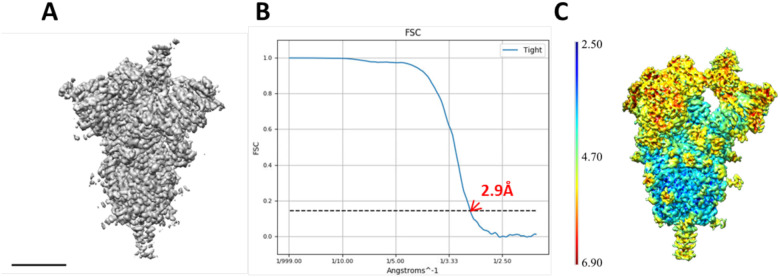
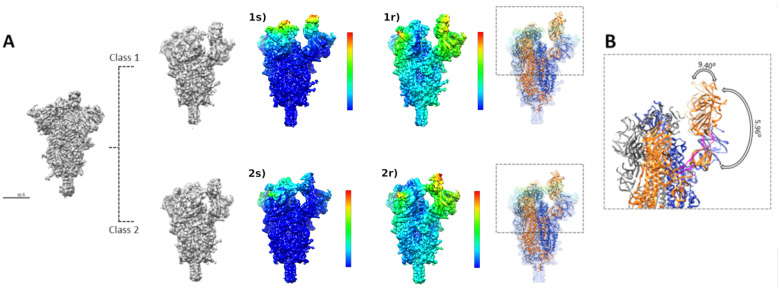
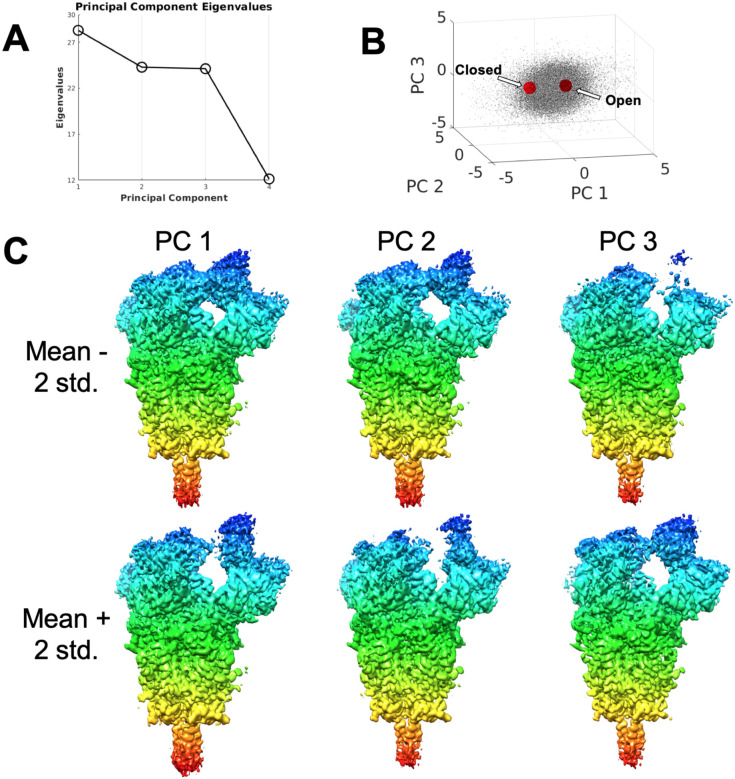
With the help of novel processing workflows and algorithms, we have obtained a better understanding of the flexibility and conformational dynamics of the SARS-CoV-2 spike in the prefusion state. We have re-analyzed previous cryo-EM data combining 3D clustering approaches with ways to explore a continuous flexibility space based on 3D Principal Component Analysis. These advanced analyses revealed a concerted motion involving the receptor-binding domain (RBD), N-terminal domain (NTD), and subdomain 1 and 2 (SD1 & SD2) around the previously characterized 1-RBD-up state, which have been modeled as elastic deformations. We show that in this dataset there are not well-defined, stable, spike conformations, but virtually a continuum of states moving in a concerted fashion. We obtained an improved resolution ensemble map with minimum bias, from which we model by flexible fitting the extremes of the change along the direction of maximal variance. Moreover, a high-resolution structure of a recently described biochemically stabilized form of the spike is shown to greatly reduce the dynamics observed for the wild-type spike. Our results provide new detailed avenues to potentially restrain the spike dynamics for structure-based drug and vaccine design and at the same time give a warning of the potential image processing classification instability of these complicated datasets, having a direct impact on the interpretability of the results.
借助新颖的处理流程和算法,我们对严重急性呼吸综合征冠状病毒2(SARS-CoV-2)刺突蛋白在融合前状态下的灵活性和构象动力学有了更深入的了解。我们重新分析了先前的冷冻电镜数据,将三维聚类方法与基于三维主成分分析探索连续灵活性空间的方法相结合。这些先进的分析揭示了一种协同运动,涉及受体结合结构域(RBD)、N端结构域(NTD)以及围绕先前表征的1-RBD向上状态的亚结构域1和2(SD1和SD2),这些已被建模为弹性变形。我们表明,在该数据集中不存在明确、稳定的刺突蛋白构象,而是实际上存在一系列以协同方式移动的连续状态。我们获得了具有最小偏差的改进分辨率总体图谱,从中通过灵活拟合沿最大方差方向变化的极值进行建模。此外,最近描述的一种生物化学稳定形式的刺突蛋白的高分辨率结构显示,其大大降低了野生型刺突蛋白所观察到的动力学。我们的结果为基于结构的药物和疫苗设计提供了潜在限制刺突蛋白动力学的新详细途径,同时也对这些复杂数据集的潜在图像处理分类不稳定性发出了警告,这对结果的可解释性有直接影响。