State Key Lab of Crop Biology, Tai'an, Shandong Province, China.
College of Agronomy, Shandong Agricultural University, Tai'an, Shandong Province, China.
BMC Plant Biol. 2020 Jul 17;20(1):339. doi: 10.1186/s12870-020-02516-y.
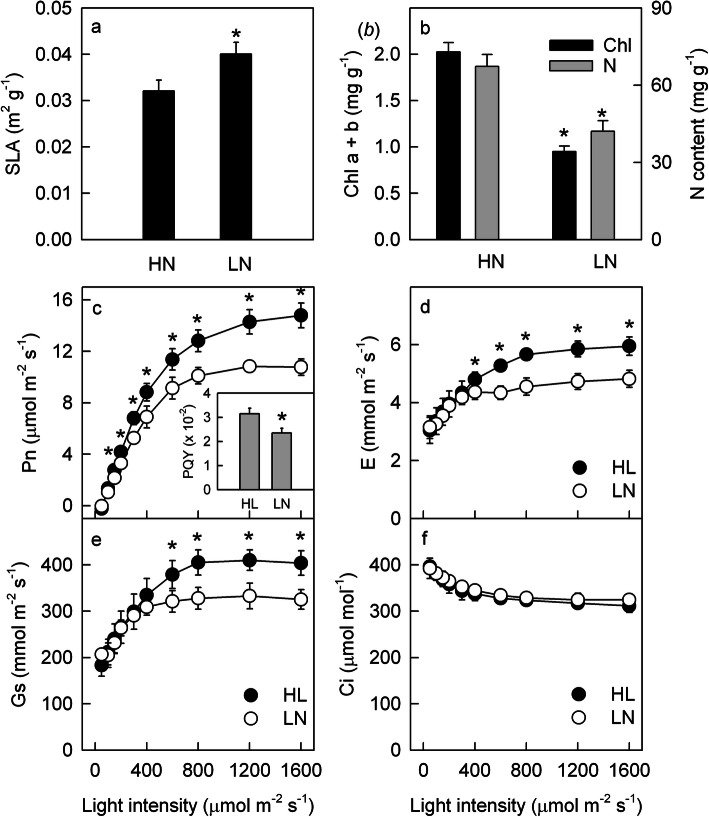
Plants are always exposed to dynamic light. The photosynthetic light use efficiency of leaves is lower in dynamic light than in uniform irradiance. Research on the influence of environmental factors on dynamic photosynthesis is very limited. Nitrogen is critical for plants, especially for photosynthesis. Low nitrogen (LN) decreases ribulose-1,5-bisphosphate carboxylase/oxygenase (Rubisco) and thus limits photosynthesis. The decrease in Rubisco also delays photosynthetic induction in LN leaves; therefore, we hypothesized that the difference of photosynthetic CO fixation between uniform and dynamic light will be greater in LN leaves compared to leaves with sufficient nitrogen supply.
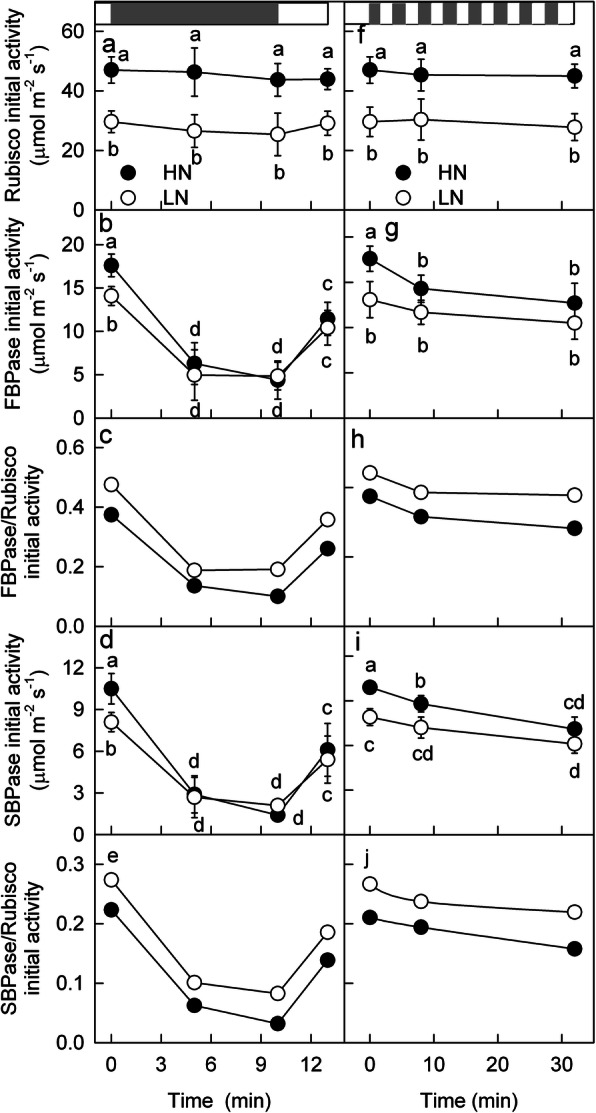
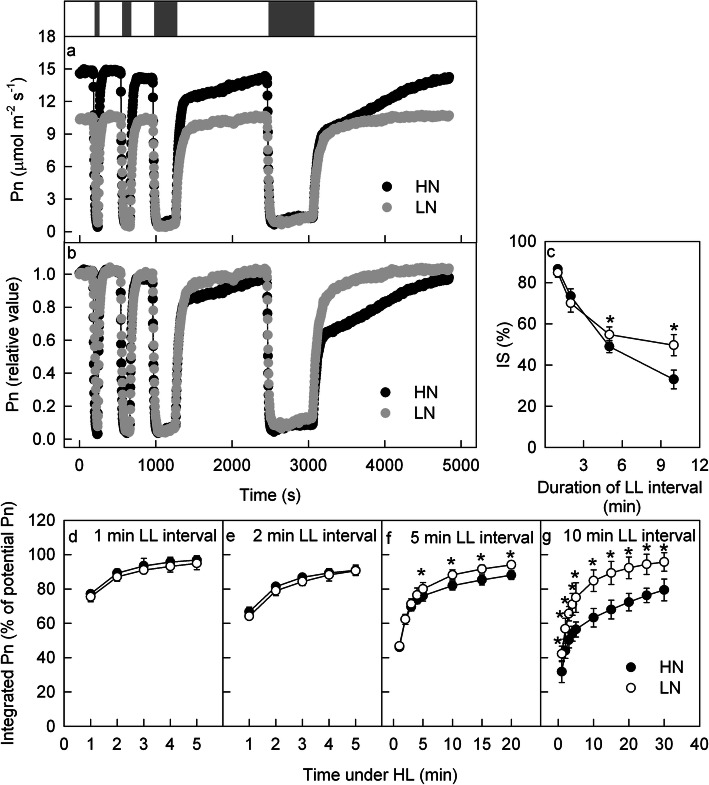
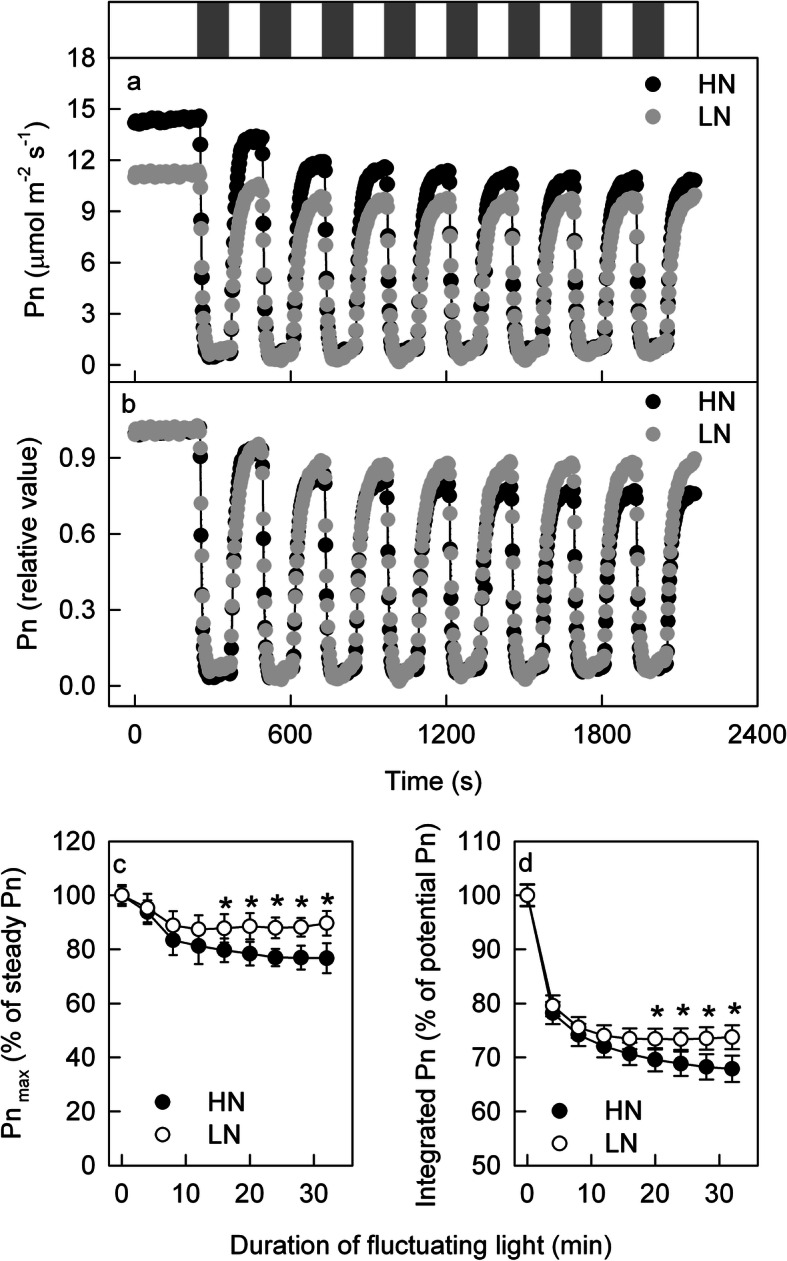
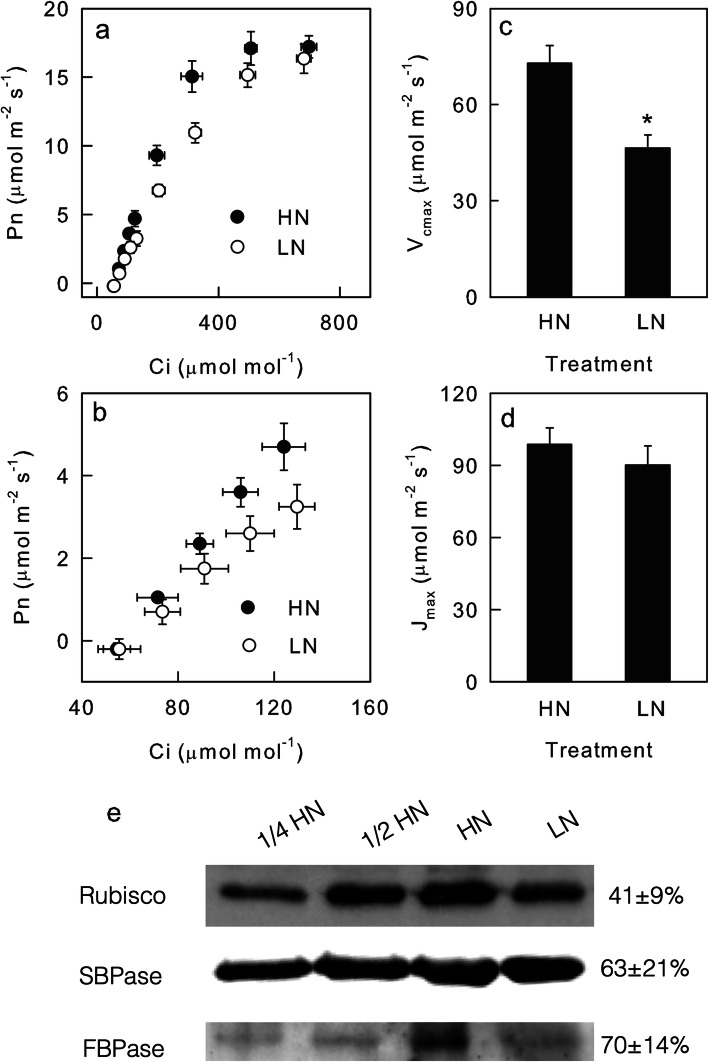
To test this hypothesis, soybean plants were grown under low or high nitrogen (HN), and the photosynthetic gas exchange, enzyme activity and protein amount in leaves were measured under uniform and dynamic light. Unexpectedly, dynamic light caused less photosynthetic suppression, rather than more, in LN leaves than in HN leaves. The underlying mechanism was also clarified. Short low-light (LL) intervals did not affect Rubisco activity but clearly deactivated fructose-1,6-bisphosphatase (FBPase) and sedoheptulose-1,7-bisphosphatase (SBPase), indicating that photosynthetic induction after a LL interval depends on the reactivation of FBPase and SBPase rather than Rubisco. In LN leaves, the amount of Rubisco decreased more than FBPase and SBPase, so FBPase and SBPase were present in relative excess. A lower fraction of FBPase and SBPase needs to be activated in LN leaves for photosynthesis recovery during the high-light phase of dynamic light. Therefore, photosynthetic recovery is faster in LN leaves than in HN leaves, which relieves the photosynthetic suppression caused by dynamic light in LN leaves.
Contrary to our expectations, dynamic light caused less photosynthetic suppression, rather than more, in LN leaves than in HN leaves of soybean. This is the first report of a stress condition alleviating the photosynthetic suppression caused by dynamic light.
植物总是暴露在动态光下。与均匀辐照度相比,叶片的光合作用光利用效率在动态光下较低。关于环境因素对动态光合作用影响的研究非常有限。氮对植物至关重要,特别是对光合作用。低氮(LN)会降低核酮糖-1,5-二磷酸羧化酶/加氧酶(Rubisco),从而限制光合作用。Rubisco 的减少也会延迟 LN 叶片光合作用的诱导;因此,我们假设与氮供应充足的叶片相比,均匀光和动态光下的光合作用 CO2 固定的差异在 LN 叶片中会更大。
为了检验这一假设,我们在低氮(HN)或高氮(HN)下种植大豆植株,并在均匀光和动态光下测量叶片的光合作用气体交换、酶活性和蛋白含量。出乎意料的是,动态光在 LN 叶片中引起的光合作用抑制作用比在 HN 叶片中要小,而不是更大。其潜在机制也得到了阐明。短暂的低光(LL)间隔不会影响 Rubisco 活性,但会明显使果糖-1,6-二磷酸酶(FBPase)和 sedoheptulose-1,7-二磷酸酶(SBPase)失活,这表明 LL 间隔后的光合作用诱导取决于 FBPase 和 SBPase 的再激活,而不是 Rubisco。在 LN 叶片中,Rubisco 的量减少得比 FBPase 和 SBPase 更多,因此 FBPase 和 SBPase 相对过剩。在 LN 叶片中,光合作用恢复期间,动态光高光相需要激活的 FBPase 和 SBPase 比例较低。因此,LN 叶片中的光合作用恢复速度比 HN 叶片更快,从而缓解了 LN 叶片中动态光引起的光合作用抑制。
与我们的预期相反,动态光在 LN 叶片中引起的光合作用抑制作用比在 HN 叶片中要小,而不是更大。这是首次报道应激条件缓解动态光引起的光合作用抑制作用。