Department of Pulmonology, Renji Hospital South Campus, Shanghai Jiaotong University School of Medicine, Shanghai, People's Republic of China.
Department of Rheumatology, Renji Hospital South Campus, Shanghai Jiaotong University School of Medicine, Shanghai, People's Republic of China.
BMC Pulm Med. 2020 Jul 17;20(1):196. doi: 10.1186/s12890-020-01226-3.
Dermatomyositis (DM) is a systemic autoimmune inflammatory disorder that affects primarily skin, muscle and lung, frequently associated with interstitial lung disease (ILD). The objective of this study is to investigate the association between serum cytokines and clinical severity in patients with DM-ILD.
Serum samples of 30 healthy controls, 14 DM patients without ILD and 40 DM patients with ILD were collected. Serum S100A8/A9 levels were analyzed by enzyme-linked immunosorbent assay (ELISA) and levels of interleukins were measured by cytometric beads array (CBA). Then we performed multivariate logistic regression analysis to determine factors independently associated with ILD development.
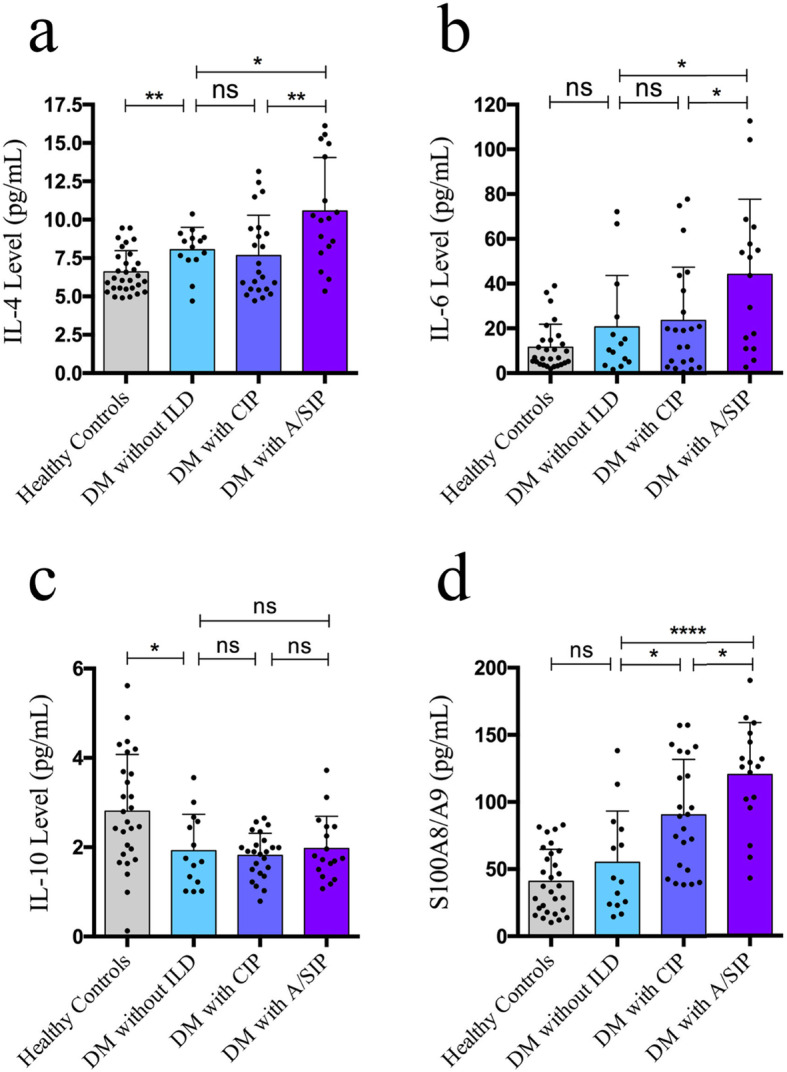
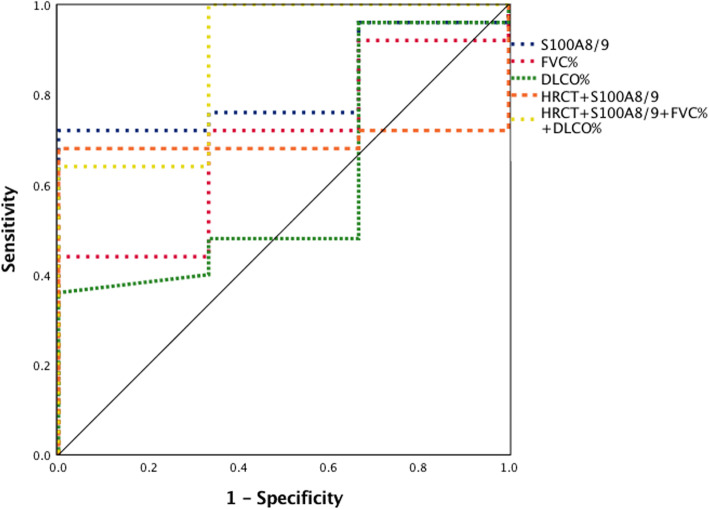
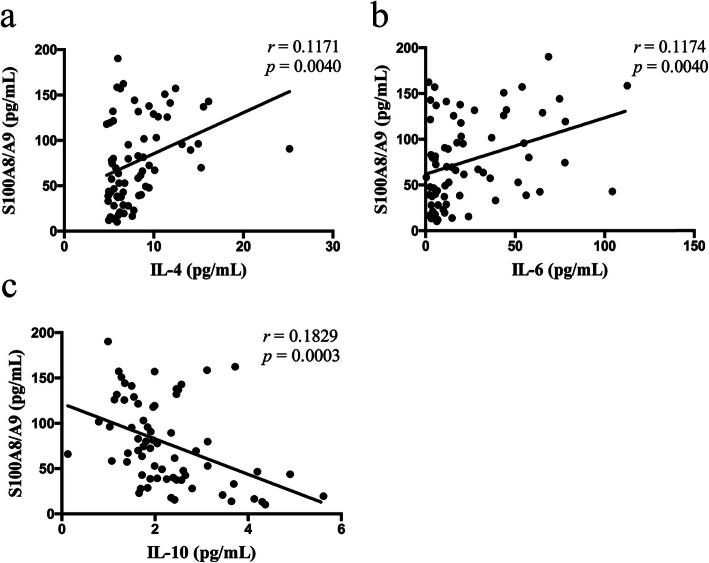
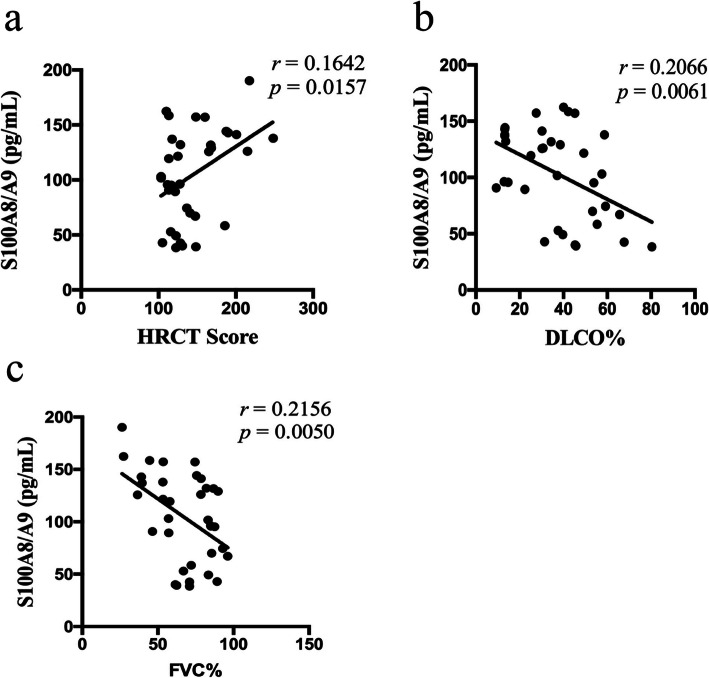
Serum IL-4, IL-6 and S100A8/A9 levels were significantly higher in DM patients with ILD than those in healthy controls (p = 0.0013, 0.0017 and < 0.0001, respectively). Serum IL-10 level of patients was dramatically lower than that in controls (p = 0.0001). In DM patients, the levels were significantly higher in patients with A/SIP than in those with CIP (p = 0.0046, 0.0339 and 0.0133) or without ILD (p = 0.0165, 0.0370 and < 0.0001). IL-4 (r = 0.1171, p = 0.0040), IL-6 (r = 0.1174, p = 0.0040) and IL-10 (r = - 0.1829, p = 0.0003) were significantly correlated with S100A8/A9 in DM-ILD patients. S100A8/A9 was significantly correlated with high-resolution computed tomography (HRCT) (r = 0.1642, p = 0.0157) and lung function (DLCO%: r = - 0.2066, p = 0.0061, FVC%: r = - 0.2156, p = 0.0050). Moreover, logistic regression analysis revealed that S100A8/A9 levels were independently associated with ILD development in DM patients (p = 0.004).
Serum level of S100A8/A9 may be a valuable predictor for assessing the clinical severity of DM-ILD patients. Serum IL-4, IL-6 and IL-10 levels were highly correlated with S100A8/A9, so these cytokines may play a synergistic effect on the progression of DM-ILD.
皮肌炎(DM)是一种主要影响皮肤、肌肉和肺部的系统性自身免疫性炎症性疾病,常伴有间质性肺病(ILD)。本研究旨在探讨 DM-ILD 患者血清细胞因子与临床严重程度的关系。
收集 30 名健康对照者、14 名无 ILD 的 DM 患者和 40 名有 ILD 的 DM 患者的血清样本。采用酶联免疫吸附试验(ELISA)检测血清 S100A8/A9 水平,采用流式细胞术珠阵列(CBA)检测白细胞介素水平。然后,我们进行多变量逻辑回归分析,以确定与 ILD 发展相关的独立因素。
与健康对照组相比,DM-ILD 患者的血清 IL-4、IL-6 和 S100A8/A9 水平明显升高(p=0.0013、0.0017 和 <0.0001)。DM 患者的血清 IL-10 水平明显低于对照组(p=0.0001)。在 DM 患者中,A/SIP 患者的水平明显高于 CIP 患者(p=0.0046、0.0339 和 0.0133)或无 ILD 患者(p=0.0165、0.0370 和 <0.0001)。IL-4(r=0.1171,p=0.0040)、IL-6(r=0.1174,p=0.0040)和 IL-10(r=−0.1829,p=0.0003)与 DM-ILD 患者的 S100A8/A9 呈显著相关。S100A8/A9 与高分辨率计算机断层扫描(HRCT)(r=0.1642,p=0.0157)和肺功能(DLCO%:r=−0.2066,p=0.0061,FVC%:r=−0.2156,p=0.0050)显著相关。此外,逻辑回归分析显示,S100A8/A9 水平与 DM 患者 ILD 的发生独立相关(p=0.004)。
血清 S100A8/A9 水平可能是评估 DM-ILD 患者临床严重程度的有价值指标。血清 IL-4、IL-6 和 IL-10 水平与 S100A8/A9 高度相关,因此这些细胞因子可能对 DM-ILD 的进展具有协同作用。