Guloksuz Selin Aktan, Abali Osman, Aktas Cetin Esin, Bilgic Gazioglu Sema, Deniz Gunnur, Yildirim Abdurrahman, Kawikova Ivana, Guloksuz Sinan, Leckman James F
Child Study Center, School of Medicine, Yale University, New Haven, CT, USA.
Department of Child and Adolescent Psychiatry, Istanbul University School of Medicine, Istanbul, Turkey.
Braz J Psychiatry. 2017 Jul-Sep;39(3):195-200. doi: 10.1590/1516-4446-2015-1843. Epub 2017 Jan 12.
: To investigate plasma concentrations of S100B (a calcium-binding protein derived primarily from the glia) and inflammatory cytokines in children with autism and the relationship between S100B and cytokine concentrations.
: Plasma levels of S100B, tumor necrosis factor alpha (TNF-α), interferon gamma, interleukin (IL)-1β, IL-4, IL-6, IL-10, and IL-17A were measured in 40 unmedicated children with autism and 35 normally developing healthy children. The severity of autism was assessed using the Childhood Autism Rating Scale (CARS).
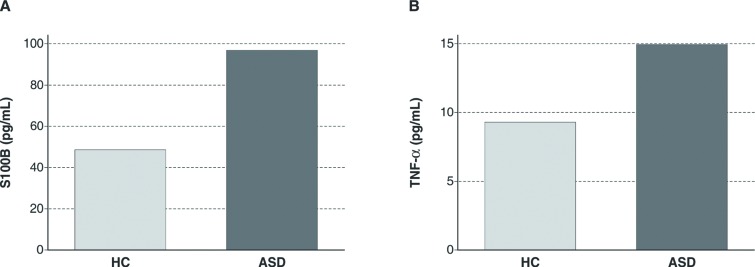
: Concentrations of both S100B and TNF-α were higher in children with autism before and after adjusting for a priori-selected confounders (age, sex, and body mass index). S100B concentrations were higher in children with severe autism compared to children with mild-moderate autism. However, this association remained as a trend after adjusting for confounders. S100B concentrations correlated positively with TNF-α concentrations.
: Our findings showing an increase in peripheral concentrations of S100B and TNF-α provide limited support to the hypothesis about the roles of altered immune function and S100B in autism spectrum disorder (ASD). Studies of larger numbers of well-characterized individuals with ASD are needed to clarify the potential role of the immune system in the pathophysiology of this disorder.
研究自闭症儿童血浆中S100B(一种主要来源于神经胶质细胞的钙结合蛋白)和炎性细胞因子的浓度,以及S100B与细胞因子浓度之间的关系。
检测40例未接受药物治疗的自闭症儿童和35例正常发育的健康儿童血浆中S100B、肿瘤坏死因子α(TNF-α)、干扰素γ、白细胞介素(IL)-1β、IL-4、IL-6、IL-10和IL-17A的水平。使用儿童自闭症评定量表(CARS)评估自闭症的严重程度。
在对预先选定的混杂因素(年龄、性别和体重指数)进行调整前后,自闭症儿童的S100B和TNF-α浓度均较高。与轻度至中度自闭症儿童相比,重度自闭症儿童的S100B浓度更高。然而,在调整混杂因素后,这种关联仍呈趋势。S100B浓度与TNF-α浓度呈正相关。
我们的研究结果显示S100B和TNF-α外周浓度升高,这为免疫功能改变和S100B在自闭症谱系障碍(ASD)中的作用假说提供了有限的支持。需要对更多特征明确的ASD个体进行研究,以阐明免疫系统在该疾病病理生理学中的潜在作用。