Department of Ecology and Genetics, PO Box 3000, Fi-90014 University of Oulu, Finland
Department of Ecology and Evolutionary Biology, Cornell University, Ithaca, New York 14853.
G3 (Bethesda). 2020 Sep 2;10(9):3061-3070. doi: 10.1534/g3.120.400886.
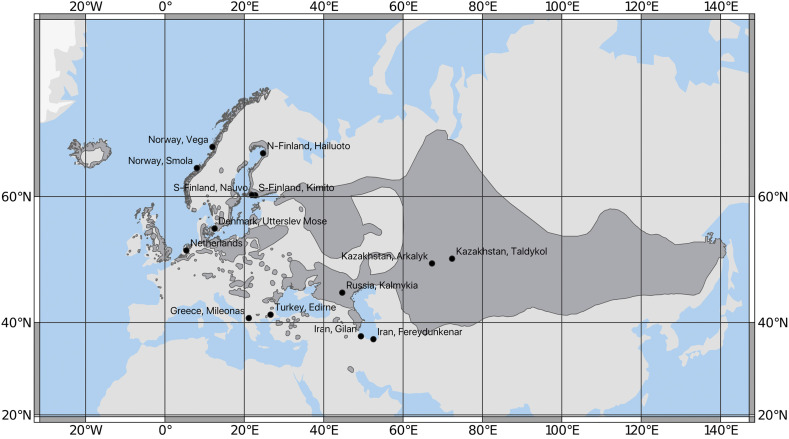
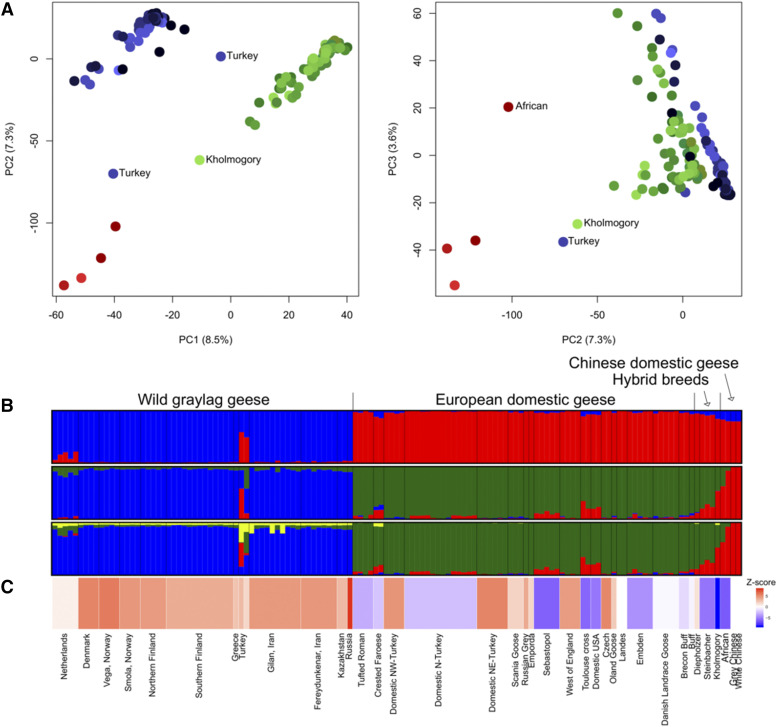
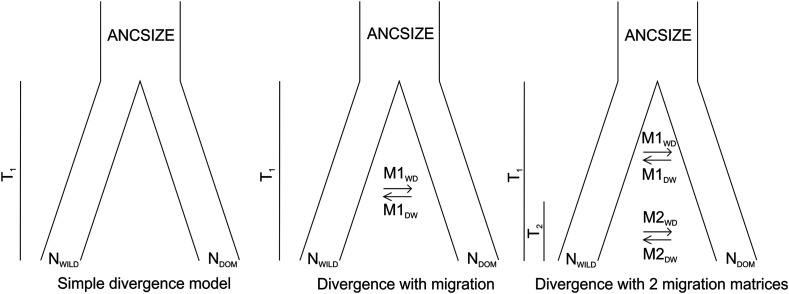
Hybridization has frequently been observed between wild and domestic species and can substantially impact genetic diversity of both counterparts. Geese show some of the highest levels of interspecific hybridization across all bird orders, and two of the goose species in the genus have been domesticated providing an excellent opportunity for a joint study of domestication and hybridization. Until now, knowledge of the details of the goose domestication process has come from archaeological findings and historical writings supplemented with a few studies based on mitochondrial DNA. Here, we used genome-wide markers to make the first genome-based inference of the timing of European goose domestication. We also analyzed the impact of hybridization on the genome-wide genetic variation in current populations of the European domestic goose and its wild progenitor: the graylag goose (). Our dataset consisted of 58 wild graylags sampled around Eurasia and 75 domestic geese representing 14 breeds genotyped for 33,527 single nucleotide polymorphisms. Demographic reconstruction and clustering analysis suggested that divergence between wild and domestic geese around 5,300 generations ago was followed by long-term genetic exchange, and that graylag populations have 3.2-58.0% admixture proportions with domestic geese, with distinct geographic patterns. Surprisingly, many modern European breeds share considerable (> 10%) ancestry with the Chinese domestic geese that is derived from the swan goose We show that the domestication process can progress despite continued and pervasive gene flow from the wild form.
杂交在野生和家养物种之间经常观察到,并且可以显著影响两者的遗传多样性。鹅在所有鸟类目中表现出最高水平的种间杂交,而该属的两个鹅种已经被驯化,为研究驯化和杂交提供了极好的机会。到目前为止,关于鹅驯化过程的详细信息来自考古发现和历史著作,辅以少数基于线粒体 DNA 的研究。在这里,我们使用全基因组标记对欧洲鹅的驯化时间进行了首次基于基因组的推断。我们还分析了杂交对当前欧洲家养鹅及其野生祖先(灰雁)的全基因组遗传变异的影响。我们的数据集包括欧亚大陆周围采集的 58 只野生灰雁和代表 14 个品种的 75 只家养鹅,这些鹅共对 33527 个单核苷酸多态性进行了基因分型。人口重建和聚类分析表明,大约 5300 代前,野生和家养鹅之间的分化之后是长期的遗传交流,灰雁种群与家养鹅的混合比例为 3.2-58.0%,具有明显的地理模式。令人惊讶的是,许多现代欧洲品种与中国家养鹅有相当大的(>10%)亲缘关系,而中国家养鹅则来自鸿雁。我们表明,即使有来自野生型的持续和普遍的基因流,驯化过程也可以进行。