St. Michael's Hospital, Toronto, Canada.
Centre Hospitalier de l'Université de Montréal, Montréal, Canada.
Am J Kidney Dis. 2020 Nov;76(5):690-695.e1. doi: 10.1053/j.ajkd.2020.07.001. Epub 2020 Jul 15.
RATIONALE & OBJECTIVE: Hemodialysis patients are at increased risk for coronavirus disease 2019 (COVID-19) transmission due in part to difficulty maintaining physical distancing. Our hemodialysis unit experienced a COVID-19 outbreak despite following symptom-based screening guidelines. We describe the course of the COVID-19 outbreak and the infection control measures taken for mitigation.
Retrospective cohort study.
SETTING & PARTICIPANTS: 237 maintenance hemodialysis patients and 93 hemodialysis staff at a single hemodialysis center in Toronto, Canada.
Universal screening of patients and staff for severe acute respiratory syndrome coronavirus 2 (SARS-CoV-2).
The primary outcome was detection of SARS-CoV-2 in nasopharyngeal samples from patients and staff using reverse transcriptase-polymerase chain reaction (RT-PCR).
Descriptive statistics were used for clinical characteristics and the primary outcome.
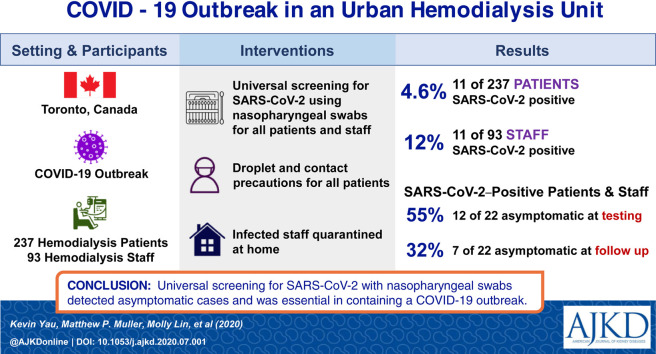
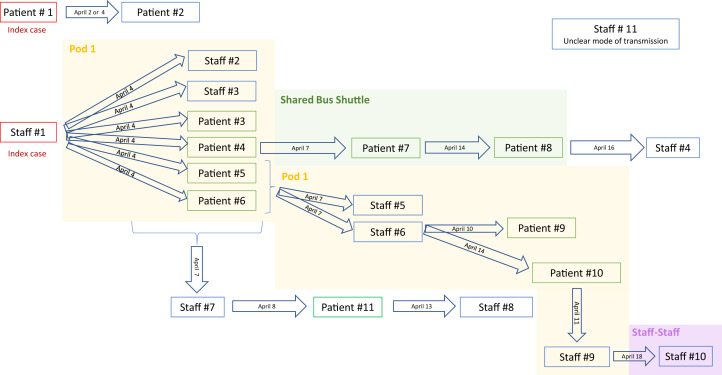
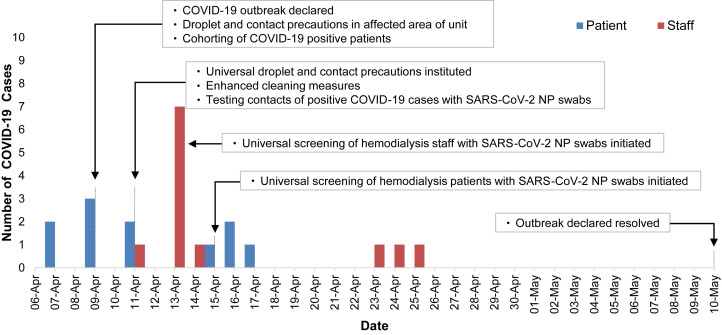
11 of 237 (4.6%) hemodialysis patients and 11 of 93 (12%) staff members had a positive RT-PCR test result for SARS-CoV-2. Among individuals testing positive, 12 of 22 (55%) were asymptomatic at time of testing and 7 of 22 (32%) were asymptomatic for the duration of follow-up. One patient was hospitalized at the time of SARS-CoV-2 infection and 4 additional patients with positive test results were subsequently hospitalized. 2 (18%) patients required admission to the intensive care unit. After 30 days' follow-up, no patients had died or required mechanical ventilation. No hemodialysis staff required hospitalization. Universal droplet and contact precautions were implemented during the outbreak. Hemodialysis staff with SARS-CoV-2 infection were placed on home quarantine regardless of symptom status. Patients with SARS-CoV-2 infection, including asymptomatic individuals, were treated with droplet and contact precautions until confirmation of negative SARS-CoV-2 RT-PCR test results. Analysis of the outbreak identified 2 index cases with subsequent nosocomial transmission within the dialysis unit and in shared shuttle buses to the hemodialysis unit.
Single-center study.
Universal SARS-CoV-2 testing and universal droplet and contact precautions in the setting of an outbreak appeared to be effective in preventing further transmission.
由于难以保持身体距离,血液透析患者感染 2019 年冠状病毒病(COVID-19)的风险增加。尽管我们的血液透析单位遵循基于症状的筛查指南,但仍发生了 COVID-19 爆发。我们描述了 COVID-19 爆发的过程以及为减轻其影响而采取的感染控制措施。
回顾性队列研究。
加拿大多伦多一家血液透析中心的 237 名维持性血液透析患者和 93 名血液透析工作人员。
对患者和工作人员进行普遍筛查,以检测严重急性呼吸综合征冠状病毒 2(SARS-CoV-2)。
使用逆转录酶-聚合酶链反应(RT-PCR)从患者和工作人员的鼻咽样本中检测 SARS-CoV-2。
使用描述性统计数据进行临床特征和主要结局分析。
237 名血液透析患者中有 11 名(4.6%)和 93 名工作人员中有 11 名(12%)的 RT-PCR 检测结果为 SARS-CoV-2 阳性。在检测结果呈阳性的个体中,12 名(55%)在检测时无症状,7 名(32%)在随访期间无症状。1 名患者在感染 SARS-CoV-2 时住院,另外 4 名检测结果呈阳性的患者随后住院。2 名(18%)患者需要入住重症监护病房。经过 30 天的随访,没有患者死亡或需要机械通气。没有血液透析工作人员需要住院治疗。在爆发期间实施了普遍的飞沫和接触预防措施。无论症状如何,感染 SARS-CoV-2 的血液透析工作人员均被居家隔离。感染 SARS-CoV-2 的患者,包括无症状患者,在确认 SARS-CoV-2 RT-PCR 检测结果阴性之前,均接受飞沫和接触预防措施治疗。对疫情的分析确定了 2 名索引病例,随后在透析病房和前往透析病房的共用班车中发生了院内传播。
单中心研究。
在爆发期间,普遍进行 SARS-CoV-2 检测和普遍采取飞沫和接触预防措施似乎可有效防止进一步传播。