Griessmair Michele, Gettinger Johannes
Visiting Research Fellow, Sir Zelman Cowen Centre, Victoria University, Melbourne, Australia.
Faculty of Business, Economics and Statistics, University of Vienna, Oskar-Morgenstern-Platz 1, 1090 Vienna, Austria.
Group Decis Negot. 2020;29(3):425-459. doi: 10.1007/s10726-020-09664-4. Epub 2020 Mar 18.
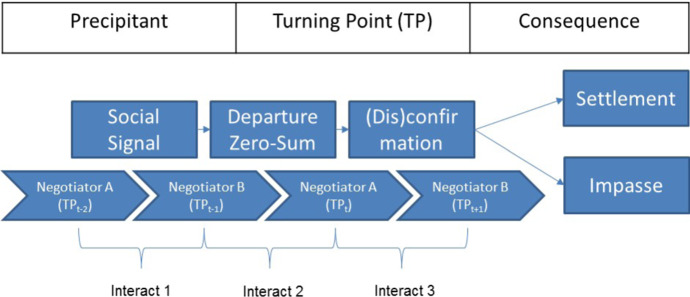
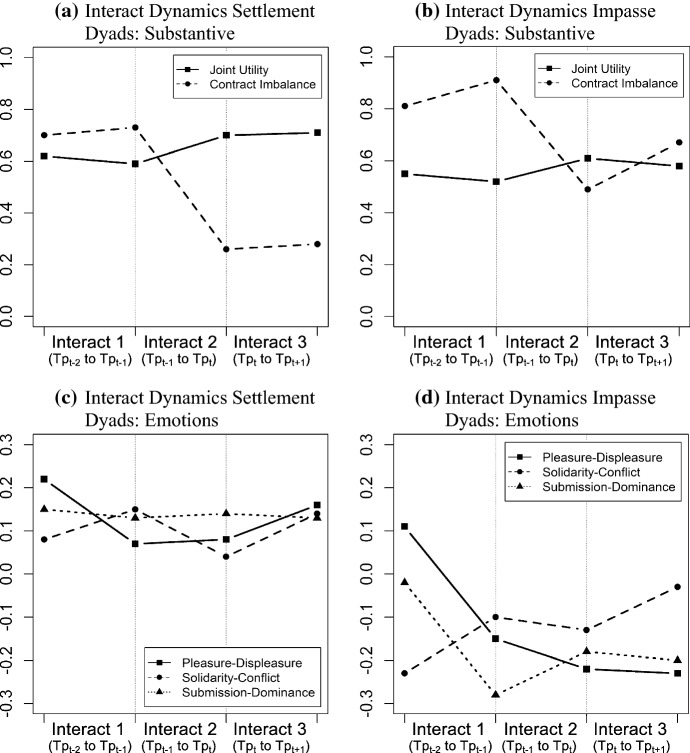
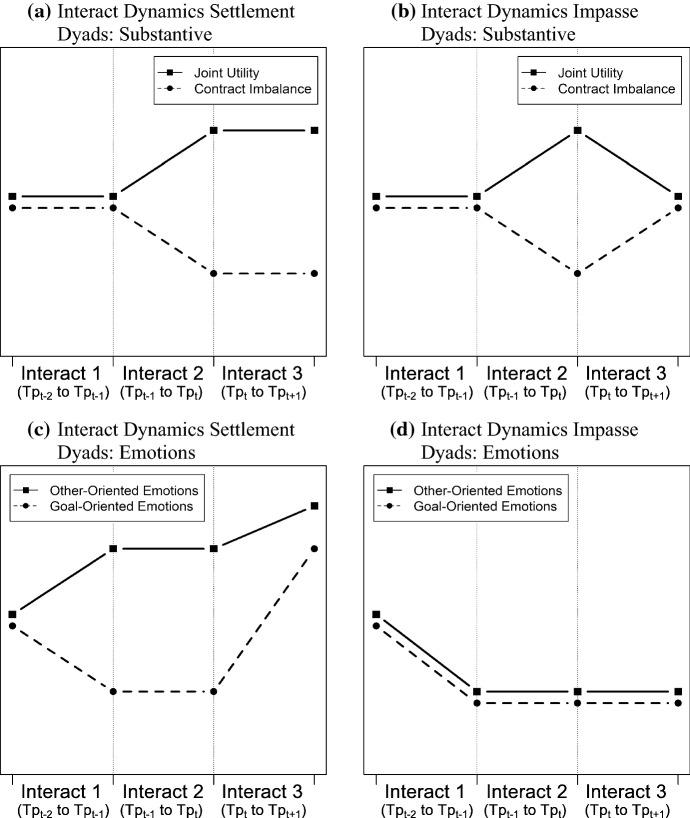
Negotiations and conflicts do not evolve smoothly but are discontinuous involving transitions, break-, and turning points that change the flow of the negotiation. Given that these departures may be decisive in determining whether the involved parties come to a successful conclusion, several scholars have pointed out the importance of investigating whether impasse and settlement dyads exhibit different turning point profiles. To address this question, we extended Druckman's (J Confl Resolut 45:519-544, 2001) turning point model by integrating interlocking action-reaction sequences that initiate and (dis)confirm the departure from zero-sum bargaining. Furthermore, we consider social signals as previously not addressed class of events triggering the turning point. We propose and show that social signals act as precipitants to substantive change at the offer level and that how negotiators enact the action-reaction sequences discriminates between successful and unsuccessful dyads.
谈判与冲突并非平稳发展,而是具有间断性,涉及改变谈判进程的过渡、中断和转折点。鉴于这些偏离在决定相关各方能否达成成功结局方面可能具有决定性作用,一些学者指出研究陷入僵局和达成和解的二元组是否呈现不同的转折点特征具有重要意义。为解决这一问题,我们扩展了德鲁克曼(《冲突解决杂志》45:519 - 544, 2001)的转折点模型,纳入了引发并(反)确认偏离零和谈判的连锁行动 - 反应序列。此外,我们将社会信号视为此前未被探讨过的一类触发转折点的事件。我们提出并证明,社会信号在提议层面充当实质性变化的催化剂,并且谈判者实施行动 - 反应序列的方式区分了成功和不成功的二元组。