Yang Qi, Qian Lin, Zhang Song
Chengdu University of Traditional Chinese Medicine, Chengdu, China.
Hospital of Chengdu University of Traditional Chinese Medicine, Chengdu, China.
Evid Based Complement Alternat Med. 2020 Jul 6;2020:3401067. doi: 10.1155/2020/3401067. eCollection 2020.
Cisplatin is widely used in the treatment of malignant patients; however, its adverse nephrotoxic effects limit its clinical use. Ginsenoside Rh1 is a main component of ginseng and has many pharmaceutical effects, including immunomodulatory effects.
The objective of this research is to assess the effects of ginsenoside Rh1 on a cisplatin-induced HK-2 injury model and to study its potential effect mechanisms.
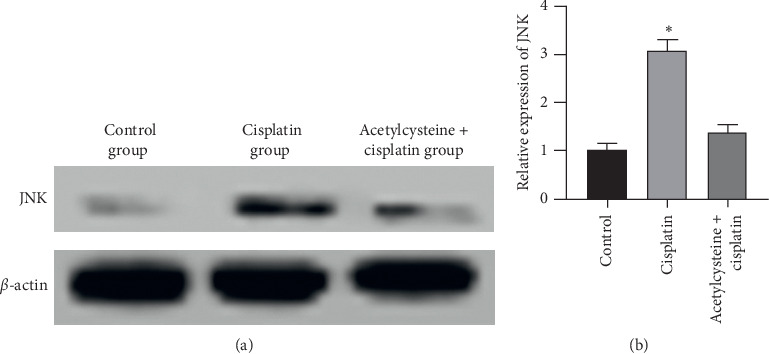
HK-2 cell vitality was assessed via Cell Counting Kit-8 (CCK-8) assay. Carboxyfluorescein succinimidyl ester/propidium iodide (CFSF/PI) staining was used to detect the apoptosis of HK-2 cells. ROS expression was detected by DCFDA. The expressions of JNK, p53, caspase-3, Bax, and NGAL were detected by western blot.
Ginsenoside Rh1 was found to increase the vitality of HK-2 cells and inhibit ROS production and the apoptosis of HK-2 cells in a cisplatin-induced injury model. Ginsenoside Rh1 was found to inhibit the expression of JNK, p53, caspase-3, Bax, and NGAL in a cisplatin-induced injury model.
Ginsenoside Rh1 alleviated HK-2 apoptosis in a cisplatin-induced injury model by inhibiting ROS production and the JNK/p53 pathway. Ginsenoside Rh1 may be a promising drug for the alleviation of cisplatin-induced nephrotoxicity in malignant patients.
顺铂广泛应用于恶性肿瘤患者的治疗;然而,其不良的肾毒性作用限制了其临床应用。人参皂苷Rh1是人参的主要成分,具有多种药理作用,包括免疫调节作用。
本研究旨在评估人参皂苷Rh1对顺铂诱导的HK-2损伤模型的影响,并探讨其潜在的作用机制。
通过细胞计数试剂盒-8(CCK-8)检测HK-2细胞活力。采用羧基荧光素琥珀酰亚胺酯/碘化丙啶(CFSF/PI)染色检测HK-2细胞凋亡。用DCFDA检测活性氧(ROS)表达。通过蛋白质免疫印迹法检测JNK、p53、半胱天冬酶-3、Bax和中性粒细胞明胶酶相关脂质运载蛋白(NGAL)的表达。
在顺铂诱导的损伤模型中,发现人参皂苷Rh1可提高HK-2细胞活力,抑制HK-2细胞的ROS生成和凋亡。在顺铂诱导的损伤模型中,发现人参皂苷Rh1可抑制JNK、p53、半胱天冬酶-3、Bax和NGAL的表达。
人参皂苷Rh1通过抑制ROS生成和JNK/p53途径减轻顺铂诱导的损伤模型中的HK-2细胞凋亡。人参皂苷Rh1可能是一种有前途的药物,可减轻恶性肿瘤患者顺铂诱导的肾毒性。