Babatuyi C Y, Boboye B E, Fagbemi T N, Enujiugha V N
Department of Food Science and Technology, Federal University of Technology, P.M.B.704, Akure, Ondo State, Nigeria.
Department of Microbiology, Federal University of Technology, P.M.B.704, Akure, Ondo State, Nigeria.
Heliyon. 2020 Jul 15;6(7):e04391. doi: 10.1016/j.heliyon.2020.e04391. eCollection 2020 Jul.
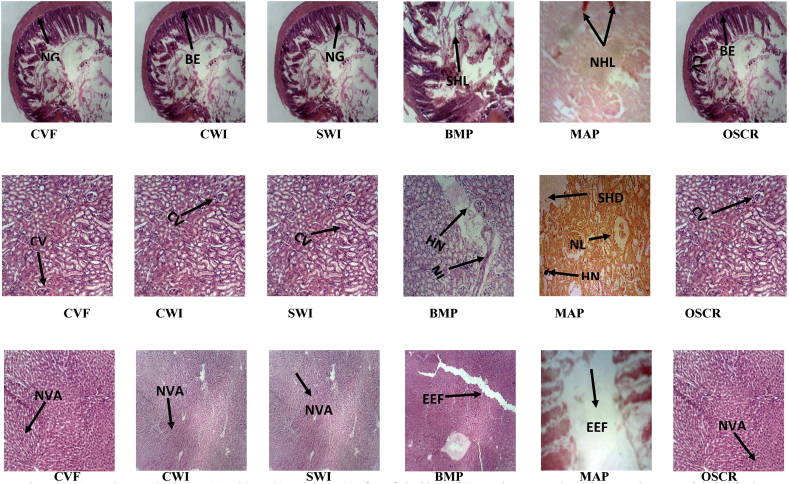
The cyanide, haematology and histopathology profiles of white albino rats fed with 'fufu'-based diets were monitored. The cassava tubers were subjected into different processing operations: spontaneous-soaked traditional method (SWI), grated before spontaneously-fermented without starter culture (CWI) and those grated, blanched at 65 °C for 15 min before fermented with microorganisms isolated, purified and identified from spontaneously fermented 'fufu' categorized into Bacteria only (BAP), Bacteria and Yeast (BYP), Yeast only (YAP), Bacteria and Mould (BMP), Mould and Yeast (MYP) and Mould only (MAP) and were oven dried and milled. The commercial ready-to-eat 'Fufu' (CWF) was served as control for laboratory processed samples. Albino rats of the wister strain with four (4) rats per group were fed with 50 % of Commercial vital feed (CVF) and 50% each of the remaining nine (9) "Fufu" samples in ratio 1:1 before haematology and histopathology profile of the animals were investigated. It was found out that Samples BMP and MAP had abnormal high Neutrophil (58-60; 41-42 %) lower Lymphocyte (40-43; 58-61 %), lower Packed cell volume (46-48; 45-47 %) and higher cyanide in the blood (0.004-0.006 mg/L) with sample BMP highest white blood cell (23-24 × 10⁹/L) and sample MAP least white blood cell (6.5-6.6 × 10⁹/L) when compared with other samples which were within the acceptable recommended values for animal studied for haematology and histopathology profiles. The "fufu" samples had reduced cyanide levels ranging from 0.001 mg/L to 0.006 mg/L in the blood of the animals assayed due to the processing operations used. Therefore, combined use of bacteria isolated as starter cultures in the production of odourless "Fufu" have acceptable haematology, histopathology and reduced cyanide level which suggests the suitability in terms of safety for human consumption.
监测了喂食以“富富”为基础日粮的白色白化大鼠的氰化物、血液学和组织病理学特征。木薯块根经过不同的加工操作:自然浸泡传统方法(SWI)、磨碎后自然发酵且无发酵剂培养(CWI),以及磨碎后在65℃下热烫15分钟,然后用从自然发酵“富富”中分离、纯化和鉴定的微生物发酵,这些微生物分为仅细菌(BAP)、细菌和酵母(BYP)、仅酵母(YAP)、细菌和霉菌(BMP)、霉菌和酵母(MYP)以及仅霉菌(MAP),之后进行烘干和研磨。市售即食“富富”(CWF)用作实验室加工样品的对照。每组4只Wistar品系的白化大鼠,在研究动物的血液学和组织病理学特征之前,按1:1的比例喂食50%的商业活性饲料(CVF)和其余9种“富富”样品各50%。结果发现,与其他处于所研究动物血液学和组织病理学特征可接受推荐值范围内的样品相比,样品BMP和MAP的中性粒细胞异常高(58 - 60;41 - 42%),淋巴细胞较低(40 - 43;58 - 61%),红细胞压积较低(46 - 48;45 - 47%),血液中氰化物含量较高(0.004 - 0.006 mg/L),其中样品BMP的白细胞最高(23 - 24×10⁹/L),样品MAP的白细胞最低(6.5 - 6.6×10⁹/L)。由于所采用的加工操作,所检测动物血液中“富富”样品的氰化物水平降低,范围为0.001 mg/L至0.006 mg/L。因此,在无味“富富”生产中联合使用分离出的细菌作为发酵剂培养物,具有可接受的血液学、组织病理学特征且氰化物水平降低,这表明在人类食用安全性方面具有适用性。