Hariprasad Roopa, Tulsyan Sonam, Babu Roshani, Dhanasekaran Kavitha, Thakur Nisha, Hussain Showket, Tripathi Richa, Sreenivas Vishnubhatla, Sharma Shashi, Sriram Latha, Singh Shalini, Mehrotra Ravi
Division of Clinical Oncology, Indian Council of Medical Research, National Institute of Cancer Prevention and Research, Noida, India.
Division of Preventive Oncology, Indian Council of Medical Research, National Institute of Cancer Prevention and Research, Noida, India.
JCO Glob Oncol. 2020 Jul;6:1147-1154. doi: 10.1200/GO.20.00024.
Currently available human papillomavirus (HPV) detection devices are expensive, requiring a continuous power supply, high-priced reagents, skilled laboratory personnel, and infrastructure. These make it difficult to implement primary HPV screening in high-risk (HR) populations, particularly in low-income settings such as in India. The objective of our study was to evaluate the diagnostic performance of a point-of-care, portable, battery-operated device called Truenat, which detects 4 HR HPV genotypes (16, 18, 31, and 45), as a potentially cost-effective alternative to conventional HPV diagnostic tests.
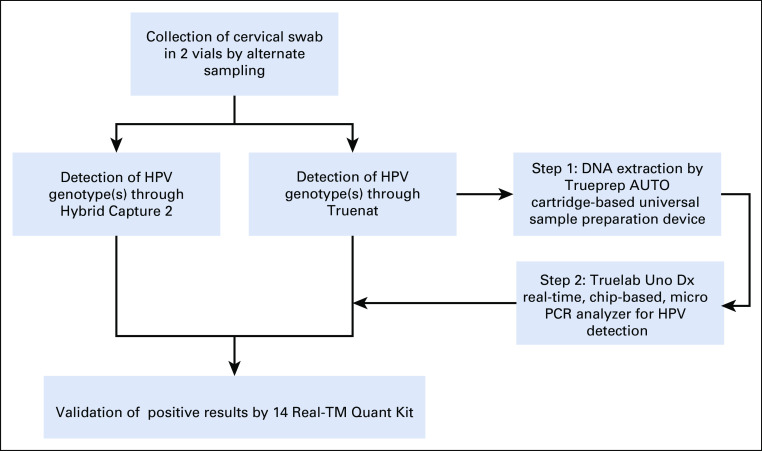
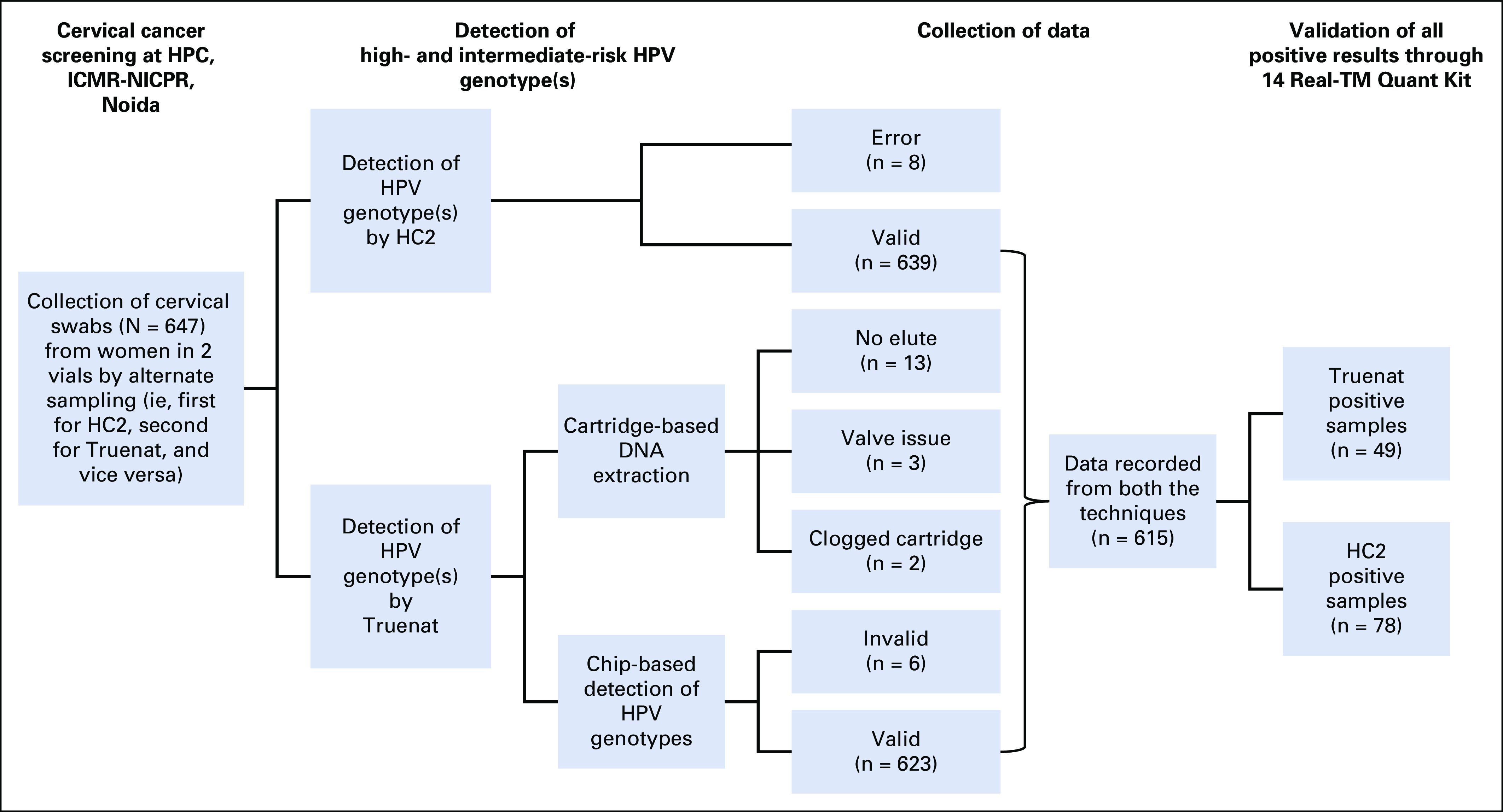
This was a single-site, blinded, cross-sectional study that evaluated the performance of the Trunat HPV-HR using cervical samples collected from nonpregnant women > 30 years old via consecutive sampling. The comparison was conducted against the Hybrid Capture 2 (HC2) method. All the positive samples were validated by 14 Real-TM Quant Kit.
Of 615 cervical samples, the HR-HPV DNA test was positive in 78 women (12.7%) by HC2 and in 49 (8%) by Truenat. With the consideration of limited genotype inclusivity, the sensitivity and specificity of Truenat HPV-HR were 97.7% and 98.9%, respectively.
The performance of Truenat HPV-HR test was comparable to that of HC2 in the 4 HPV genotypes and would be appropriate to consider for use in primary HR cervical cancer screening and particularly in low-income settings.
目前可用的人乳头瘤病毒(HPV)检测设备价格昂贵,需要持续电源、高价试剂、技术熟练的实验室人员和基础设施。这些因素使得在高危(HR)人群中开展HPV初筛变得困难,尤其是在印度等低收入地区。我们研究的目的是评估一种即时检测、便携式、电池供电的设备Truenat的诊断性能,该设备可检测4种HR HPV基因型(16、18、31和45),作为传统HPV诊断检测潜在的经济高效替代方法。
这是一项单中心、盲法横断面研究,通过连续采样,使用从30岁以上非妊娠女性采集的宫颈样本评估Truenat HPV-HR的性能。与杂交捕获2(HC2)方法进行比较。所有阳性样本均通过14 Real-TM定量试剂盒进行验证。
在615份宫颈样本中,HC2检测显示78名女性(12.7%)的HR-HPV DNA检测呈阳性,Truenat检测显示49名女性(8%)呈阳性。考虑到有限的基因型涵盖范围,Truenat HPV-HR的敏感性和特异性分别为97.7%和98.9%。
Truenat HPV-HR检测在4种HPV基因型中的性能与HC2相当,适合考虑用于HR宫颈癌初筛,特别是在低收入地区。