Testa Giulia, Baenas Isabel, Vintró-Alcaraz Cristina, Granero Roser, Agüera Zaida, Sánchez Isabel, Riesco Nadine, Jiménez-Murcia Susana, Fernández-Aranda Fernando
Ciber Physiopathology, Obesity and Nutrition (CIBERObn), Instituto de Salud Carlos III, 08907 Barcelona, Spain.
Department of Psychiatry, Bellvitge University Hospital-IDIBELL, 08907 Barcelona, Spain.
J Clin Med. 2020 Jul 20;9(7):2305. doi: 10.3390/jcm9072305.
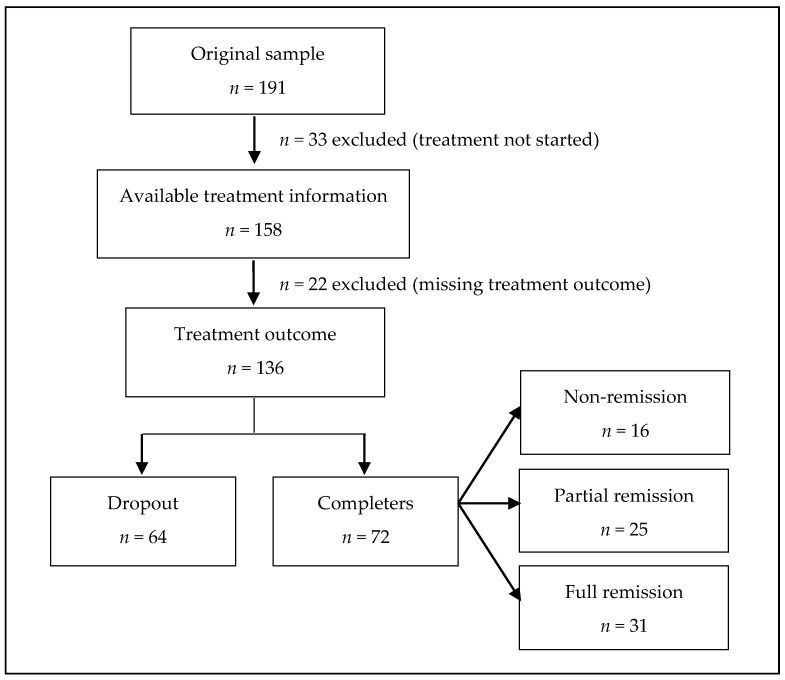
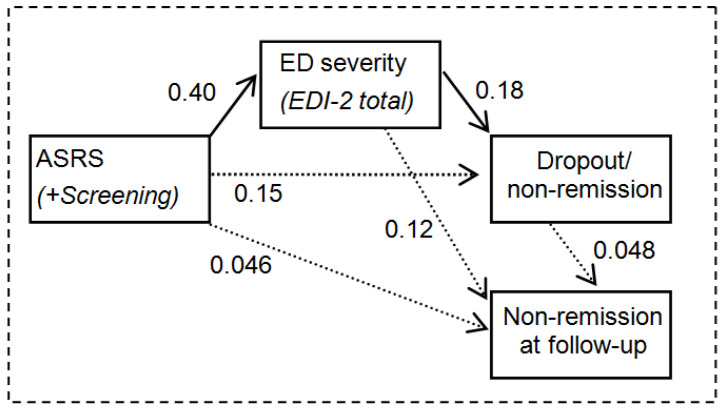
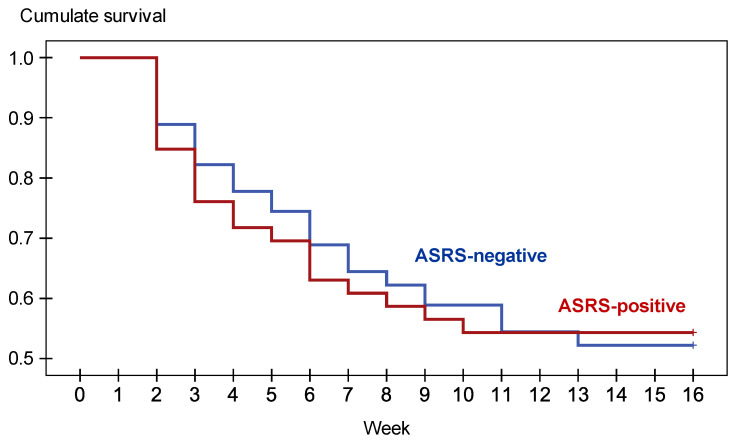
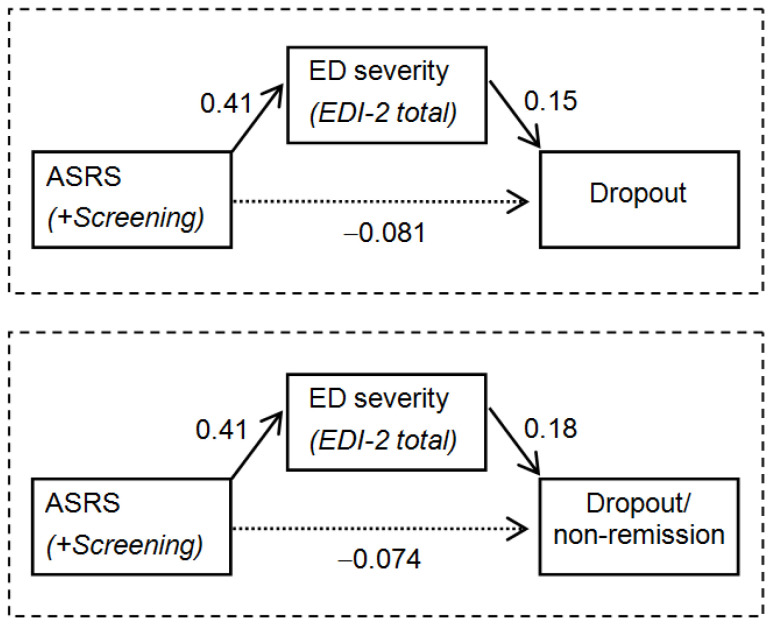
Attention-deficit/hyperactivity disorder (ADHD) and its symptoms have been shown to be present in patients with eating disorders (EDs) and are associated with increased psychopathology and more dysfunctional personality traits. This study aimed to assess if the presence of ADHD symptoms in patients with EDs affects their short and long-term therapy outcome. A total of 136 consecutively treated ED patients were considered in this study. Baseline pre-treatment evaluation included the Adult ADHD Self-Report Scale (ASRS v1.1) for ADHD symptoms and the assessment of eating symptomatology using the Eating Disorders Inventory (EDI-2). Treatment outcome was evaluated in terms of ED symptoms after cognitive behavioral therapy (CBT) and dropout rate during treatment. Furthermore, we evaluated ED symptoms in treatment completers after a follow-up of 8 years on average. Path analyses assessed the potential mediational role of the EDI-2 total score in the relationship between ADHD and treatment outcome. Results showed that baseline symptoms of ADHD indirectly affected treatment outcome after CBT; the ASRS positive screening was related to higher eating symptomatology (standardized coefficient B = 0.41, = 0.001, 95% CI: 0.26 to 0.55), and the presence of high ED levels contributed to the increase of dropout (B = 0.15, = 0.041, 95% CI: 0.03 to 0.33) and a worse treatment outcome (B = 0.18, = 0.041, 95% CI: 0.01 to 0.35). No direct effect was found between the ASRS positive screening with the risk of dropout (B = -0.08, = 0.375) and worse treatment outcome (B = -0.07, = 0.414). These results suggest the relevance of identifying specific treatment approaches for patients with ADHD symptoms and severe eating symptomatology.
注意力缺陷多动障碍(ADHD)及其症状已在饮食失调(EDs)患者中被证实存在,并且与精神病理学增加及更多功能失调的人格特质相关。本研究旨在评估EDs患者中ADHD症状的存在是否会影响其短期和长期治疗结果。本研究共纳入了136例连续接受治疗的ED患者。基线治疗前评估包括使用成人ADHD自我报告量表(ASRS v1.1)评估ADHD症状,以及使用饮食失调量表(EDI-2)评估饮食症状。治疗结果通过认知行为疗法(CBT)后的ED症状以及治疗期间的脱落率进行评估。此外,我们在平均随访8年后评估了完成治疗患者的ED症状。路径分析评估了EDI-2总分在ADHD与治疗结果关系中的潜在中介作用。结果显示,ADHD的基线症状间接影响了CBT后的治疗结果;ASRS阳性筛查与更高的饮食症状相关(标准化系数B = 0.41,P = 0.001,95% CI:0.26至0.55),高ED水平的存在导致脱落率增加(B = 0.15,P = 0.041,95% CI:0.03至0.33)和更差的治疗结果(B = 0.18,P = 0.041,95% CI:0.01至0.35)。未发现ASRS阳性筛查与脱落风险(B = -0.08,P = 0.375)及更差治疗结果(B = -0.07,P = 0.414)之间存在直接效应。这些结果表明,为有ADHD症状和严重饮食症状的患者确定特定治疗方法具有重要意义。