Neuropsychopharmacology and Brain Imaging, Department of Psychiatry, Psychotherapy and Psychosomatics, University Hospital for Psychiatry Zurich, Lenggstrasse 31, 8032, Zürich, Switzerland.
Independent Max Planck Research Group for Social Neuroscience, Max Planck Institute of Psychiatry, Kraepelinstr. 2-10, 80804, Munich, Germany.
Sci Rep. 2020 Jul 22;10(1):12181. doi: 10.1038/s41598-020-68899-y.
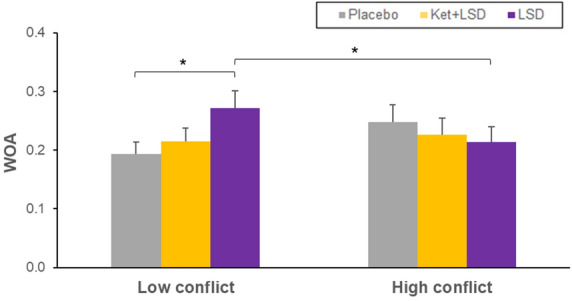
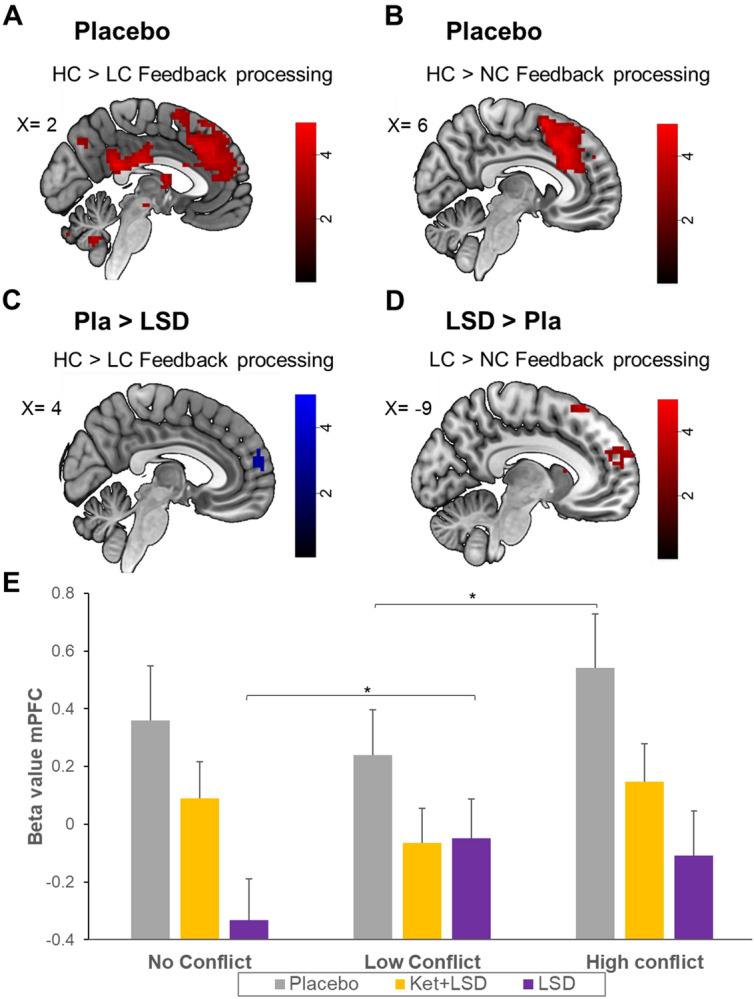
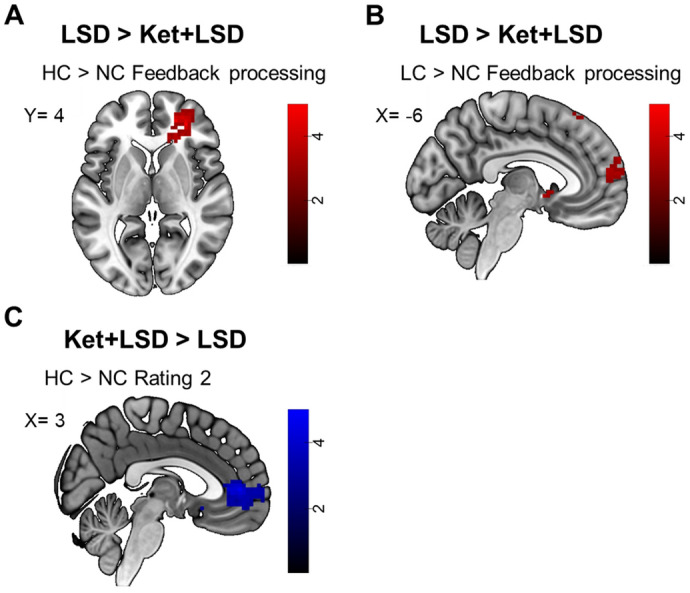
Adapting one's attitudes and behaviors to group norms is essential for successful social interaction and, thus, participation in society. Yet, despite its importance for societal and individual functioning, the underlying neuropharmacology is poorly understood. We therefore investigated its neurochemical and neural correlates in a pharmacological functional magnetic resonance imaging study. Lysergic acid diethylamide (LSD) has been shown to alter social processing and therefore provides the unique opportunity to investigate the role of the 5-HT receptor in social influence processing. Twenty-four healthy human volunteers received either (1) placebo + placebo, (2) placebo + LSD (100 µg), or (3) the 5-HT receptor antagonist ketanserin (40 mg) + LSD (100 µg) at three different occasions in a double-blind, randomized, counterbalanced, cross-over design. LSD increases social adaptation but only if the opinions of others are similar to the individual's own. These increases were associated with increased activity in the medial prefrontal cortex while participants received social feedback. Furthermore, pretreatment with the 5-HT antagonist ketanserin fully blocked LSD-induced changes during feedback processing, indicating a key role of the 5-HT system in social feedback processing. Our results highlight the crucial role of the 5-HT-system in social influence and, thus, provide important insight into the neuropharmacological basis of social cognition and behavior.
适应群体规范对于成功的社会互动至关重要,因此也是参与社会的必要条件。然而,尽管它对社会和个人功能很重要,但神经药理学基础仍知之甚少。因此,我们在一项药理学功能磁共振成像研究中研究了其神经化学和神经相关性。麦角酸二乙酰胺(LSD)已被证明可以改变社交处理,因此为研究 5-羟色胺受体在社交影响处理中的作用提供了独特的机会。二十四名健康的人类志愿者在双盲、随机、交叉、平衡的设计中,分三次接受以下三种处理:(1)安慰剂+安慰剂,(2)安慰剂+LSD(100μg),或(3)5-羟色胺受体拮抗剂酮色林(40mg)+LSD(100μg)。LSD 增加了社交适应能力,但只有当他人的意见与个人自己的意见相似时才会增加。这些增加与参与者接受社交反馈时中前额叶皮层的活动增加有关。此外,5-羟色胺拮抗剂酮色林的预处理完全阻断了 LSD 诱导的反馈处理过程中的变化,表明 5-羟色胺系统在社交反馈处理中起着关键作用。我们的结果强调了 5-羟色胺系统在社交影响中的关键作用,从而为社交认知和行为的神经药理学基础提供了重要的见解。