• 文献检索
  • 文档翻译
  • 深度研究
  • 学术资讯
  • Suppr Zotero 插件Zotero 插件
  • 邀请有礼
  • 套餐&价格
  • 历史记录
应用&插件
Suppr Zotero 插件Zotero 插件浏览器插件Mac 客户端Windows 客户端微信小程序
定价
高级版会员购买积分包购买API积分包
服务
文献检索文档翻译深度研究API 文档MCP 服务
关于我们
关于 Suppr公司介绍联系我们用户协议隐私条款
关注我们

Suppr 超能文献

核心技术专利:CN118964589B侵权必究
粤ICP备2023148730 号-1Suppr @ 2026

文献检索

告别复杂PubMed语法,用中文像聊天一样搜索,搜遍4000万医学文献。AI智能推荐,让科研检索更轻松。

立即免费搜索

文件翻译

保留排版,准确专业,支持PDF/Word/PPT等文件格式,支持 12+语言互译。

免费翻译文档

深度研究

AI帮你快速写综述,25分钟生成高质量综述,智能提取关键信息,辅助科研写作。

立即免费体验

心脏骤停后初始疾病严重程度与结局与 36°C 或 33°C 目标体温管理的关联。

Association of Initial Illness Severity and Outcomes After Cardiac Arrest With Targeted Temperature Management at 36 °C or 33 °C.

机构信息

Pittsburgh Post-Cardiac Arrest Service, Department of Emergency Medicine, University of Pittsburgh, Pittsburgh, Pennsylvania.

出版信息

JAMA Netw Open. 2020 Jul 1;3(7):e208215. doi: 10.1001/jamanetworkopen.2020.8215.

DOI:10.1001/jamanetworkopen.2020.8215
PMID:32701158
原文链接:https://pmc.ncbi.nlm.nih.gov/articles/PMC7378753/
Abstract

IMPORTANCE

It is uncertain what the optimal target temperature is for targeted temperature management (TTM) in patients who are comatose following cardiac arrest.

OBJECTIVE

To examine whether illness severity is associated with changes in the association between target temperature and patient outcome.

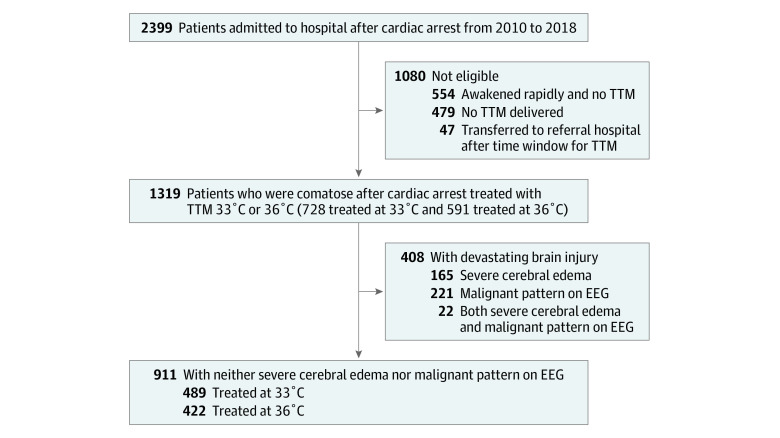
DESIGN, SETTING, AND PARTICIPANTS: This cohort study compared outcomes for 1319 patients who were comatose after cardiac arrest at a single center in Pittsburgh, Pennsylvania, from January 2010 to December 2018. Initial illness severity was based on coma and organ failure scores, presence of severe cerebral edema, and presence of highly malignant electroencephalogram (EEG) after resuscitation.

EXPOSURE

TTM at 36 °C or 33 °C.

MAIN OUTCOMES AND MEASURES

Primary outcome was survival to hospital discharge, and secondary outcomes were modified Rankin Scale and cerebral performance category.

RESULTS

Among 1319 patients, 728 (55.2%) had TTM at 33 °C (451 [62.0%] men; median [interquartile range] age, 61 [50-72] years) and 591 (44.8%) had TTM at 36 °C (353 [59.7%] men; median [interquartile range] age, 59 [48-69] years). Overall, 184 of 187 patients (98.4%) with severe cerebral edema died and 234 of 243 patients (96.3%) with highly malignant EEG died regardless of TTM strategy. Comparing TTM at 33 °C with TTM at 36 °C in 911 patients (69.1%) with neither severe cerebral edema nor highly malignant EEG, survival was lower in patients with mild to moderate coma and no shock (risk difference, -13.8%; 95% CI, -24.4% to -3.2%) but higher in patients with mild to moderate coma and cardiopulmonary failure (risk difference, 21.8%; 95% CI, 5.4% to 38.2%) or with severe coma (risk difference, 9.7%; 95% CI, 4.0% to 15.3%). Interactions were similar for functional outcomes. Most deaths (633 of 968 [65.4%]) resulted after withdrawal of life-sustaining therapies.

CONCLUSIONS AND RELEVANCE

In this study, TTM at 33 °C was associated with better survival than TTM at 36 °C among patients with the most severe post-cardiac arrest illness but without severe cerebral edema or malignant EEG. However, TTM at 36 °C was associated with better survival among patients with mild- to moderate-severity illness.

摘要

重要性

对于心脏骤停后昏迷的患者,目标体温管理(TTM)的最佳目标温度尚不确定。

目的

研究疾病严重程度是否与目标温度与患者预后之间的关联变化有关。

设计、地点和参与者:这项队列研究比较了 2010 年 1 月至 2018 年 12 月在宾夕法尼亚州匹兹堡的一家单一中心因心脏骤停而昏迷的 1319 名患者的结局。初始疾病严重程度基于昏迷和器官衰竭评分、是否存在严重脑水肿以及复苏后是否存在高度恶性脑电图(EEG)。

暴露

36°C 或 33°C 的 TTM。

主要结局和措施

主要结局是出院时的存活,次要结局是改良的兰金量表和脑功能分类。

结果

在 1319 名患者中,728 名(55.2%)接受了 33°C 的 TTM(451 名[62.0%]男性;中位[四分位距]年龄,61[50-72]岁),591 名(44.8%)接受了 36°C 的 TTM(353 名[59.7%]男性;中位[四分位距]年龄,59[48-69]岁)。总体而言,187 名(98.4%)有严重脑水肿的患者和 243 名(96.3%)有高度恶性 EEG 的患者无论 TTM 策略如何,均死亡。在 911 名(69.1%)无严重脑水肿和无高度恶性 EEG 的患者中,与 33°C 的 TTM 相比,36°C 的 TTM 患者中轻度至中度昏迷且无休克的患者存活率较低(风险差异,-13.8%;95%CI,-24.4%至-3.2%),但轻度至中度昏迷和心肺衰竭(风险差异,21.8%;95%CI,5.4%至 38.2%)或严重昏迷(风险差异,9.7%;95%CI,4.0%至 15.3%)患者的存活率较高。功能结局的交互作用相似。大多数死亡(968 例中的 633 例[65.4%])发生在停止维持生命的治疗之后。

结论和相关性

在这项研究中,与 36°C 的 TTM 相比,33°C 的 TTM 与心脏骤停后最严重疾病患者的存活率更高,但无严重脑水肿或恶性 EEG。然而,在轻度至中度疾病患者中,36°C 的 TTM 与更好的存活率相关。
https://cdn.ncbi.nlm.nih.gov/pmc/blobs/3095/7378753/c3589560d75f/jamanetwopen-3-e208215-g001.jpg

相似文献

1
Association of Initial Illness Severity and Outcomes After Cardiac Arrest With Targeted Temperature Management at 36 °C or 33 °C.心脏骤停后初始疾病严重程度与结局与 36°C 或 33°C 目标体温管理的关联。
JAMA Netw Open. 2020 Jul 1;3(7):e208215. doi: 10.1001/jamanetworkopen.2020.8215.
2
Pyrexia and neurologic outcomes after therapeutic hypothermia for cardiac arrest.发热与心肺复苏后亚低温治疗的神经系统转归
Resuscitation. 2013 Aug;84(8):1056-61. doi: 10.1016/j.resuscitation.2012.11.003. Epub 2012 Nov 12.
3
The Outcomes of Targeted Temperature Management After Cardiac Arrest at Emergency Department: A Real-World Experience in a Developing Country.急诊科心脏骤停后目标温度管理的结果:一个发展中国家的真实世界经验。
Ther Hypothermia Temp Manag. 2017 Mar;7(1):24-29. doi: 10.1089/ther.2016.0014. Epub 2016 Nov 11.
4
Effects of targeted temperature management at 33 °C vs. 36 °C on comatose patients after cardiac arrest stratified by the severity of encephalopathy.心脏骤停后昏迷患者中,根据脑病严重程度分层,33°C与36°C目标温度管理的效果。
Resuscitation. 2022 Apr;173:147-153. doi: 10.1016/j.resuscitation.2022.01.026. Epub 2022 Feb 2.
5
Temperature variability during targeted temperature management is not associated with neurological outcomes following cardiac arrest.目标温度管理期间的体温变异性与心脏骤停后的神经学预后无关。
Am J Emerg Med. 2017 Jun;35(6):889-892. doi: 10.1016/j.ajem.2017.01.058. Epub 2017 Jan 27.
6
Do Lower Target Temperatures or Prolonged Cooling Provide Improved Outcomes for Comatose Survivors of Cardiac Arrest Treated With Hypothermia?较低的目标温度或延长降温时间能否改善接受低温治疗的心脏骤停昏迷幸存者的预后?
J Am Heart Assoc. 2015 Sep 21;4(9):e002123. doi: 10.1161/JAHA.115.002123.
7
Impact of time to return of spontaneous circulation on neuroprotective effect of targeted temperature management at 33 or 36 degrees in comatose survivors of out-of hospital cardiac arrest.院外心脏骤停昏迷幸存者中,自主循环恢复时间对33℃或36℃目标温度管理神经保护作用的影响。
Resuscitation. 2015 Nov;96:310-6. doi: 10.1016/j.resuscitation.2015.06.021. Epub 2015 Jul 7.
8
Relationship Between Duration of Targeted Temperature Management, Ischemic Interval, and Good Functional Outcome From Out-of-Hospital Cardiac Arrest.目标温度管理持续时间、缺血间隔与院外心脏骤停后良好功能结局的关系。
Crit Care Med. 2020 Mar;48(3):370-377. doi: 10.1097/CCM.0000000000004160.
9
Effect of Moderate vs Mild Therapeutic Hypothermia on Mortality and Neurologic Outcomes in Comatose Survivors of Out-of-Hospital Cardiac Arrest: The CAPITAL CHILL Randomized Clinical Trial.中度与轻度治疗性低温对院外心脏骤停昏迷幸存者死亡率和神经结局的影响:CAPITAL CHILL 随机临床试验。
JAMA. 2021 Oct 19;326(15):1494-1503. doi: 10.1001/jama.2021.15703.
10
Therapeutic Hypothermia and Targeted Temperature Management for Traumatic Arrest and Surgical Patients.创伤性心脏骤停及外科手术患者的治疗性低温与目标温度管理
Ther Hypothermia Temp Manag. 2019 Jun;9(2):156-158. doi: 10.1089/ther.2018.0022. Epub 2018 Nov 22.

引用本文的文献

1
Neurological outcomes with hypothermia versus normothermia in patients with moderate initial illness severity following resuscitation from out-of-hospital cardiac arrest: protocol for a multicentre randomised controlled trial (R-CAST OHCA).院外心脏骤停复苏后初始病情严重程度为中度的患者中,低温与常温对神经功能结局的影响:一项多中心随机对照试验(R-CAST OHCA)方案
BMJ Open. 2025 Aug 22;15(8):e101809. doi: 10.1136/bmjopen-2025-101809.
2
The association between the severity of out-of-hospital cardiac arrest and the effectiveness of target temperature management: a retrospective study based on prediction models.院外心脏骤停的严重程度与目标温度管理有效性之间的关联:一项基于预测模型的回顾性研究
Int J Emerg Med. 2025 Aug 19;18(1):154. doi: 10.1186/s12245-025-00947-8.
3

本文引用的文献

1
Temporal trends in the use of targeted temperature management after cardiac arrest and association with outcome: insights from the Paris Sudden Death Expertise Centre.心脏骤停后目标温度管理的使用趋势及其与结局的关系:来自巴黎 Sudden Death Expertise Centre 的见解。
Crit Care. 2019 Dec 3;23(1):391. doi: 10.1186/s13054-019-2677-1.
2
Targeted temperature management guided by the severity of hyperlactatemia for out-of-hospital cardiac arrest patients: a post hoc analysis of a nationwide, multicenter prospective registry.基于高乳酸血症严重程度的目标温度管理用于院外心脏骤停患者:一项全国性、多中心前瞻性注册研究的事后分析
Ann Intensive Care. 2019 Nov 19;9(1):127. doi: 10.1186/s13613-019-0603-y.
3
Clinical heterogeneity and phenotyping of post cardiac arrest brain injury: one size may not fit all.心脏骤停后脑损伤的临床异质性与表型分析:一种方法可能并不适用于所有情况。
Intensive Care Med. 2025 Jul 16. doi: 10.1007/s00134-025-08012-x.
4
Tailoring Targeted Temperature Management in Comatose Out-of-Hospital Cardiac Arrest Survivors: A Retrospective Analysis Based on the rCAST Score Classification.昏迷的院外心脏骤停幸存者的个性化目标温度管理:基于rCAST评分分类的回顾性分析
J Clin Med. 2025 Jun 3;14(11):3931. doi: 10.3390/jcm14113931.
5
Prediction model of in-hospital mortality risk in intensive care unit patients with cardiac arrest: a multicenter retrospective cohort study based on an ensemble model.重症监护病房心脏骤停患者院内死亡风险预测模型:一项基于集成模型的多中心回顾性队列研究
Front Cardiovasc Med. 2025 May 20;12:1582636. doi: 10.3389/fcvm.2025.1582636. eCollection 2025.
6
Targeted temperature management at 33 versus 36 degrees after out-of-hospital cardiac arrest: A follow-up study.院外心脏骤停后33℃与36℃目标温度管理的随访研究
Resusc Plus. 2025 Mar 4;22:100921. doi: 10.1016/j.resplu.2025.100921. eCollection 2025 Mar.
7
Association between the Clinical Frailty Scale and Neurological Outcomes in Out-of-Hospital Cardiac Arrest: A Retrospective Study.院外心脏骤停患者临床衰弱量表与神经学预后的相关性:一项回顾性研究
Rev Cardiovasc Med. 2025 Mar 21;26(3):26333. doi: 10.31083/RCM26333. eCollection 2025 Mar.
8
Recovery Potential in Patients After Cardiac Arrest Who Die After Limitations or Withdrawal of Life Support.心脏骤停后在生命支持受限或撤除后死亡患者的恢复潜力。
JAMA Netw Open. 2025 Mar 3;8(3):e251714. doi: 10.1001/jamanetworkopen.2025.1714.
9
Brain health: A concern for anaesthesiologists and intensivists.脑健康:麻醉医师和重症监护医师关注的问题。
Eur J Anaesthesiol Intensive Care. 2024 Oct 4;3(6):e0063. doi: 10.1097/EA9.0000000000000063. eCollection 2024 Dec.
10
Effect Size of Targeted Temperature Management in Pediatric Patients with Post-Cardiac Arrest Syndrome According to the Severity.根据严重程度分析目标温度管理对小儿心脏骤停综合征患者的效应量
Life (Basel). 2024 Dec 30;15(1):26. doi: 10.3390/life15010026.
Targeted Temperature Management for Cardiac Arrest with Nonshockable Rhythm.
心脏骤停伴非颤动感心律失常的目标温度管理。
N Engl J Med. 2019 Dec 12;381(24):2327-2337. doi: 10.1056/NEJMoa1906661. Epub 2019 Oct 2.
4
Targeted hypothermia versus targeted Normothermia after out-of-hospital cardiac arrest (TTM2): A randomized clinical trial-Rationale and design.院外心脏骤停后目标低温与目标正常体温治疗(TTM2):一项随机临床试验——原理与设计。
Am Heart J. 2019 Nov;217:23-31. doi: 10.1016/j.ahj.2019.06.012. Epub 2019 Jun 26.
5
Cardiac arrest: prediction models in the early phase of hospitalization.心脏骤停:住院早期的预测模型。
Curr Opin Crit Care. 2019 Jun;25(3):204-210. doi: 10.1097/MCC.0000000000000613.
6
Prognostication after cardiac arrest: Results of an international, multi-professional survey.心搏骤停后的预后预测:一项国际性、多专业调查的结果。
Resuscitation. 2019 May;138:190-197. doi: 10.1016/j.resuscitation.2019.03.016. Epub 2019 Mar 19.
7
Long-Term Outcomes of Out-of-Hospital Cardiac Arrest Care at Regionalized Centers.院外心脏骤停急救的区域性中心的长期效果。
Ann Emerg Med. 2019 Jan;73(1):29-39. doi: 10.1016/j.annemergmed.2018.05.018. Epub 2018 Jul 4.
8
Neuroprognostication postcardiac arrest: translating probabilities to individuals.心脏停搏后神经预后:将概率转化为个体情况。
Curr Opin Crit Care. 2018 Jun;24(3):158-164. doi: 10.1097/MCC.0000000000000500.
9
Return to Work and Participation in Society After Out-of-Hospital Cardiac Arrest.院外心脏骤停后的重返工作与社会参与
Circ Cardiovasc Qual Outcomes. 2018 Jan;11(1):e003566. doi: 10.1161/CIRCOUTCOMES.117.003566.
10
Efficacy of different cooling technologies for therapeutic temperature management: A prospective intervention study.不同冷却技术在治疗性体温管理中的疗效:一项前瞻性干预研究。
Resuscitation. 2018 Mar;124:14-20. doi: 10.1016/j.resuscitation.2017.12.026. Epub 2017 Dec 26.