Aoyama Taiki, Fukumoto Akira, Shigita Kenjiro, Asayama Naoki, Mukai Shinichi, Nagata Shinji
Department of Gastroenterology, Hiroshima City Asa Citizens Hospital, 2-1-1 Kabe-minami, Asakita-ku, Hiroshima, 731-0293, Japan.
Department of Endoscopy, Hiroshima City Asa Citizens Hospital, 2-1-1 Kabe-minami, Asakita-ku, Hiroshima, 731-0293, Japan.
BMC Gastroenterol. 2020 Jul 23;20(1):237. doi: 10.1186/s12876-020-01382-0.
Pigmented bile salts darken the small-bowel lumen and are present with bile acid, which is involved in the development of bowel habits. The small-bowel water content (SBWC) in the ileum could represent the colonic environment, but no studies have focused on this feature. However, measurement of crude SBWC can be challenging because of the technical difficulty of the endoscopic approach without preparation. Our aim was to evaluate optically active bile pigments in the SBWC of patients with abnormal bowel habits using capsule endoscopy (CE) to investigate the impact of bile acid on bowel habits.
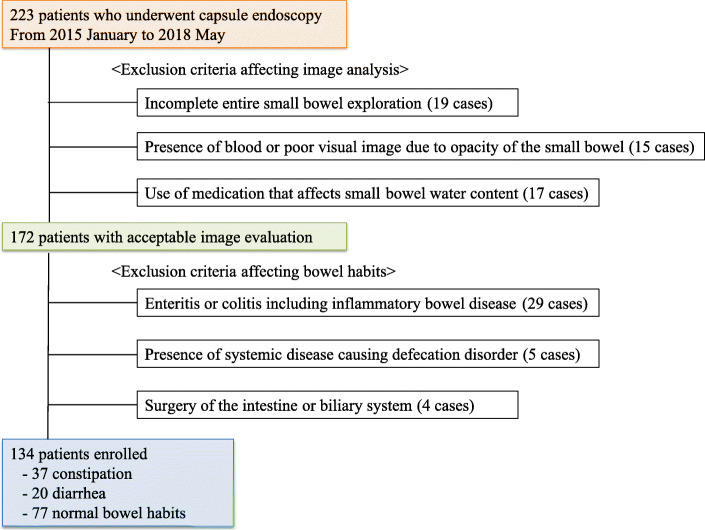
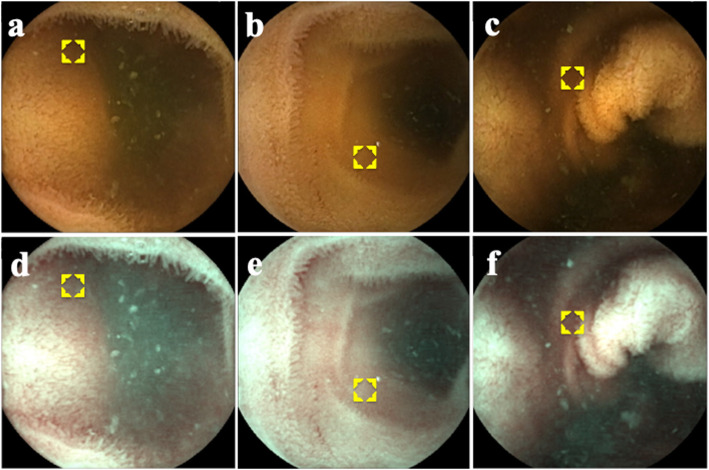
The study population included 37 constipated patients, 20 patients with diarrhea, and 77 patients with normal bowel habits who underwent CE between January 2015 and May 2018. Patients with secondary abnormal bowel habits were excluded. In addition to conventional imaging, we used flexible spectral imaging color enhancement (FICE) setting 1 imaging, in which the effects of bile pigments on color are suppressed. Intergroup color differences of SBWC in the ileum (ΔE) were evaluated from conventional and FICE setting 1 images. Color values were assessed using the CIE Lab* color space. Differences in SBWC lightness (black to white, range 0-100) were also evaluated.
The ΔE values from the comparison of conventional images between patients with constipation and with normal bowel habits and between patients with diarrhea and with normal bowel habits were 12.4 and 11.2, respectively. These values decreased to 4.4 and 3.3, respectively, when FICE setting 1 images were evaluated. Patients with constipation and diarrhea had significantly brighter (34.4 versus 27.6, P < .0001) and darker (19.6 versus 27.6, P < .0001) SBWC lightness, respectively, than patients with normal bowel habits. The FICE setting 1 images did not reveal significant differences in SBWC lightness between those with constipation and with normal bowel habits (44.1 versus 43.5, P = .83) or between those with diarrhea and with normal bowel habits (39.1 versus 43.5, P = .20).
Differences in SBWC color and darkness in the ileum appear to be attributable to bile pigments. Therefore, bile pigments in SBWC may reflect bowel habits.
色素性胆盐会使小肠肠腔变黑,且与胆汁酸同时存在,而胆汁酸与排便习惯的形成有关。回肠中的小肠含水量(SBWC)可能代表结肠环境,但尚无研究关注此特征。然而,由于内镜检查方法在无准备情况下存在技术难度,测量粗SBWC具有挑战性。我们的目的是使用胶囊内镜(CE)评估排便习惯异常患者的SBWC中的光学活性胆色素,以研究胆汁酸对排便习惯的影响。
研究人群包括2015年1月至2018年5月期间接受CE检查的37例便秘患者、20例腹泻患者和77例排便习惯正常的患者。排除继发性排便习惯异常的患者。除了传统成像外,我们使用了灵活光谱成像颜色增强(FICE)设置1成像,其中胆色素对颜色的影响被抑制。从传统图像和FICE设置1图像评估回肠中SBWC的组间颜色差异(ΔE)。使用CIE Lab*颜色空间评估颜色值。还评估了SBWC亮度(从黑到白,范围0 - 100)的差异。
便秘患者与排便习惯正常患者之间以及腹泻患者与排便习惯正常患者之间,传统图像比较的ΔE值分别为12.4和11.2。当评估FICE设置1图像时,这些值分别降至4.4和3.3。便秘患者和腹泻患者的SBWC亮度分别显著高于(34.4对27.6,P <.0001)和低于(19.6对27.6,P <.0001)排便习惯正常的患者。FICE设置1图像未显示便秘患者与排便习惯正常患者之间(44.1对43.5,P =.83)或腹泻患者与排便习惯正常患者之间(39.1对43.5,P =.20)的SBWC亮度有显著差异。
回肠中SBWC颜色和深浅的差异似乎归因于胆色素。因此,SBWC中的胆色素可能反映排便习惯。