Department of Medicine, Division of Nephrology, The Johns Hopkins University School of Medicine, Baltimore, MD, USA.
The Welch Center for Prevention, Epidemiology, and Clinical Research, Baltimore, MD, USA.
BMC Nephrol. 2020 Jul 23;21(1):296. doi: 10.1186/s12882-020-01967-7.
Sodium bicarbonate, in the form of baking soda, is widely used as a home remedy, and as an additive for personal and household cleaning products. Its toxicity has previously been reported following oral ingestion in the setting of dyspepsia. However, its use as a non-ingested agent, like a toothpaste additive, has not been reported as a potential cause of toxicity.
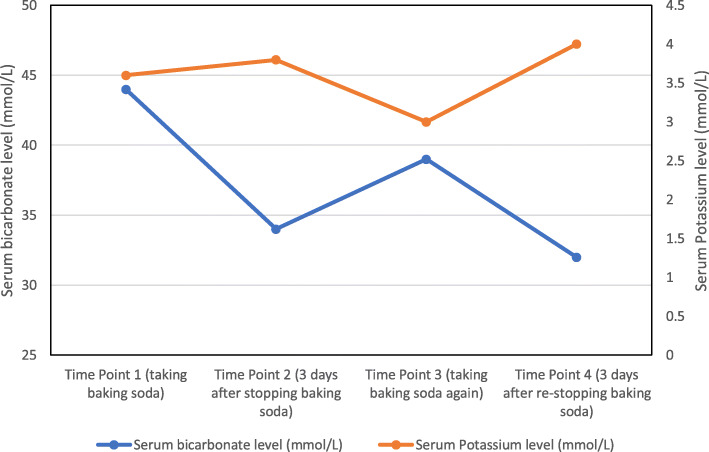
We are reporting a case of an 80-year-old woman who presented with chronic metabolic alkalosis and hypokalemia secondary to exogenous alkali exposure from baking soda as a toothpaste additive, which might have represented an underreported ingestion of the substance.
Considering that one teaspoon of baking soda provides approximately 59 m-equivalents (mEq) of bicarbonate, specific questioning on its general use should be pursued in similar cases of chloride resistant metabolic alkalosis.
小苏打(碳酸氢钠)作为一种家用疗法,广泛用于个人和家庭清洁产品的添加剂。此前曾有报道称,在消化不良的情况下,口服小苏打会导致其毒性。然而,将其作为一种非摄入性的物质(如牙膏添加剂)使用,尚未被报道为毒性的潜在原因。
我们报告了一例 80 岁女性病例,因小苏打(碳酸氢钠)作为牙膏添加剂而导致的慢性代谢性碱中毒和低钾血症,这可能代表了对该物质的一种未被报告的摄入。
考虑到一茶匙小苏打提供了大约 59 毫当量(mEq)的碳酸氢盐,在类似的氯耐药性代谢性碱中毒病例中,应针对其一般用途进行具体询问。