Prince Peprah, Social Policy Research Centre, University of New South Wales, Sydney, Australia.
Department of Planning, Kwame Nkrumah University of Science and Technology, Kumasi, Ghana.
Subst Abuse Treat Prev Policy. 2020 Jul 23;15(1):49. doi: 10.1186/s13011-020-00292-4.
The misuse of tramadol has become a major aspect of the wider substance use challenge in recent years and is evolving into a health crisis at an alarming rate. However, literature on motivations for non-medical purpose tramadol use among commercial vehicle operators remains inadequate. The aim of this study was to document the motivations for non-medical purposes tramadol use in Kumasi. Such an understanding could inform policy direction to regulate non-medical purposes tramadol use in Ghana.
We conducted this exploratory qualitative study with 23 purposively selected commercial vehicle drivers (15) and assistants (8) in Kumasi, Ghana. Data for the study were collected through in-depth face-to-face interviews between June 2018 and March 2019. Using a thematic analytical approach, the interviews were coded and analysed.
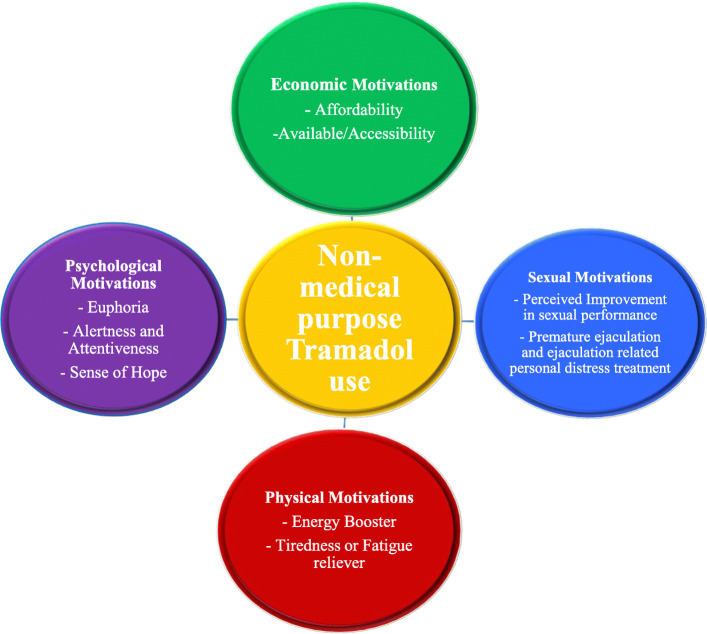
Multiple motivations for non-medical purposes tramadol use were found including those related to: (1) sexual; (2) psychological; (3) physical; and (4) economic factors. Participants also reported three main inter-linking categories of perceived tramadol adverse effects: (1) physical; (2) psychological; and (3) social effects. Although participants indicated no plans for stopping their non-medical use of tramadol any time soon, strong willingness was voiced for supporting officials in finding and dealing with non-medical purpose tramadol sellers.
Non-medical purposes tramadol use was associated with a confluence of factors, ranging from enhanced sexual performance to economic reasons. Based on the findings of the study and the dependence and addictive potentials of tramadol, there is the need for psychoeducational programmes for persons who misuse tramadol and enhancement of operational capacities of regulatory agencies.
近年来,曲马多的滥用已成为更广泛的物质使用挑战的一个主要方面,且正以惊人的速度演变成一场健康危机。然而,关于商业车辆驾驶员非医疗目的使用曲马多的动机的文献仍然不足。本研究旨在记录库马西非医疗目的使用曲马多的动机。这种理解可以为规范加纳非医疗目的使用曲马多的政策方向提供信息。
我们在加纳库马西进行了这项探索性的定性研究,共纳入了 23 名有目的地选择的商业车辆驾驶员(15 名)和助手(8 名)。研究数据于 2018 年 6 月至 2019 年 3 月期间通过深入的面对面访谈收集。采用主题分析方法,对访谈进行编码和分析。
发现了多种非医疗目的使用曲马多的动机,包括与以下方面相关的动机:(1)性方面;(2)心理方面;(3)身体方面;和(4)经济因素。参与者还报告了三种主要的相互关联的曲马多不良影响类别:(1)身体方面;(2)心理方面;和(3)社会影响。尽管参与者表示近期内没有停止非医疗用途使用曲马多的计划,但他们强烈表示愿意支持官员找到并处理非医疗目的的曲马多卖家。
非医疗目的使用曲马多与一系列因素有关,从增强性表现到经济原因。基于研究结果以及曲马多的依赖性和成瘾潜力,有必要为滥用曲马多的人提供心理教育计划,并增强监管机构的运作能力。