Knez David, Hanninen Adam M, Prince Richard C, Potma Eric O, Fishman Dmitry A
Department of Chemistry, University of California, Irvine, CA 92697 USA.
Department of Biomedical Engineering, University of California, Irvine, CA 92697 USA.
Light Sci Appl. 2020 Jul 20;9:125. doi: 10.1038/s41377-020-00369-6. eCollection 2020.
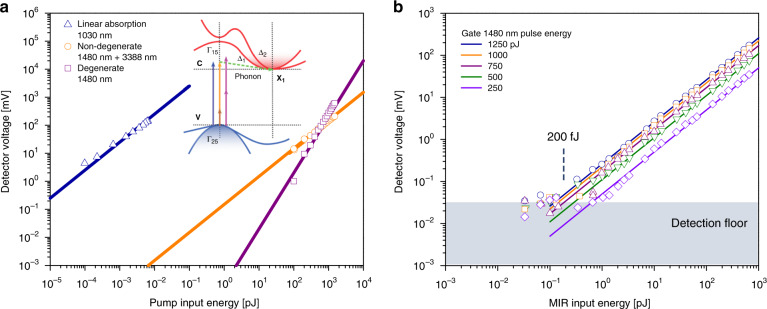
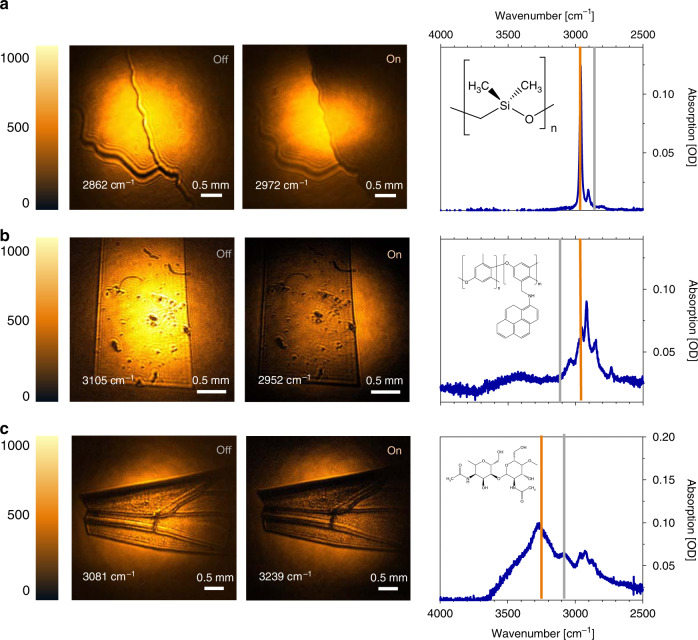
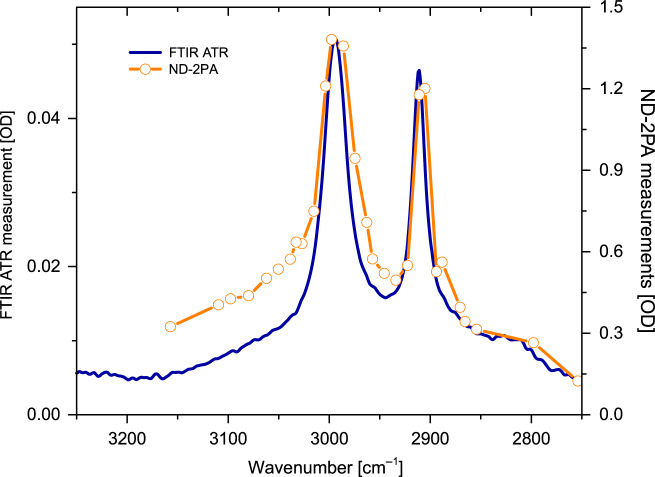
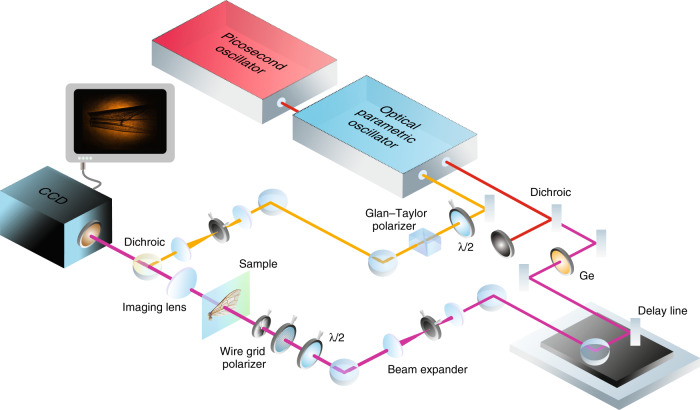
Chemical imaging based on mid-infrared (MIR) spectroscopic contrast is an important technique with a myriad of applications, including biomedical imaging and environmental monitoring. Current MIR cameras, however, lack performance and are much less affordable than mature Si-based devices, which operate in the visible and near-infrared regions. Here, we demonstrate fast MIR chemical imaging through non-degenerate two-photon absorption (NTA) in a standard Si-based charge-coupled device (CCD). We show that wide-field MIR images can be obtained at 100 ms exposure times using picosecond pulse energies of only a few femtojoules per pixel through NTA directly on the CCD chip. Because this on-chip approach does not rely on phase matching, it is alignment-free and does not necessitate complex postprocessing of the images. We emphasize the utility of this technique through chemically selective MIR imaging of polymers and biological samples, including MIR videos of moving targets, physical processes and live nematodes.
基于中红外(MIR)光谱对比度的化学成像是一项重要技术,有众多应用,包括生物医学成像和环境监测。然而,当前的中红外相机性能欠佳,且远不如在可见光和近红外区域工作的成熟硅基设备那样价格亲民。在此,我们展示了通过标准硅基电荷耦合器件(CCD)中的非简并双光子吸收(NTA)实现快速中红外化学成像。我们表明,通过直接在CCD芯片上利用NTA,仅需每像素几飞焦的皮秒脉冲能量,在100毫秒曝光时间就能获得宽视野中红外图像。由于这种片上方法不依赖相位匹配,它无需校准,也无需对图像进行复杂的后处理。我们通过对聚合物和生物样本进行化学选择性中红外成像,包括对移动目标、物理过程和活线虫的中红外视频,强调了该技术的实用性。