Department of Respiratory Medicine, Xijing Hospital, The Fourth Military Medical University, Xi'an, Shaanxi 710032, P.R. China.
Shaanxi Key Laboratory of Brain Disorders and Institute of Basic Medical Sciences and Institute of Basic and Translational Medicine, Xi'an Medical University, Xi'an, Shaanxi 710021, P.R. China.
Oncol Rep. 2020 Sep;44(3):1049-1063. doi: 10.3892/or.2020.7683. Epub 2020 Jul 9.
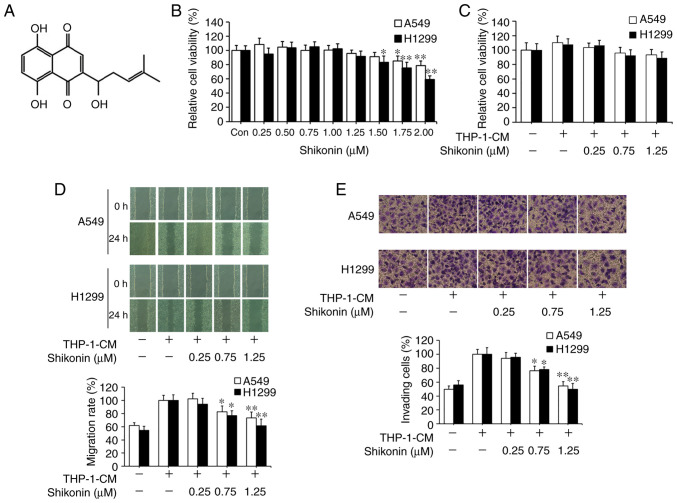
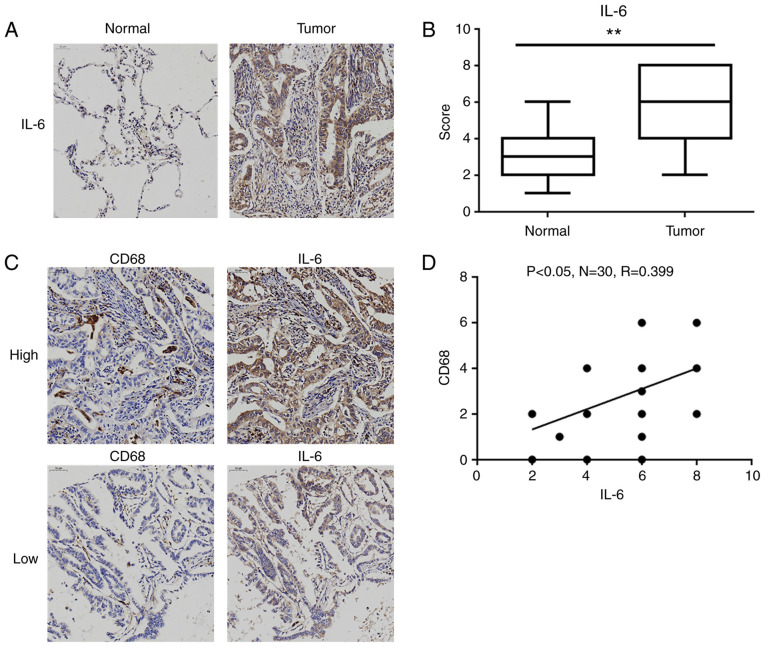
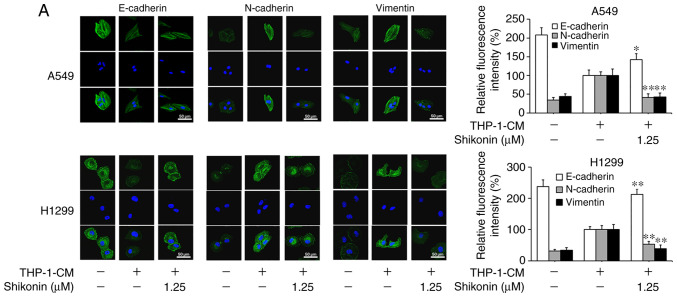
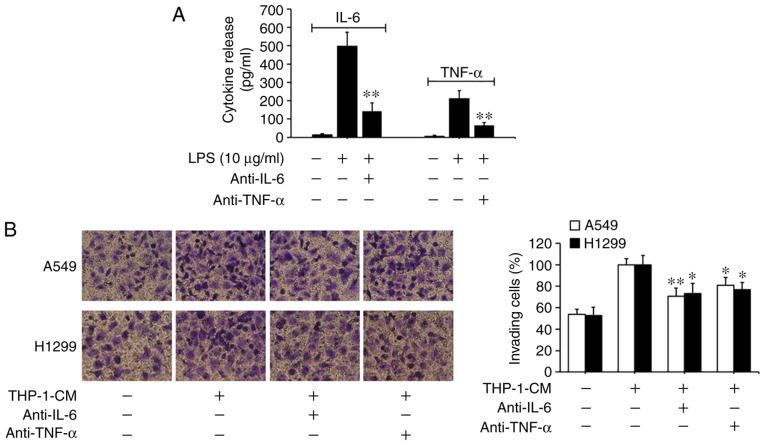
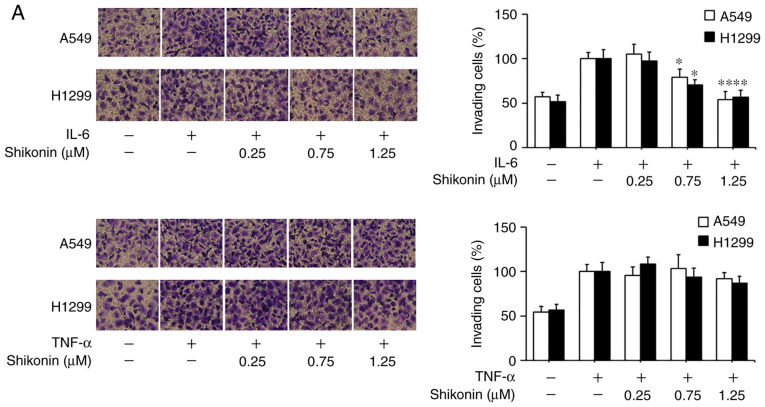
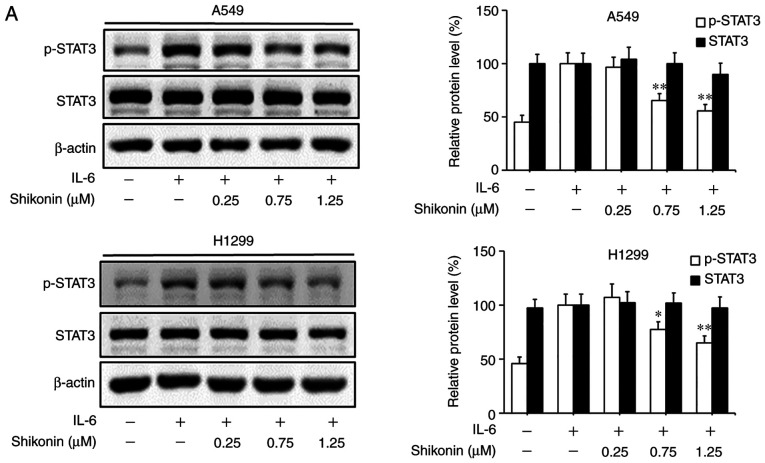
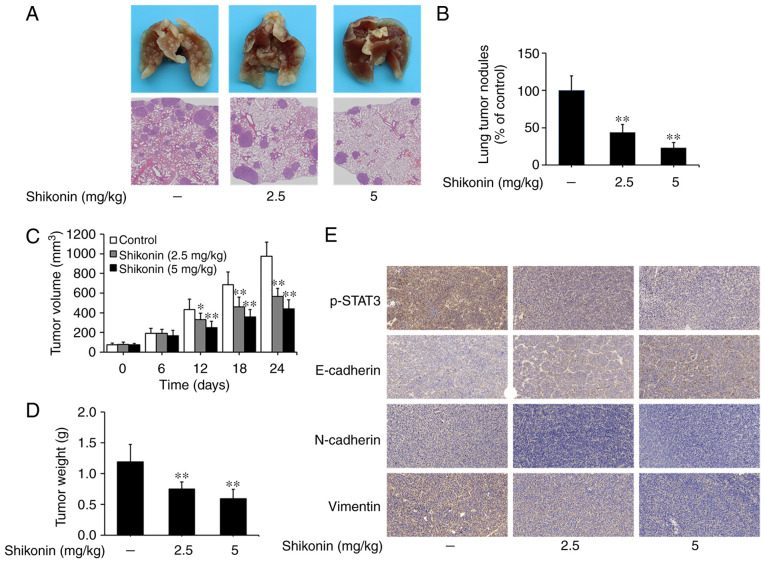
Increasing evidence indicates that the inflammatory tumor microenvironment can lead to cancer cell metastasis. Shikonin, which is extracted from the Chinese herb Zicao (the dried root of Lithospermum erythrorhizon), possesses various pharmacological effects, but its effect on tumor metastasis in the inflammatory microenvironment remains unknown. In the present study, we aimed to investigate the potential effect of shikonin on tumor metastasis in an inflammatory microenvironment as well as the underlying molecular mechanisms. It was found that, in the inflammatory microenvironment simulated by THP‑1 cell conditioned medium (THP‑1‑CM) in vitro, shikonin significantly inhibited the epithelial‑mesenchymal transition (EMT), migration and invasion of human lung adenocarcinoma cell lines A549 and H1299. In addition, we found that interleukin‑6 (IL‑6), which is expressed in THP‑1‑CM, promoted the EMT of lung adenocarcinoma cells, and shikonin markedly inhibited IL‑6‑induced EMT and cell motility. Moreover, shikonin inhibited IL‑6‑induced phosphorylation of signal transducer and activator of transcription 3 (STAT3), prevented phosphorylated STAT3 (p‑STAT3) translocation into the nucleus, and suppressed p‑STAT3 transactivation activity. Additionally, it was found that shikonin inhibited lung metastasis, EMT and expression of p‑STAT3 of A549 cells in vivo. Furthermore, IL‑6 levels in human lung adenocarcinoma tissues were significantly associated with tumor‑node‑metastasis stage and lymph node metastasis, and its expression was correlated with tumor‑associated macrophage (TAM) infiltration. Together, these results suggest that shikonin suppresses the migration and invasion of human lung adenocarcinoma cells in an inflammatory microenvironment involving the IL‑6/STAT3 signaling pathway.
越来越多的证据表明,炎症肿瘤微环境可导致癌细胞转移。紫草素是从中国草药紫草(紫草的干燥根)中提取的,具有多种药理作用,但它对炎症微环境中肿瘤转移的影响尚不清楚。本研究旨在探讨紫草素在炎症微环境中对肿瘤转移的潜在影响及其潜在的分子机制。结果发现,在体外 THP-1 细胞条件培养基(THP-1-CM)模拟的炎症微环境中,紫草素显著抑制人肺腺癌细胞系 A549 和 H1299 的上皮间质转化(EMT)、迁移和侵袭。此外,我们发现 THP-1-CM 中表达的白细胞介素-6(IL-6)促进肺腺癌细胞的 EMT,而紫草素显著抑制 IL-6 诱导的 EMT 和细胞迁移。此外,紫草素抑制 IL-6 诱导的信号转导和转录激活因子 3(STAT3)磷酸化,阻止磷酸化 STAT3(p-STAT3)易位入核,并抑制 p-STAT3 反式激活活性。此外,还发现紫草素抑制 A549 细胞在体内的肺转移、EMT 和 p-STAT3 的表达。此外,人肺腺癌组织中 IL-6 水平与肿瘤-淋巴结-转移分期显著相关,其表达与肿瘤相关巨噬细胞(TAM)浸润相关。综上所述,这些结果表明,紫草素通过 IL-6/STAT3 信号通路抑制人肺腺癌细胞在炎症微环境中的迁移和侵袭。