Department of Environmental Health, Boston University School of Public Health, Boston, MA 02118, USA.
Department of Molecular Genetics and Microbiology, University of New Mexico School of Medicine, Albuquerque, NM 87131, USA.
Int J Environ Res Public Health. 2020 Jul 22;17(15):5263. doi: 10.3390/ijerph17155263.
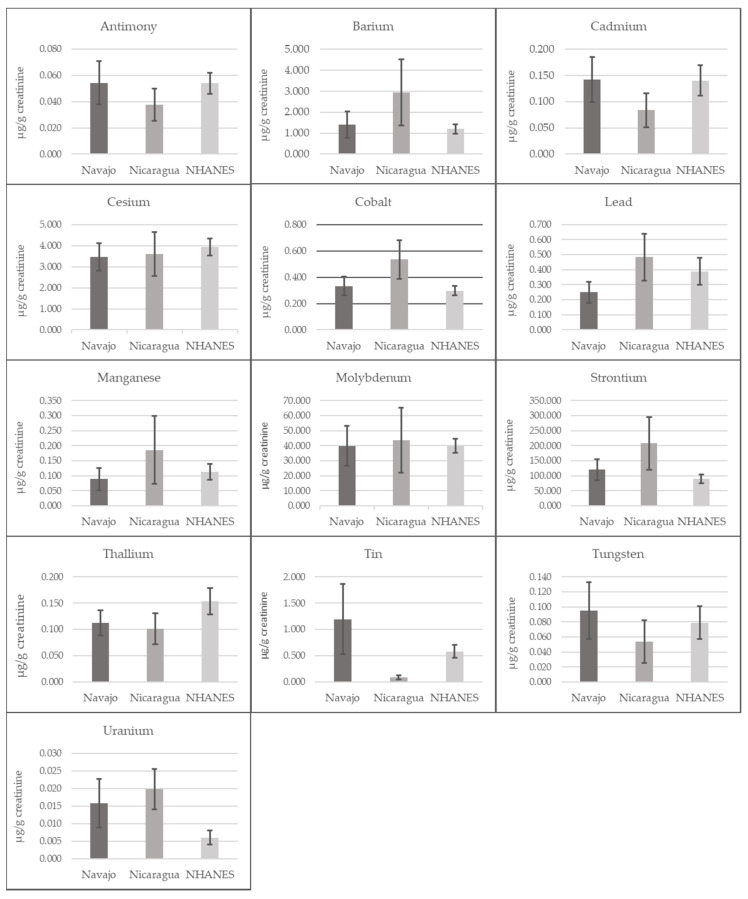
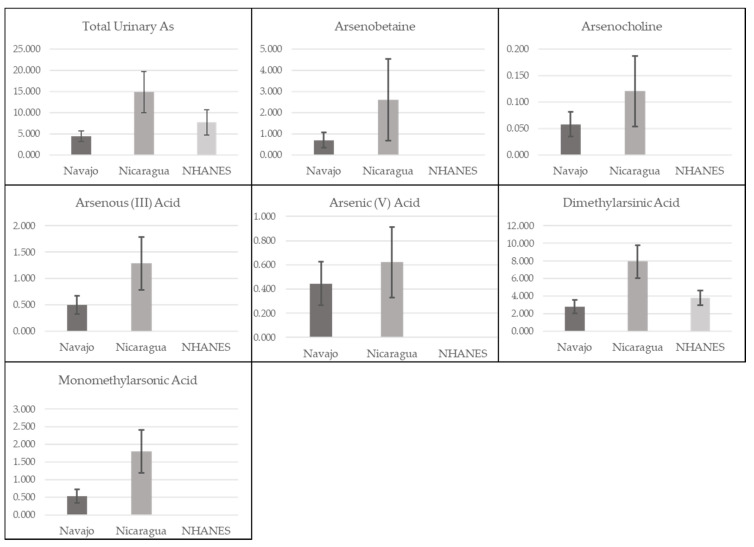
Metals are suspected contributors of autoimmune disease among indigenous Americans. However, the association between metals exposure and biomarkers of autoimmunity is under-studied. In Nicaragua, environmental exposure to metals is also largely unexamined with regard to autoimmunity. We analyzed pooled and stratified exposure and outcome data from Navajo ( = 68) and Nicaraguan ( = 47) men of similar age and health status in order to characterize urinary concentrations of metals, compare concentrations with the US National Health and Nutrition Examination Survey (NHANES) male population, and examine the associations with biomarkers of autoimmunity. Urine samples were analyzed for metals via inductively coupled plasma mass spectrometry (ICP-MS) at the US Centers for Disease Control and Prevention. Serum samples were examined for antinuclear antibodies (ANA) at 1:160 and 1:40 dilutions, using an indirect immunofluorescence assay and for specific autoantibodies using enzyme-linked immunosorbent assay (ELISA). Logistic regression analyses evaluated associations of urinary metals with autoimmune biomarkers, adjusted for group (Navajo or Nicaraguan), age, and seafood consumption. The Nicaraguan men had higher urinary metal concentrations compared with both NHANES and the Navajo for most metals; however, tin was highest among the Navajo, and uranium was much higher in both populations compared with NHANES. Upper tertile associations with ANA positivity at the 1:160 dilution were observed for barium, cesium, lead, strontium and tungsten.
金属被怀疑是导致美洲原住民自身免疫疾病的因素之一。然而,金属暴露与自身免疫生物标志物之间的关联还没有得到充分研究。在尼加拉瓜,环境暴露与金属对自身免疫的影响也基本上没有被研究过。我们分析了来自纳瓦霍族( = 68 人)和尼加拉瓜人( = 47 人)的、年龄和健康状况相似的男性的合并和分层暴露与结局数据,以描述尿液中金属的浓度,将这些浓度与美国国家健康和营养检查调查(NHANES)男性人群进行比较,并研究其与自身免疫生物标志物的关联。尿液样本通过电感耦合等离子体质谱法(ICP-MS)在美国疾病控制与预防中心进行金属分析。血清样本通过间接免疫荧光测定法在 1:160 和 1:40 稀释度下检查抗核抗体(ANA),并使用酶联免疫吸附测定法(ELISA)检查特定的自身抗体。逻辑回归分析评估了尿液金属与自身免疫生物标志物之间的关联,调整了组(纳瓦霍族或尼加拉瓜族)、年龄和海鲜摄入因素。与 NHANES 相比,尼加拉瓜男性的大多数金属尿液浓度均高于 NHANES 和纳瓦霍族男性;然而,锡在纳瓦霍族男性中含量最高,铀在两个群体中的含量均远高于 NHANES。在 1:160 稀释度下,与 ANA 阳性相关的上三分位值与钡、铯、铅、锶和钨有关。