Picca Anna, Calvani Riccardo, Coelho-Junior Hélio José, Landi Francesco, Bernabei Roberto, Marzetti Emanuele
Fondazione Policlinico Universitario "Agostino Gemelli" IRCCS, 00168 Rome, Italy.
Università Cattolica del Sacro Cuore, 00168 Rome, Italy.
Antioxidants (Basel). 2020 Jul 22;9(8):647. doi: 10.3390/antiox9080647.
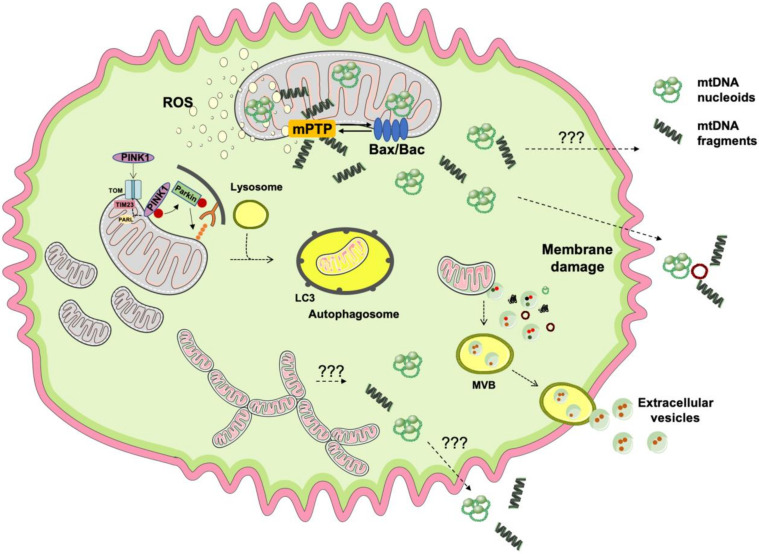
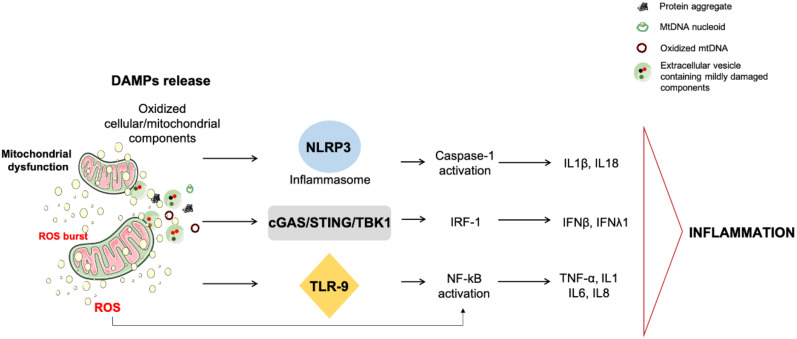
Oxidative stress develops as a response to injury and reflects a breach in the cell's antioxidant capacity. Therefore, the fine-tuning of reactive oxygen species (ROS) generation is crucial for preserving cell's homeostasis. Mitochondria are a major source and an immediate target of ROS. Under different stimuli, including oxidative stress and impaired quality control, mitochondrial constituents (e.g., mitochondrial DNA, mtDNA) are displaced toward intra- or extracellular compartments. However, the mechanisms responsible for mtDNA unloading remain largely unclear. While shuttling freely within the cell, mtDNA can be delivered into the extracellular compartment via either extrusion of entire nucleoids or the generation and release of extracellular vesicles. Once discarded, mtDNA may act as a damage-associated molecular pattern (DAMP) and trigger an innate immune inflammatory response by binding to danger-signal receptors. Neuroinflammation is associated with a large array of neurological disorders for which mitochondrial DAMPs could represent a common thread supporting disease progression. The exploration of non-canonical pathways involved in mitochondrial quality control and neurodegeneration may unveil novel targets for the development of therapeutic agents. Here, we discuss these processes in the setting of two common neurodegenerative diseases (Alzheimer's and Parkinson's disease) and Down syndrome, the most frequent progeroid syndrome.
氧化应激作为对损伤的一种反应而产生,反映了细胞抗氧化能力的破坏。因此,精确调节活性氧(ROS)的产生对于维持细胞的稳态至关重要。线粒体是ROS的主要来源和直接靶点。在包括氧化应激和质量控制受损在内的不同刺激下,线粒体成分(如线粒体DNA,mtDNA)会向细胞内或细胞外区室转移。然而,负责mtDNA卸载的机制在很大程度上仍不清楚。mtDNA在细胞内自由穿梭时,可通过整个核仁的挤出或细胞外囊泡的产生和释放进入细胞外区室。一旦被丢弃,mtDNA可能作为一种损伤相关分子模式(DAMP),通过与危险信号受体结合触发先天性免疫炎症反应。神经炎症与一系列神经疾病有关,线粒体DAMPs可能是支持疾病进展的一个共同因素。探索参与线粒体质量控制和神经退行性变的非经典途径可能会揭示治疗药物开发的新靶点。在这里,我们在两种常见的神经退行性疾病(阿尔茨海默病和帕金森病)以及最常见的早衰综合征唐氏综合征的背景下讨论这些过程。