Toma Milan, Einstein Daniel R, Kohli Keshav, Caroll Sheridan L, Bloodworth Charles H, Cochran Richard P, Kunzelman Karyn S, Yoganathan Ajit P
Department of Osteopathic Manipulative Medicine, College of Osteopathic Medicine, New York Institute of Technology, Old Westbury Campus, Northern Boulevard, Old Westbury, NY 11568-8000, USA.
Wallace H. Coulter Department of Biomedical Engineering, Georgia Institute of Technology and Emory University, Technology Enterprise Park, 387 Technology Circle, Atlanta, GA 30313-2412, USA.
Biology (Basel). 2020 Jul 18;9(7):173. doi: 10.3390/biology9070173.
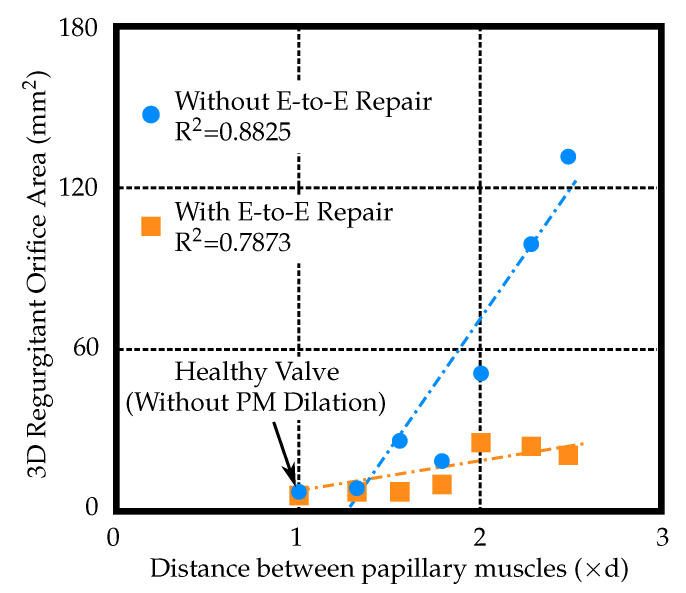
Edge-to-edge repair for mitral valve regurgitation is being increasingly performed in high-surgical risk patients using minimally invasive mitral clipping devices. Known procedural complications include chordal rupture and mitral leaflet perforation. Hence, it is important to quantitatively evaluate the effect of edge-to-edge repair on chordal integrity. in this study, we employ a computational mitral valve model to simulate functional mitral regurgitation (FMR) by creating papillary muscle displacement. Edge-to-edge repair is then modeled by simulated coaptation of the mid portion of the mitral leaflets. in the setting of simulated FMR, edge-to-edge repair was shown to sustain low regurgitant orifice area, until a two fold increase in the inter-papillary muscle distance as compared to the normal mitral valve. Strain in the chordae was evaluated near the papillary muscles and the leaflets. Following edge-to-edge repair, strain near the papillary muscles did not significantly change relative to the unrepaired valve, while strain near the leaflets increased significantly relative to the unrepaired valve. These data demonstrate the potential for computational simulations to aid in the pre-procedural evaluation of possible complications such as chordal rupture and leaflet perforation following percutaneous edge-to-edge repair.
对于手术风险高的患者,越来越多地使用微创二尖瓣夹合装置进行二尖瓣反流的缘对缘修复。已知的手术并发症包括腱索断裂和二尖瓣叶穿孔。因此,定量评估缘对缘修复对腱索完整性的影响非常重要。在本研究中,我们采用一个计算二尖瓣模型,通过制造乳头肌移位来模拟功能性二尖瓣反流(FMR)。然后通过模拟二尖瓣叶中部的对合来模拟缘对缘修复。在模拟FMR的情况下,与正常二尖瓣相比,直到乳头肌间距离增加两倍时,缘对缘修复仍能维持较低的反流口面积。在乳头肌和瓣叶附近评估腱索的应变。缘对缘修复后,相对于未修复的瓣膜,乳头肌附近的应变没有显著变化,而相对于未修复的瓣膜,瓣叶附近的应变显著增加。这些数据表明,计算模拟有可能有助于在经皮缘对缘修复后对诸如腱索断裂和瓣叶穿孔等可能并发症进行术前评估。