ATORG, Aschaffenburg Trauma and Orthopedic Research Group, Center for Orthopedics, Trauma Surgery and Sports Medicine, Hospital Aschaffenburg-Alzenau, D-63739 Aschaffenburg, Germany.
HTRG, Heidelberg Trauma Research Group, Center for Orthopedics, Trauma Surgery and Spinal Cord Injury, Heidelberg University Hospital, D-69118 Heidelberg, Germany.
Nutrients. 2020 Jul 16;12(7):2098. doi: 10.3390/nu12072098.
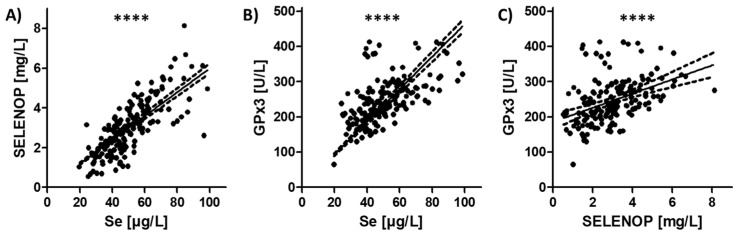
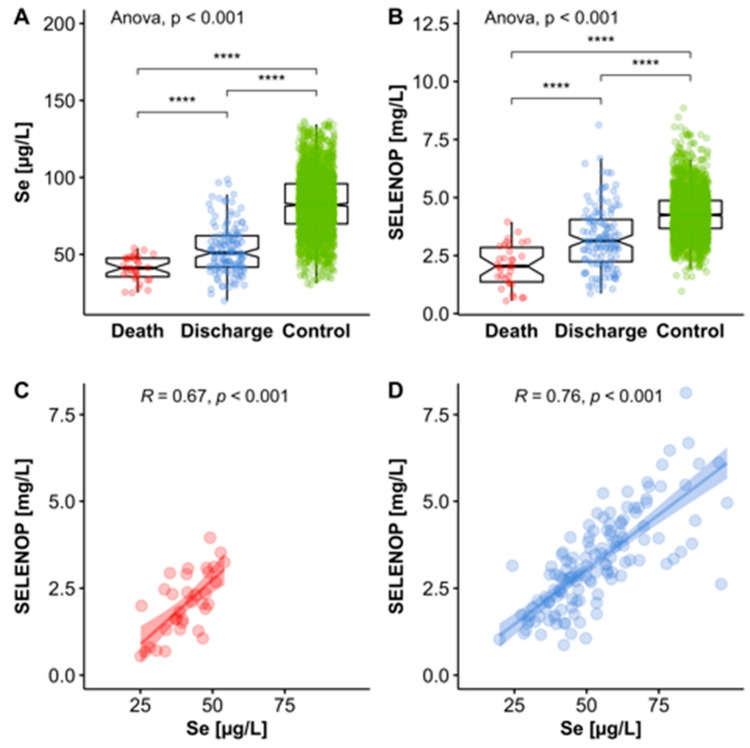
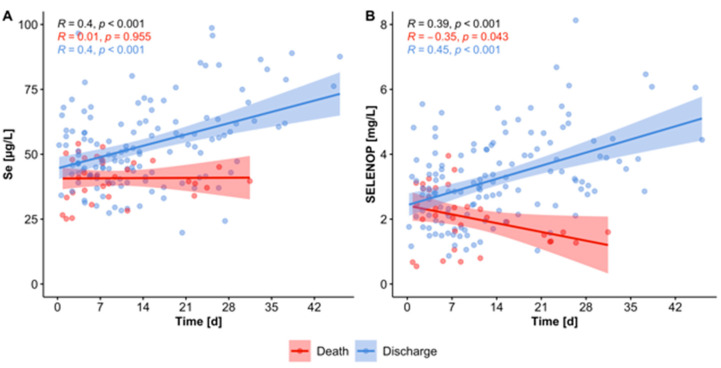
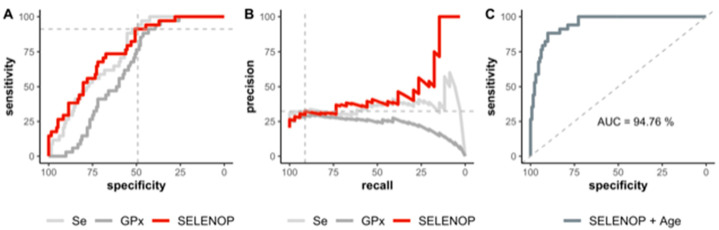
SARS-CoV-2 infections underlie the current coronavirus disease (COVID-19) pandemic and are causative for a high death toll particularly among elderly subjects and those with comorbidities. Selenium (Se) is an essential trace element of high importance for human health and particularly for a well-balanced immune response. The mortality risk from a severe disease like sepsis or polytrauma is inversely related to Se status. We hypothesized that this relation also applies to COVID-19. Serum samples ( = 166) from COVID-19 patients ( = 33) were collected consecutively and analyzed for total Se by X-ray fluorescence and selenoprotein P (SELENOP) by a validated ELISA. Both biomarkers showed the expected strong correlation ( = 0.7758, < 0.001), pointing to an insufficient Se availability for optimal selenoprotein expression. In comparison with reference data from a European cross-sectional analysis (EPIC, = 1915), the patients showed a pronounced deficit in total serum Se (mean ± SD, 50.8 ± 15.7 vs. 84.4 ± 23.4 µg/L) and SELENOP (3.0 ± 1.4 vs. 4.3 ± 1.0 mg/L) concentrations. A Se status below the 2.5th percentile of the reference population, i.e., [Se] < 45.7 µg/L and [SELENOP] < 2.56 mg/L, was present in 43.4% and 39.2% of COVID samples, respectively. The Se status was significantly higher in samples from surviving COVID patients as compared with non-survivors (Se; 53.3 ± 16.2 vs. 40.8 ± 8.1 µg/L, SELENOP; 3.3 ± 1.3 vs. 2.1 ± 0.9 mg/L), recovering with time in survivors while remaining low or even declining in non-survivors. We conclude that Se status analysis in COVID patients provides diagnostic information. However, causality remains unknown due to the observational nature of this study. Nevertheless, the findings strengthen the notion of a relevant role of Se for COVID convalescence and support the discussion on adjuvant Se supplementation in severely diseased and Se-deficient patients.
SARS-CoV-2 感染是当前冠状病毒病(COVID-19)大流行的基础,也是导致老年人和合并症患者高死亡率的原因。硒(Se)是人体健康的必需微量元素,对平衡免疫反应尤为重要。严重疾病(如败血症或多发伤)的死亡率与 Se 状态呈负相关。我们假设这种关系也适用于 COVID-19。连续收集了 COVID-19 患者(n=33)的血清样本(n=166),并用 X 射线荧光法测定总 Se,用经过验证的 ELISA 测定硒蛋白 P(SELENOP)。两种生物标志物均表现出强烈的相关性(r=0.7758,<0.001),表明 Se 的可用性不足以实现最佳的硒蛋白表达。与欧洲横断面分析(EPIC,n=1915)的参考数据相比,患者的总血清 Se(平均值±标准差,50.8±15.7 vs. 84.4±23.4 µg/L)和 SELENOP(3.0±1.4 vs. 4.3±1.0 mg/L)浓度明显降低。人群中 Se 状态低于参考值的第 2.5 百分位数,即[Se]<45.7 µg/L 和[SELENOP]<2.56 mg/L,分别存在于 43.4%和 39.2%的 COVID 样本中。与非幸存者相比,存活 COVID 患者的 Se 状态明显更高(Se:53.3±16.2 vs. 40.8±8.1 µg/L,SELENOP:3.3±1.3 vs. 2.1±0.9 mg/L),幸存者的 Se 状态随时间恢复,而非幸存者的 Se 状态保持较低甚至下降。我们得出结论,COVID 患者的 Se 状态分析提供了诊断信息。然而,由于本研究的观察性质,因果关系尚不清楚。尽管如此,这些发现还是加强了 Se 对 COVID 康复有重要作用的观点,并支持了关于在严重疾病和 Se 缺乏患者中辅助补充 Se 的讨论。