Max Planck Institute for Biophysics, Max-von-Laue Strasse, 3, 60348, Frankfurt am Main, Germany.
Buchmann Institute for Molecular Life Sciences, Goethe University of Frankfurt am Main, Max-von-Laue Strasse, 15, 60348, Frankfurt am Main, Germany.
Nat Commun. 2020 Jul 24;11(1):3709. doi: 10.1038/s41467-020-17466-0.
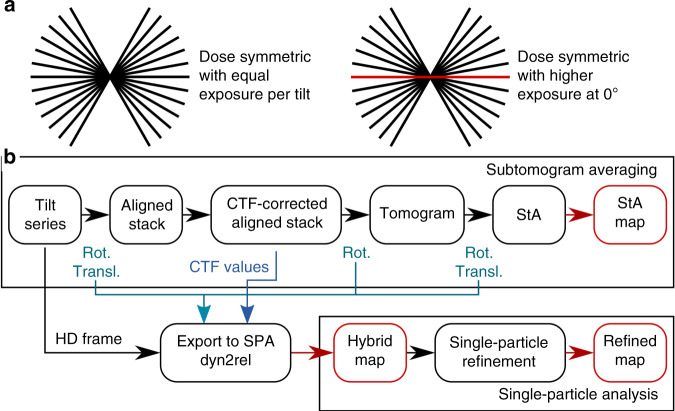
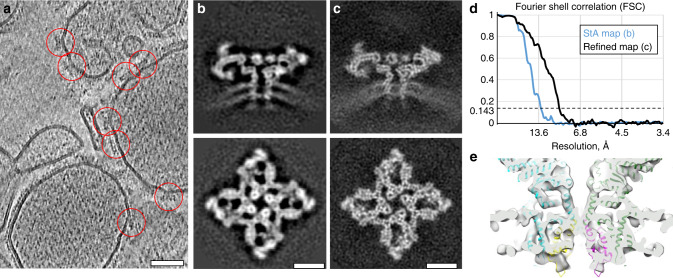
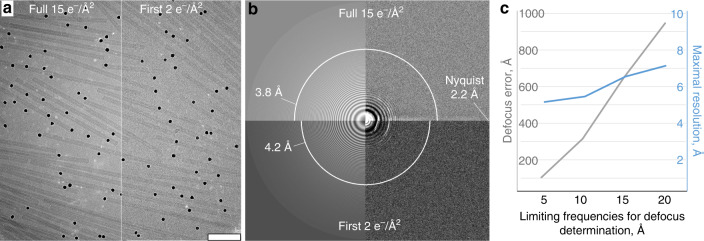
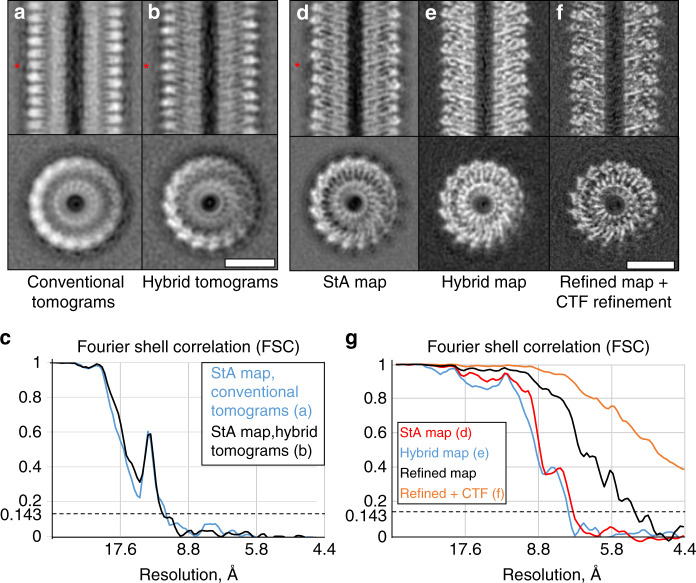
Cryo-electron tomography combined with subtomogram averaging (StA) has yielded high-resolution structures of macromolecules in their native context. However, high-resolution StA is not commonplace due to beam-induced sample drift, images with poor signal-to-noise ratios (SNR), challenges in CTF correction, and limited particle number. Here we address these issues by collecting tilt series with a higher electron dose at the zero-degree tilt. Particles of interest are then located within reconstructed tomograms, processed by conventional StA, and then re-extracted from the high-dose images in 2D. Single particle analysis tools are then applied to refine the 2D particle alignment and generate a reconstruction. Use of our hybrid StA (hStA) workflow improved the resolution for tobacco mosaic virus from 7.2 to 4.4 Å and for the ion channel RyR1 in crowded native membranes from 12.9 to 9.1 Å. These resolution gains make hStA a promising approach for other StA projects aimed at achieving subnanometer resolution.
冷冻电子断层扫描结合子断层平均(StA)已获得了在其自然环境下的大分子的高分辨率结构。然而,由于束流引起的样品漂移、信噪比(SNR)差的图像、CTF 校正的挑战以及有限的粒子数量,高分辨率的 StA 并不常见。在这里,我们通过在零角度倾斜时收集更高电子剂量的倾斜系列来解决这些问题。然后在重建的断层扫描中找到感兴趣的粒子,通过传统的 StA 进行处理,然后从高剂量图像中以 2D 重新提取。然后应用单粒子分析工具来改进 2D 粒子对准并生成重建。我们的混合 StA(hStA)工作流程的使用将烟草花叶病毒的分辨率从 7.2 提高到了 4.4 Å,将拥挤的天然膜中的离子通道 RyR1 的分辨率从 12.9 提高到了 9.1 Å。这些分辨率的提高使得 hStA 成为实现亚纳米分辨率的其他 StA 项目的有前途的方法。