Department of Integrative Medical Biologi, Umeå University, Umeå, Sweden.
Department of Medical Epidemiology and Biostatistics, Karolinska Institutet, Stockholm, Sweden.
Transl Psychiatry. 2020 Jul 24;10(1):250. doi: 10.1038/s41398-020-00934-y.
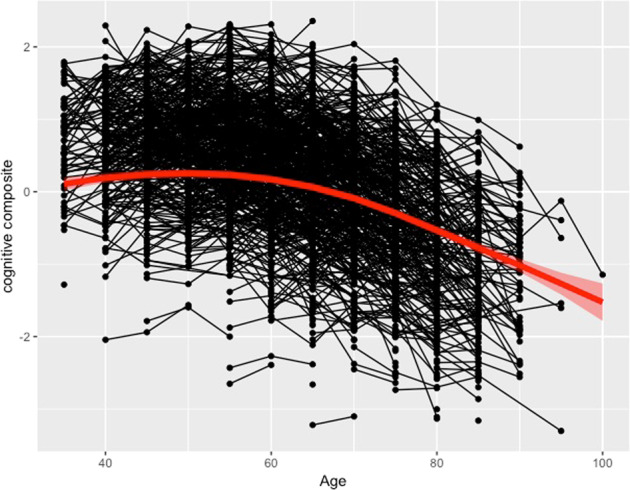
Most people's cognitive abilities decline with age, with significant and partly genetically driven, individual differences in rate of change. Although APOE ɛ4 and genetic scores for late-onset Alzheimer's disease (LOAD) have been related to cognitive decline during preclinical stages of dementia, there is limited knowledge concerning genetic factors implied in normal cognitive aging. In the present study, we examined three potential genetic predictors of age-related cognitive decline as follows: (1) the APOE ɛ4 allele, (2) a polygenic score for general cognitive ability (PGS-cog), and (3) a polygenic risk score for late-onset AD (PRS-LOAD). We examined up to six time points of cognitive measurements in the longitudinal population-based Betula study, covering a 25-year follow-up period. Only participants that remained alive and non-demented until the most recent dementia screening (1-3 years after the last test occasion) were included (n = 1087). Individual differences in rate of cognitive change (composite score) were predicted by the PRS-LOAD and APOE ɛ4, but not by PGS-cog. To control for the possibility that the results reflected a preclinical state of Alzheimer's disease in some participants, we re-ran the analyses excluding cognitive data from the last test occasion to model cognitive change up-until a minimum of 6 years before potential onset of clinical Alzheimers. Strikingly, the association of PRS-LOAD, but not APOE ɛ4, with cognitive change remained. The results indicate that PRS-LOAD predicts individual difference in rate of cognitive decline in normal aging, but it remains to be determined to what extent this reflects preclinical Alzheimer's disease brain pathophysiology and subsequent risk to develop the disease.
大多数人的认知能力会随着年龄的增长而下降,其变化速度存在显著的个体差异,部分受到遗传因素的影响。尽管 APOE ɛ4 等位基因和迟发性阿尔茨海默病(LOAD)的遗传评分与痴呆前阶段的认知能力下降有关,但对于正常认知衰老中涉及的遗传因素知之甚少。在本研究中,我们研究了三个可能的遗传预测因子与年龄相关的认知下降有关,如下所示:(1)APOE ɛ4 等位基因,(2)一般认知能力的多基因评分(PGS-cog),和(3)迟发性 AD 的多基因风险评分(PRS-LOAD)。我们在纵向人群基础的 Betula 研究中检查了六个时间点的认知测量,涵盖了 25 年的随访期。只有那些在最近的痴呆筛查中仍然存活且没有痴呆(在最后一次测试后 1-3 年)的参与者才被包括在内(n=1087)。认知变化率(综合评分)的个体差异由 PRS-LOAD 和 APOE ɛ4 预测,但不受 PGS-cog 预测。为了控制结果反映某些参与者的阿尔茨海默病临床前状态的可能性,我们排除了最后一次测试时的认知数据,重新分析了认知变化模型,直到潜在的临床阿尔茨海默病发病前至少 6 年。引人注目的是,PRS-LOAD 与认知变化的关联仍然存在,但 APOE ɛ4 则不然。结果表明,PRS-LOAD 可预测正常衰老过程中认知下降率的个体差异,但仍有待确定这在多大程度上反映了临床前阿尔茨海默病的大脑病理生理学以及随后发展为该病的风险。