Chandler Hannah Louise, Wheeler Joshua, Escott-Price Valentina, Murphy Kevin, Lancaster Thomas Matthew
School of Physics and Astronomy, Cardiff University Brain Research Imaging Centre (CUBRIC), Cardiff University, Cardiff, UK.
School of Clinical Sciences, University of Bristol, Bristol, UK.
Alzheimers Dement. 2025 Feb;21(2):e14455. doi: 10.1002/alz.14455. Epub 2024 Dec 31.
White matter hyperintensity volumes (WMHVs) are disproportionally prevalent in individuals with Alzheimer's disease (AD), potentially reflecting neurovascular injury. We quantify the association between AD polygenic risk score (AD-PRS) and WMHV, exploring single-nucleotide polymorphisms (SNPs) that are proximal to genes overexpressed in cerebrovascular cell species.
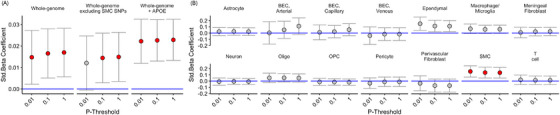
In a UK-Biobank sub-sample (mean age = 64, range = 45-81 years), we associate WMHV with (1) AD-PRS estimated via SNPs across the genome (minus apolipoprotein E [APOE] locus) and (2) AD-PRS estimated with SNPs proximal to specific genes that are overexpressed in cerebrovascular cell species.
We observed a positive association between non-APOE-AD-PRS and WMHVs. We further demonstrate an association between WMHVs and AD-PRS constructed with SNPs that are proximal to genes over-represented in smooth muscles cells (SMCs; β = 0.135, P < 0.01) and internally replicated (P< 0.01).
Common AD genetic risk could explain physiological processes underlying vascular pathology in AD. SMC function may offer a treatment target to prevent WMHV-related AD pathophysiology prior to the onset of symptoms.
Alzheimer's disease (AD) risk factors such as apolipoprotein E (APOE) ε4, link to increased white matter hyperintensity volume (WMHV). WMHVs indicate vascular risk and neurovascular injury in AD. The broader genetic link between AD risk and WMHV is not fully understood. We quantify AD polygenic risk score (PRS) associations with WMHV, excluding APOE. AD-PRS in smooth muscle cells (SMCs) shows a significant association with increased WMHV.
白质高信号体积(WMHV)在阿尔茨海默病(AD)患者中普遍存在,可能反映神经血管损伤。我们量化了AD多基因风险评分(AD-PRS)与WMHV之间的关联,探索与脑血管细胞中过表达基因邻近的单核苷酸多态性(SNP)。
在英国生物银行的一个子样本(平均年龄=64岁,范围=45-81岁)中,我们将WMHV与(1)通过全基因组SNP估计的AD-PRS(减去载脂蛋白E [APOE]基因座)以及(2)用脑血管细胞中过表达的特定基因邻近的SNP估计的AD-PRS相关联。
我们观察到非APOE-AD-PRS与WMHV之间存在正相关。我们进一步证明了WMHV与用平滑肌细胞(SMC)中过表达基因邻近的SNP构建的AD-PRS之间的关联(β=0.135,P<0.01),并在内部重复验证(P<0.01)。
常见的AD遗传风险可以解释AD血管病理的生理过程。SMC功能可能为在症状出现之前预防与WMHV相关的AD病理生理提供一个治疗靶点。
阿尔茨海默病(AD)的风险因素如载脂蛋白E(APOE)ε4与白质高信号体积(WMHV)增加有关。WMHV表明AD中的血管风险和神经血管损伤。AD风险与WMHV之间更广泛的遗传联系尚未完全了解。我们量化了排除APOE的AD多基因风险评分(PRS)与WMHV的关联。平滑肌细胞(SMC)中的AD-PRS与WMHV增加显著相关。