Department of Chinese Medicine, The First Affiliated Hospital of Zhengzhou University, Zhengzhou, 450000, China.
Department of Clinical Pharmacology, Xiangya Hospital, Central South University, Changsha, 410000, China.
Cell Death Dis. 2020 Jul 24;11(7):579. doi: 10.1038/s41419-020-02794-2.
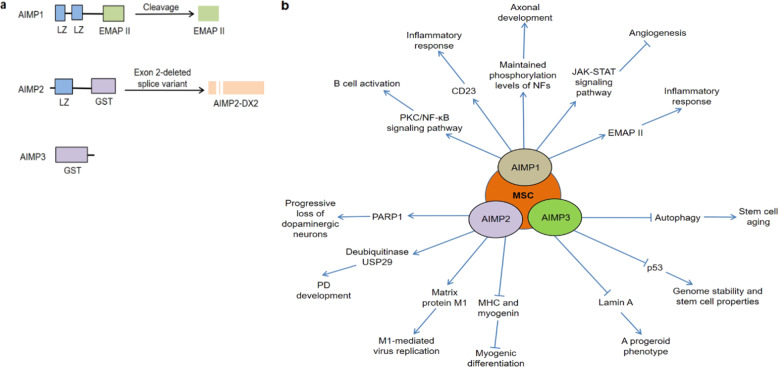
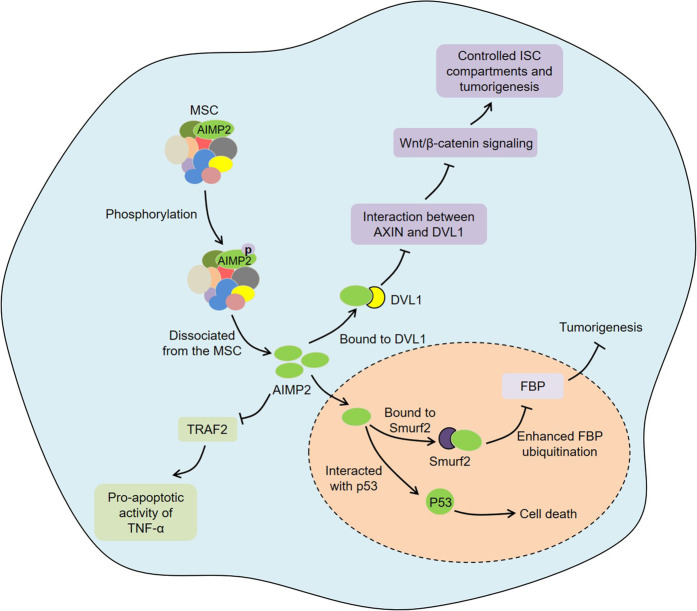
Aminoacyl-tRNA synthetases (ARSs) are an important class of enzymes with an evolutionarily conserved mechanism for protein synthesis. In higher eukaryotic systems, eight ARSs and three ARS-interacting multi-functional proteins (AIMPs) form a multi-tRNA synthetase complex (MSC), which seems to contribute to cellular homeostasis. Of these, AIMPs are generally considered as non-enzyme factors, playing a scaffolding role during MSC assembly. Although the functions of AIMPs are not fully understood, increasing evidence indicates that these scaffold proteins usually exert tumor-suppressive activities. In addition, endothelial monocyte-activating polypeptide II (EMAP II), as a cleavage product of AIMP1, and AIMP2-DX2, as a splice variant of AIMP2 lacking exon 2, also have a pivotal role in regulating tumorigenesis. In this review, we summarize the biological functions of AIMP1, EMAP II, AIMP2, AIMP2-DX2, and AIMP3. Also, we systematically introduce their emerging roles in cancer, aiming to provide new ideas for the treatment of cancer.
氨酰-tRNA 合成酶(ARSs)是一类重要的酶,具有进化上保守的蛋白质合成机制。在高等真核系统中,八种 ARSs 和三种 ARS 相互作用的多功能蛋白(AIMPs)形成多 tRNA 合成酶复合物(MSC),似乎有助于细胞内稳态。其中,AIMPs 通常被认为是非酶因子,在 MSC 组装过程中发挥支架作用。尽管 AIMPs 的功能尚未完全阐明,但越来越多的证据表明,这些支架蛋白通常具有肿瘤抑制活性。此外,内皮单核细胞激活肽 II(EMAP II)作为 AIMP1 的裂解产物,以及 AIMP2-DX2 作为缺少外显子 2 的 AIMP2 的剪接变体,也在调节肿瘤发生中起着关键作用。在这篇综述中,我们总结了 AIMP1、EMAP II、AIMP2、AIMP2-DX2 和 AIMP3 的生物学功能。此外,我们系统地介绍了它们在癌症中的新作用,旨在为癌症治疗提供新的思路。