SAMRC Microbial Water Quality Monitoring Centre, University of Fort Hare, Alice, South Africa.
Applied and Environmental Microbiology Research Group, Department of Biochemistry and Microbiology, University of Fort Hare, Alice, South Africa.
Microbiologyopen. 2020 Sep;9(9):e1035. doi: 10.1002/mbo3.1035. Epub 2020 Jul 25.
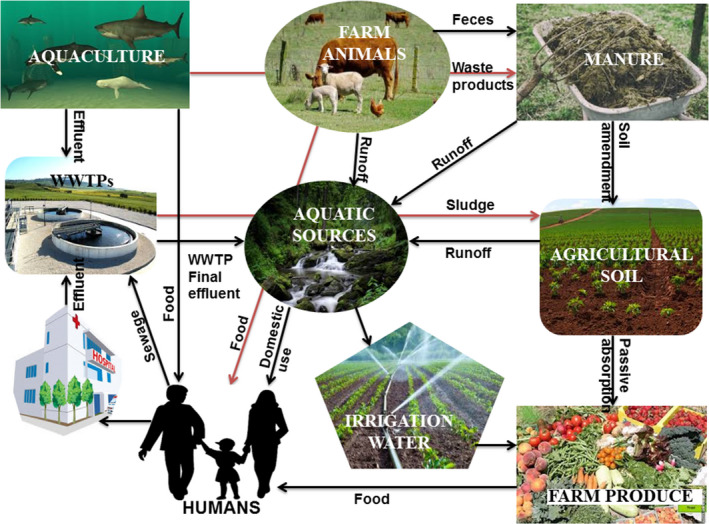
The agricultural ecosystem creates a platform for the development and dissemination of antimicrobial resistance, which is promoted by the indiscriminate use of antibiotics in the veterinary, agricultural, and medical sectors. This results in the selective pressure for the intrinsic and extrinsic development of the antimicrobial resistance phenomenon, especially within the aquaculture-animal-manure-soil-water-plant nexus. The existence of antimicrobial resistance in the environment has been well documented in the literature. However, the possible transmission routes of antimicrobial agents, their resistance genes, and naturally selected antibiotic-resistant bacteria within and between the various niches of the agricultural environment and humans remain poorly understood. This study, therefore, outlines an overview of the discovery and development of commonly used antibiotics; the timeline of resistance development; transmission routes of antimicrobial resistance in the agro-ecosystem; detection methods of environmental antimicrobial resistance determinants; factors involved in the evolution and transmission of antibiotic resistance in the environment and the agro-ecosystem; and possible ways to curtail the menace of antimicrobial resistance.
农业生态系统为抗生素在兽医、农业和医疗领域的滥用所推动的抗药性的发展和传播提供了一个平台。这导致了抗药性现象的内在和外在发展的选择压力,特别是在水产养殖-动物-粪便-土壤-水-植物的相互关系中。文献中已经充分记录了环境中存在抗药性的情况。然而,在农业环境和人类的各个生态位中,抗生素和其抗性基因的可能传播途径,以及天然选择的抗药性细菌,仍然知之甚少。因此,本研究概述了常用抗生素的发现和发展;抗药性发展的时间线;农业生态系统中抗药性的传播途径;环境中抗药性决定因素的检测方法;环境和农业生态系统中抗生素抗性进化和传播涉及的因素;以及遏制抗药性威胁的可能方法。