SAMRC Microbial Water Quality Monitoring Centre, University of Fort Hare, Alice, South Africa.
Applied and Environmental Microbiology Research Group, Department of Biochemistry and Microbiology, University of Fort Hare, Alice, South Africa.
PLoS One. 2020 Feb 10;15(2):e0228956. doi: 10.1371/journal.pone.0228956. eCollection 2020.
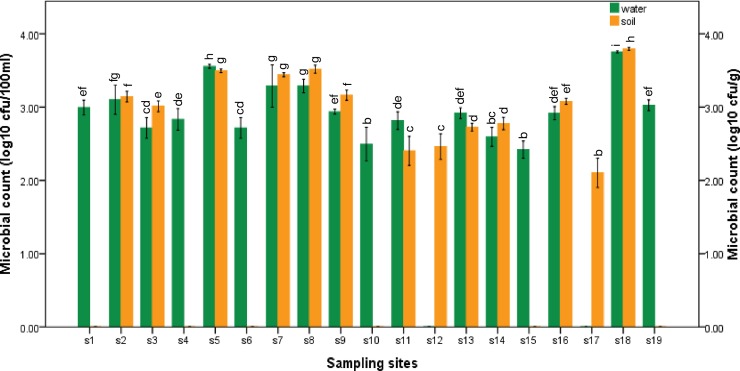
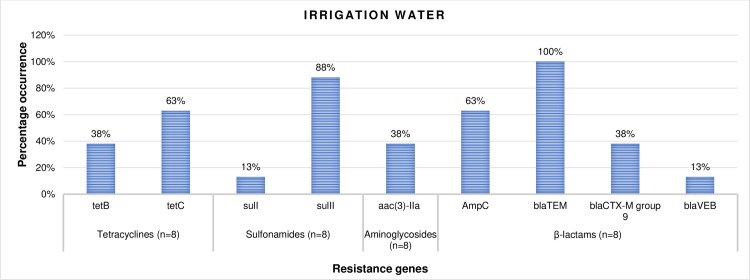
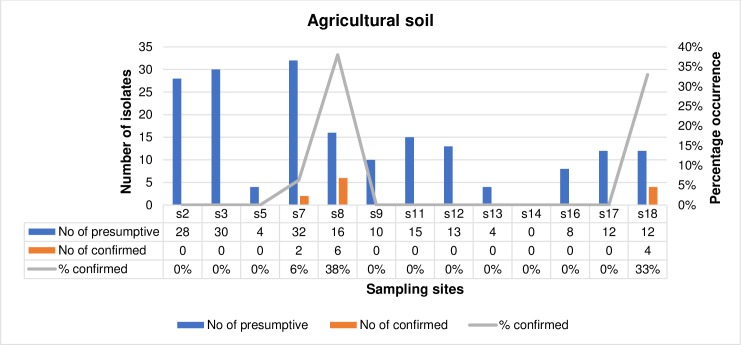
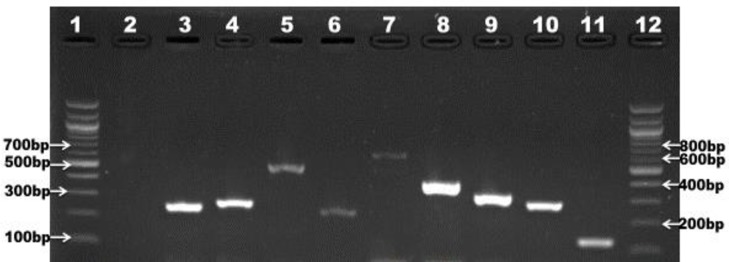
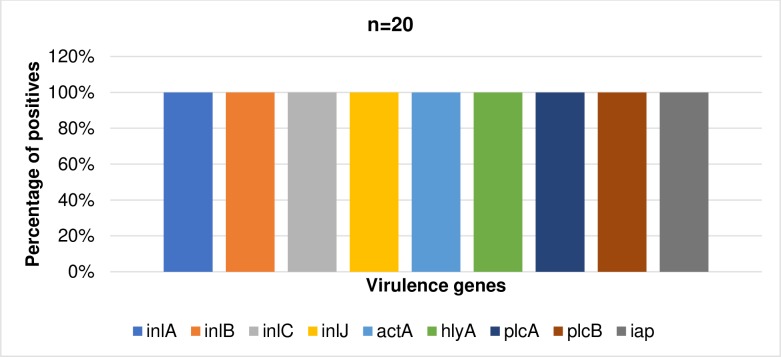
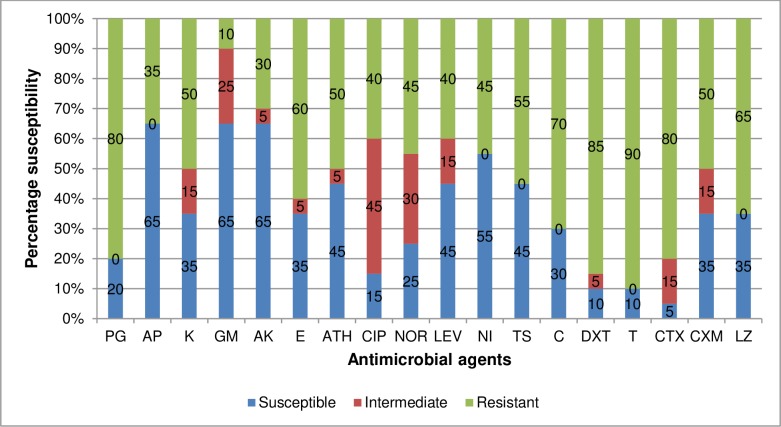
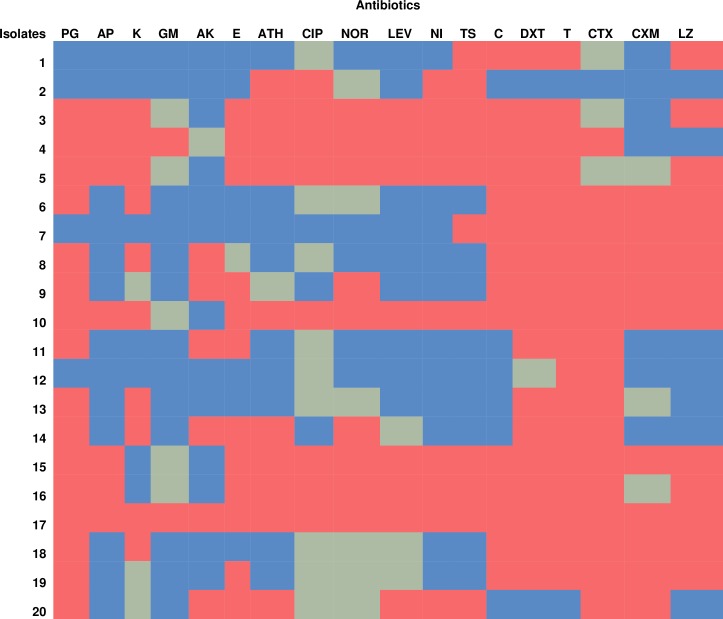
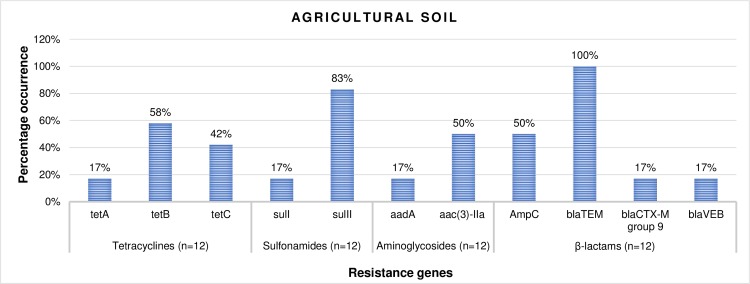
Listeria monocytogenes (L. monocytogenes) is a foodborne pathogen and the etiologic agent of listeriosis, which can be disseminated within the agricultural environment particularly soil and irrigation water, contaminate farm produce and cause high mortality and morbidity among vulnerable individuals. This study assessed the incidence and antibiogram of L. monocytogenes recovered from irrigation water and agricultural soil samples collected from Chris Hani and Amathole District Municipalities (DMs) in Eastern Cape Province, South Africa. The distribution of presumptive L. monocytogenes in irrigation water and agricultural soil samples was done using the standard plate count method, while polymerase chain reaction (PCR) was used to identify the isolates. The confirmed isolates were screened for 9 key virulence markers using PCR after which they were subjected to antibiotic susceptibility testing against 18 antibiotics used for the alleviation of listeriosis using the disk diffusion method. Relevant putative antibiotic resistance genes in the resistant variants were screened for using PCR. The distribution of L. monocytogenes in irrigation water samples was statistically significant (P ≤ 0.05) and ranged from log10 1.00 CFU/100ml to log10 3.75 CFU/100 ml. In agricultural soil samples, the distribution ranged significantly (P ≤ 0.05) from log10 2.10 CFU/g to log10 3.51 CFU/g. Of the 117 presumptive L. monocytogenes recovered from irrigation water samples and 183 presumptive L. monocytogenes isolated from agricultural soil samples, 8 (6.8%) and 12 (6.6%) isolates were confirmed respectively. Nine virulence genes including inlA, inlB, inlC, inlJ, actA, hlyA, plcA, plcB, and iap were detected in all the isolates. The proportion of the isolates exhibiting phenotypic resistance against the test antimicrobials followed the order: tetracycline (90%), doxycycline (85%), cefotaxime (80%), penicillin (80%), chloramphenicol (70%), linezolid (65%), erythromycin (60%) and trimethoprim/sulfamethoxazole (55%). The isolates exhibited multiple antibiotic resistance against 3 or more antibiotics and the MAR indices of all the multidrug isolates were ≥0.2. The isolates harboured antibiotic resistance genes including tetA, tetB, tetC, sulI, sulII, aadA, aac(3)-IIa and ESBLs including blaTEM, blaCTX-M group 9, blaVEB as well as AmpC. None of the isolates harboured the carbapenemases. We conclude that irrigation water and agricultural soil collected from Chris Hani and Amathole District Municipalities (DMs) in Eastern Cape Province of South Africa are reservoirs and potential transmission routes of multidrug-resistant L. monocytogenes to the food web and consequently threat to public health.
单增李斯特菌(L. monocytogenes)是一种食源性病原体,也是李斯特菌病的病原体,可在农业环境中传播,特别是土壤和灌溉水中,污染农产品,并导致脆弱人群的高死亡率和发病率。本研究评估了从南非东开普省克里斯·哈尼和阿马托勒区市(DMs)采集的灌溉水和农业土壤样本中分离出的单增李斯特菌的发病率和抗生素谱。使用标准平板计数法检测灌溉水和农业土壤样本中推定的单增李斯特菌的分布,使用聚合酶链反应(PCR)鉴定分离株。对确认的分离株进行了 9 种关键毒力标记物的筛选,然后使用纸片扩散法对 18 种用于缓解李斯特菌病的抗生素进行了抗生素敏感性测试。使用 PCR 筛选抗性变体中的相关推定抗生素耐药基因。在灌溉水中,单增李斯特菌的分布具有统计学意义(P ≤ 0.05),范围为 log10 1.00 CFU/100ml 至 log10 3.75 CFU/100 ml。在农业土壤样本中,分布范围显著(P ≤ 0.05),从 log10 2.10 CFU/g 到 log10 3.51 CFU/g。从 117 份来自灌溉水样本的推定单增李斯特菌和 183 份来自农业土壤样本的推定单增李斯特菌中,分别有 8(6.8%)和 12(6.6%)份分离物被确认。所有分离株均检测到 9 种毒力基因,包括 inlA、inlB、inlC、inlJ、actA、hlyA、plcA、plcB 和 iap。所有分离株均表现出对测试抗菌药物的表型耐药性,耐药性的比例依次为:四环素(90%)、强力霉素(85%)、头孢噻肟(80%)、青霉素(80%)、氯霉素(70%)、利奈唑胺(65%)、红霉素(60%)和磺胺甲恶唑/甲氧苄啶(55%)。分离株对 3 种或更多抗生素表现出多重抗生素耐药性,所有多药耐药分离株的 MAR 指数均≥0.2。分离株携带抗生素耐药基因,包括 tetA、tetB、tetC、sulI、sulII、aadA、aac(3)-IIa 和 ESBLs,包括 blaTEM、blaCTX-M 组 9、blaVEB 以及 AmpC。分离株未携带碳青霉烯酶。我们得出结论,从南非东开普省克里斯·哈尼和阿马托勒区市(DMs)采集的灌溉水和农业土壤是多药耐药单增李斯特菌向食物网传播的储库和潜在传播途径,从而对公共健康构成威胁。