Dong Xiaoli, Yang Yang, Wang Bingliang, Cao Yongjie, Wang Nan, Li Panlong, Wang Yonggang, Xia Yongyao
Department of Chemistry and Shanghai Key Laboratory of Molecular Catalysis and Innovative Materials Institute of New Energy iChEM (Collaborative Innovation Center of Chemistry for Energy Materials) Fudan University Shanghai 200433 P. R. China.
Adv Sci (Weinh). 2020 Jun 10;7(14):2000196. doi: 10.1002/advs.202000196. eCollection 2020 Jul.
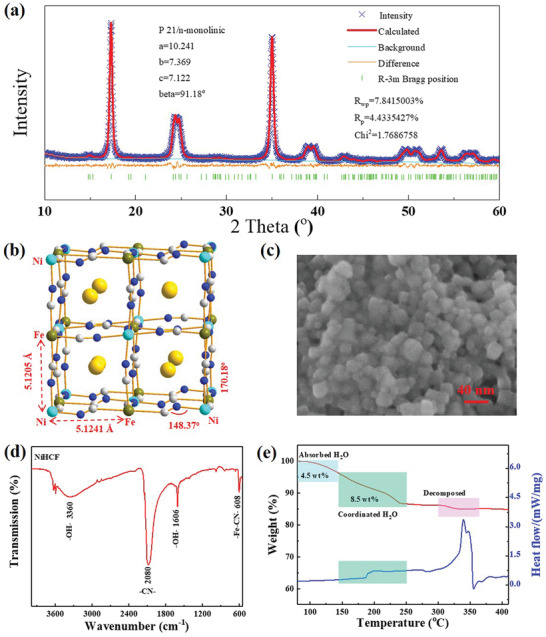
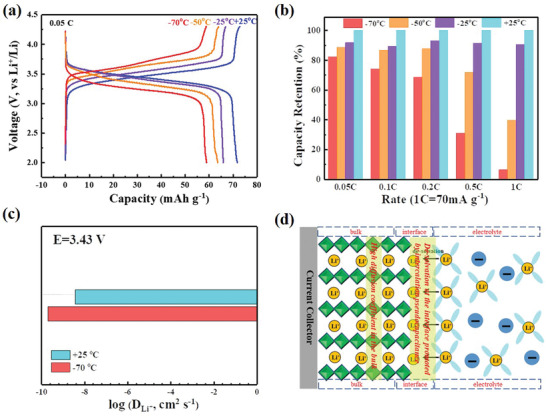
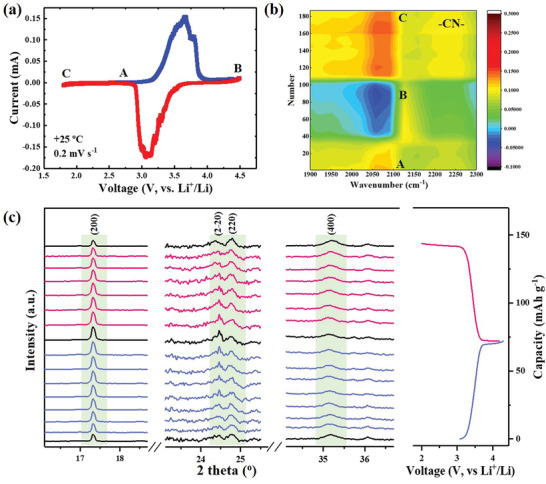
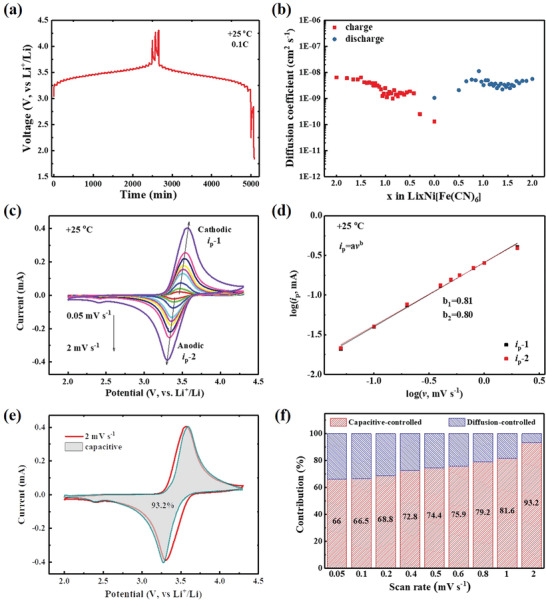
Conventional intercalation compounds for lithium-ion batteries (LIBs) suffer from rapid capacity fading and are even unable to charge-discharge with temperature decline, owing to the sluggish kinetics and solvation/desolvation process. In this work, a high-performance rechargeable battery at ultralow temperature is developed by employing a nanosized Ni-based Prussian blue (NiHCF) cathode. The battery delivers a high capacity retention of 89% (low temperature of -50 °C) and 82% (ultralow temperature of -70 °C) compared with that at +25 °C. Various characterizations and electrochemical investigations, including operando Fourier transform infrared spectra, in situ X-ray diffraction, cyclic voltammetry response, and galvanostatic intermittent titration technique are carried out to detect the structural stability and electrochemical behavior at different temperatures. It turns out that the pseudocapacitive behavior drives the desolvation process at the interface, while fast diffusion in the bulk electrode accelerates the movement of Li from the interface to the bulk materials. The unique synergistic features of intercalation pseudocapacitance at the electrolyte/electrode interface and high diffusion coefficient in the bulk electrode enables the NiHCF cathode with excellent low temperature performance. These findings offer a new direction for the design of LIBs operated at low temperature.
用于锂离子电池(LIBs)的传统插层化合物由于动力学缓慢和溶剂化/去溶剂化过程,存在容量快速衰减的问题,甚至在温度下降时无法进行充放电。在这项工作中,通过采用纳米尺寸的镍基普鲁士蓝(NiHCF)阴极,开发了一种在超低温下具有高性能的可充电电池。与在+25°C时相比,该电池在-50°C的低温下容量保持率高达89%,在-70°C的超低温下容量保持率为82%。进行了各种表征和电化学研究,包括原位傅里叶变换红外光谱、原位X射线衍射、循环伏安响应和恒电流间歇滴定技术,以检测不同温度下的结构稳定性和电化学行为。结果表明,赝电容行为驱动了界面处的去溶剂化过程,而本体电极中的快速扩散加速了Li从界面向本体材料的移动。电解质/电极界面处插层赝电容的独特协同特性和本体电极中的高扩散系数,使NiHCF阴极具有优异的低温性能。这些发现为低温下工作的锂离子电池的设计提供了新的方向。